Quick Answer: Yes. Methamphetamine is one of the most addictive drugs available because it floods the brain’s reward system fast and the high fades quickly, which pushes repeat dosing. Dependence can form within weeks. No medication is FDA-approved to treat methamphetamine use disorder, so treatment relies on behavioral therapy and structure.
Key Takeaways
- Meth reaches the brain’s reward system faster and harder than most other drugs, which is what makes it so addictive.
- Addiction can develop in just a few weeks, and tolerance increases while the reward diminishes.
- There are no FDA-approved drugs for stimulant use disorder; thus, behavioral therapy is the only available treatment.
- Between January 2021 and June 2024, the CDC identified methamphetamine as being present in 31.2% of overdose deaths.
- Is meth addictive? Yes, and more so than almost anything else people ask about. Methamphetamine triggers a large, fast release of dopamine in the brain’s reward circuit; the high is brief, and that combination pushes repeat dosing until dependence forms.
- Most people asking whether meth is addictive are not asking in the abstract. They are asking whether a few weeks of use already counts.
Weeks of use already? Ask Solutions Healthcare today
How Addictive Is Meth Compared With Other Drugs?
Meth sits at the top end of addiction risk. It reaches the brain faster and releases more dopamine than ordinary rewards can, and the effect is short, so people redose repeatedly. MedlinePlus calls it a very addictive stimulant and notes that use can lead to addiction quickly.
100% Confidential Support is Available 24/7
No matter what you’re going through, you’re not alone. Our dedicated team is here to provide a safe, judgment-free space where you can talk openly and honestly. Whether you need emotional support, resources, or just someone to listen.
We’re here for you—completely confidential and always respectful of your privacy. Call us today!
What Is Meth, Exactly?
NIDA describes methamphetamine as a stimulant chemically similar to amphetamine, appearing as a white, bitter-tasting powder or a pill, with crystal meth resembling glass fragments or bluish-white rocks.
Why Tolerance Builds So Fast
Tolerance climbs alongside use. The same amount stops producing the same effect, so doses rise while the reward shrinks.
Contact Solutions Healthcare
Battling with Drug and Alcohol Addition? Remember, you are not alone and we are here to help you!
Why Does Meth Addiction Develop So Fast?
Speed of onset drives it. Smoked or injected meth reaches the brain within seconds, and the brain encodes that association with unusual force. Each episode strengthens the link between the behavior and the reward, while the drug blunts the capacity to enjoy anything else.
That second half explains why motivation collapses. Ordinary pleasures stop registering, which leaves the drug as the only reliable relief.
The collapse in ordinary pleasure is not a character change. It is what an overloaded reward system looks like, and it is the part that recovers slowest.
Is Meth Addictive After One Use?
A single use does not create addiction, but it can set the pattern that does. The first experience is intense, and MedlinePlus notes that meth use can quickly lead to addiction. Weeks of repeated use, rather than one episode, is where dependence usually takes hold.
Binge and Crash Patterns
Binge patterns compress that timeline. Days awake on repeated doses deliver in one stretch what occasional use takes months to accumulate.
Is Meth a Hard or Soft Drug?
Neither term means anything clinically. Hard and soft are informal labels with no basis in medicine, law or research, and no health authority uses them. Clinicians diagnose methamphetamine use disorder instead, grading severity against criteria such as loss of control, cravings, tolerance and withdrawal.
If the real question is whether meth is dangerous, overdose data answers that.
Measure | Figure | Period |
Overdose deaths involving methamphetamine | 31.2% of 309,274 deaths | January 2021 to June 2024 |
Meth-involved deaths also involving opioids | 68.8% | January 2021 to June 2024 |
Overdose deaths involving cocaine | 30.0% | January 2021 to June 2024 |
Psychostimulant death rate per 100,000 | Rose from 3.9 to 10.4 | 2018 to 2023 |
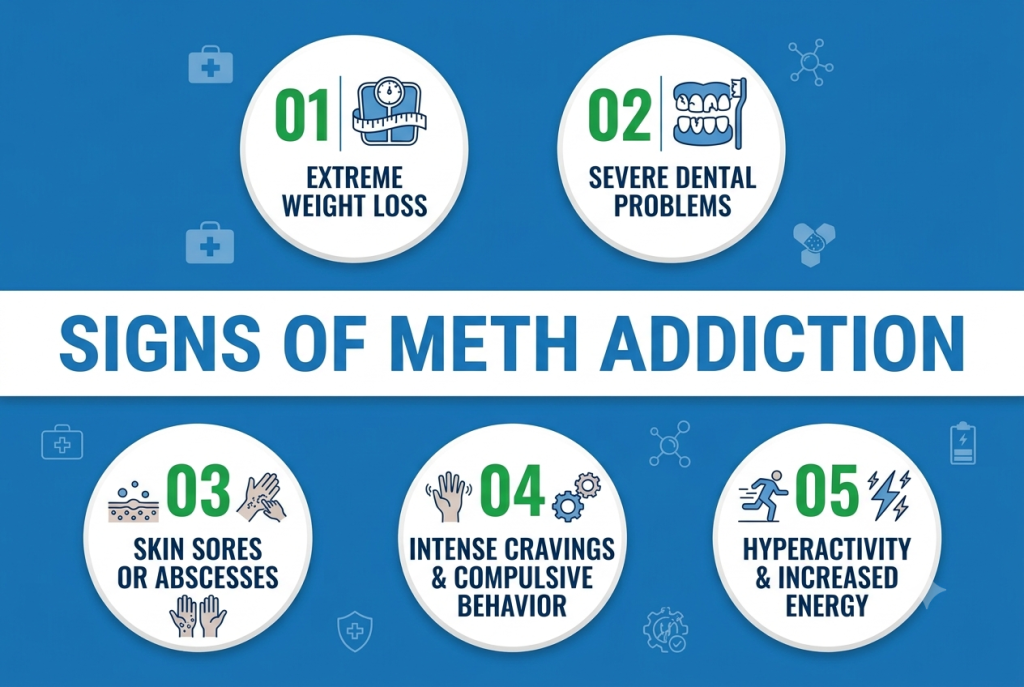
What Are the Signs of Meth Addiction?
Signs fall into behavioral, physical and psychological groups, and families usually notice the behavioral ones first. Long stretches without sleep, secrecy and sudden money problems tend to appear before the physical changes. Binge and crash cycles are characteristic, and that contrast is often what prompts action.
What families notice, by category
Category | What to look for |
Behavioral | Staying awake for days, secrecy, missed work, sudden financial problems |
Physical | Rapid weight loss, dental deterioration, skin sores, visible agitation |
Psychological | Paranoia, irritability, flat mood between uses, intense cravings |
Recognizing 3 or 4 of these at home? Talk to us today!!
100% Confidential Support is Available 24/7
No matter what you’re going through, you’re not alone. Our dedicated team is here to provide a safe, judgment-free space where you can talk openly and honestly. Whether you need emotional support, resources, or just someone to listen.
We’re here for you—completely confidential and always respectful of your privacy. Call us today!
What Does Meth Do to the Body?
Effects accumulate across body systems, from cardiovascular strain and weight loss to dental damage and skin sores. The mortality picture is the blunt version. CDC recorded the death rate involving psychostimulants, mainly methamphetamine, rising from 3.9 to 10.4 per 100,000 people between 2018 and 2023.
Short-Term Effects of Meth Use
The first effects are stimulant effects. Wakefulness increases and appetite drops, while heart rate, blood pressure, breathing rate and body temperature all climb. People often describe feeling capable and focused in those early hours, which is part of why the pattern repeats rather than stops.
Long-Term Effects of Meth Use
Sustained use leaves a different picture. Severe weight loss, tooth decay and tooth loss, skin sores, disrupted sleep, memory and concentration problems, paranoia and hallucinations all turn up in chronic use. Injecting adds its own risks, including skin infections and blood-borne infections.
Meth Overdose and Opioid Contamination
The same CDC analysis of 309,274 overdose deaths found methamphetamine involved in 31.2% of them, with 68.8% of those deaths also involving opioids.
That overlap is the risk people underestimate. Meth sold illegally often contains opioids, which creates an overdose nobody chose.
Expert Advice: Ask any program whether it offers contingency management by that exact name.
Which Addictions Count as the Worst?
No credible authority ranks addictions one, two and three, so any such list is editorial rather than evidential. Research does show that some substances carry higher dependence risk and overdose mortality, and opioids, stimulants including meth, and alcohol appear in that group repeatedly.
Scale is measurable even where ranking is not. CDC provisionally counted 69,973 drug overdose deaths in 2025, down close to 14% from 81,313 in 2024, with 44,564 of the 2025 total involving opioids.
Regional direction matters for Florida families. CDC’s emergency department data recorded meth involvement in the South rising 17.2% between late 2024 and late 2025, from 11.2% to 13.1%, while other regions held steady.
100% Confidential Support is Available 24/7
No matter what you’re going through, you’re not alone. Our dedicated team is here to provide a safe, judgment-free space where you can talk openly and honestly. Whether you need emotional support, resources, or just someone to listen.
We’re here for you—completely confidential and always respectful of your privacy. Call us today!
What is the Hardest Addiction to Overcome?
Nobody can answer that for a whole population, because difficulty depends on the substance, the length of use, any mental health condition, and the support available. Stimulants do carry one specific obstacle: no approved medication reduces cravings, so people rely on behavioral treatment and structure.
What makes stimulant recovery harder?
- No approved medication reduces stimulant cravings
- Withdrawal brings deep fatigue and depression that can last weeks
- Sleep and appetite take time to normalize, so early recovery feels worse before better
- Co-occurring depression or anxiety frequently needs treatment at the same time
None of that makes recovery unlikely. It makes the type of support matter more, which argues for structured treatment over willpower.
No medication for cravings. Structure does the work. Call Solutions Healthcare
What Does Meth Withdrawal Involve?
Stopping meth is rarely physically dangerous in the way alcohol or benzodiazepine withdrawal can be, which is a different thing from saying it is easy. The opening stretch is a crash, with heavy sleeping, exhaustion and a mood floor that feels permanent while it lasts. What follows is slower and less visible, and it is where most people get caught out.
When Medical Supervision Helps
Supervision earns its place when mood symptoms turn severe, when other substances are in the picture, or when someone has nowhere stable to get through the first weeks. Because no approved medication treats stimulant withdrawal, the value of a supervised setting is monitoring, safety and daily contact rather than a prescription.
What Treats Methamphetamine Use Disorder?
Behavioral therapy carries the evidence, because the medication option does not exist yet. Contingency management, cognitive behavioral therapy and motivational interviewing are the approaches NIMH names for co-occurring substance use and mental illness, and CDC calls contingency management the most effective intervention for stimulant use disorder.
Approaches with evidence behind them
Approach | What it does | Evidence note |
Contingency management | Rewards verified abstinence with tangible incentives | CDC calls it the most effective intervention, and underused |
Cognitive behavioral therapy | Targets the thinking and situations driving use | Named by NIMH among behavioral therapies used |
Motivational interviewing | Builds commitment to change where ambivalence exists | Named by NIMH among behavioral therapies used |
Medically supervised detox | Monitors and supports the crash period | Manages symptoms rather than treating the disorder |
Integrated dual diagnosis care | Treats a mental health condition at the same time | NIMH describes integrated care as combining both |
FDA stated in October 2023 that there is currently no FDA-approved medication for stimulant use disorder, and published draft guidance meant to speed the development of new ones.
Contingency management deserves mention by name. CDC calls it both the most effective intervention and underused, which makes it a fair question for any provider.
Co-occurring conditions change the plan. NIMH describes integrated care as combining mental health and substance use treatment in one setting and names the three behavioral therapies above.
Fact: No medication is FDA-approved for stimulant use disorder anywhere in the country.

Meth Addiction Treatment at Solutions Healthcare
The crash period and the months afterward need different things, which is why stimulant treatment here runs across a continuum rather than a single program.
How treatment usually opens
Medically supervised detox at the DeLand and Melbourne locations, where a team monitors the extreme fatigue, deep depression, intense cravings, and mood swings that follow stopping
Residential care for anyone who cannot hold early recovery together at home
Placement decided by assessment rather than by default
Where it goes next
Intensive outpatient and outpatient treatment as structured steps down
CBT and DBT alongside individual and group sessions, with fitness, nutritional counseling, and mindfulness supporting physical recovery
Dual diagnosis care when depression, anxiety or trauma sits underneath the use
Coping skills and relapse prevention continuing through aftercare
“People arrive expecting medication to take the edge off cravings, and there isn’t one. What works instead is frequency of contact, and that surprises them more than the diagnosis does.” Our clinical team at Solutions Healthcare.
Ask what a meth-specific plan actually includes before admitting anyone. Call Now!
Summary:
Yes, meth is addictive and among the most addictive drugs known. Methamphetamine floods the brain’s reward system with dopamine, then fades fast, driving repeat dosing. Dependence can form within weeks. No FDA-approved medication treats stimulant use disorder, so behavioral therapy and structure carry treatment.
Meth Addiction Questions Families Ask
How long does meth withdrawal last?
Meth withdrawal often begins with a crash lasting several days, marked by exhaustion, increased sleep, and low energy. Depression, anxiety, concentration difficulties, and cravings may continue for weeks. Duration varies depending on use frequency, overall health, co-occurring conditions, and other substances involved.
Can the brain recover after meth use?
Many people experience improvements in brain function after stopping methamphetamine and receiving appropriate support. Concentration, motivation, and enjoyment of everyday activities may gradually return. Recovery varies between individuals, however, and some cognitive or emotional effects can persist, particularly after prolonged or heavy use.
Is crystal meth different from other meth?
Crystal meth is a crystalline form of methamphetamine, a powerful stimulant that may resemble glass fragments or bluish-white rocks. It is commonly smoked or injected, producing rapid effects. These routes can increase health risks, while methamphetamine itself carries substantial risks of dependence, psychosis, and overdose.
What should someone do in a suspected overdose?
Call emergency services immediately and stay with the person if it is safe. Methamphetamine overdose can cause chest pain, overheating, seizures, or stroke symptoms. If opioid exposure is possible, administer naloxone if available. Follow emergency dispatcher instructions and begin CPR if directed or appropriately trained.
Is meth addictive compared with cocaine?
Both methamphetamine and cocaine have substantial addiction potential, but their effects differ. Methamphetamine generally lasts longer per dose, potentially contributing to prolonged stimulation and disrupted sleep. Individual risk depends on factors including frequency of use, route of administration, health history, and personal vulnerability to addiction.
Does meth cause permanent dental damage?
Methamphetamine use can contribute to severe dental problems through dry mouth, teeth grinding, poor nutrition, and reduced oral hygiene. Some damage can be treated, but advanced decay and tooth loss may be irreversible. Early dental assessment, preventive care, and treatment can help protect remaining teeth.
How is meth use diagnosed clinically?
Clinicians evaluate patterns of methamphetamine use and their effects on daily life, including cravings, impaired control, tolerance, withdrawal, and continued use despite harm. They use established diagnostic criteria to determine severity. Urine testing may detect recent exposure, but a positive result alone cannot diagnose a substance use disorder.
Can meth trigger psychosis?
Yes. Methamphetamine can cause psychotic symptoms, including paranoia, hallucinations, and delusions. Symptoms may improve after stopping use, but they can sometimes persist and require psychiatric treatment. Prompt professional assessment is important because stimulant-induced psychosis can resemble other mental health conditions and may create serious safety concerns.
Is detox needed for meth?
Professional support can help people manage methamphetamine withdrawal, particularly when exhaustion, cravings, or depression become difficult to manage. Withdrawal is not typically associated with the same dangerous physical complications as alcohol or benzodiazepine withdrawal, but severe psychiatric symptoms may require close monitoring and urgent treatment.
How do families raise it with someone using it?
Choose a calm, private moment when the person is not intoxicated. Describe specific concerns without blame, listen carefully, and suggest a practical next step, such as a professional assessment. Set appropriate boundaries, and prioritize everyone’s safety if the conversation leads to threats or aggression.
References
- https://nida.nih.gov/research-topics/methamphetamine
- https://medlineplus.gov/methamphetamine.html
- https://www.cdc.gov/mmwr/volumes/74/wr/mm7432a1.htm
- https://www.cdc.gov/nchs/pressroom/releases/20260513.html
- https://www.cdc.gov/overdose-prevention/data-research/facts-stats/cdtd-key-findings.html
- https://www.fda.gov/news-events/press-announcements/fda-takes-steps-advance-development-novel-therapies-stimulant-use-disorders
- https://www.nimh.nih.gov/health/topics/substance-use-and-mental-health
Medical Disclaimer: This blog is for informational purposes only and should not replace professional medical advice, diagnosis, or treatment. If you or someone you know is struggling with substance use, contact Solutions Healthcare or visit https://shc.health/ to learn about available treatment options.