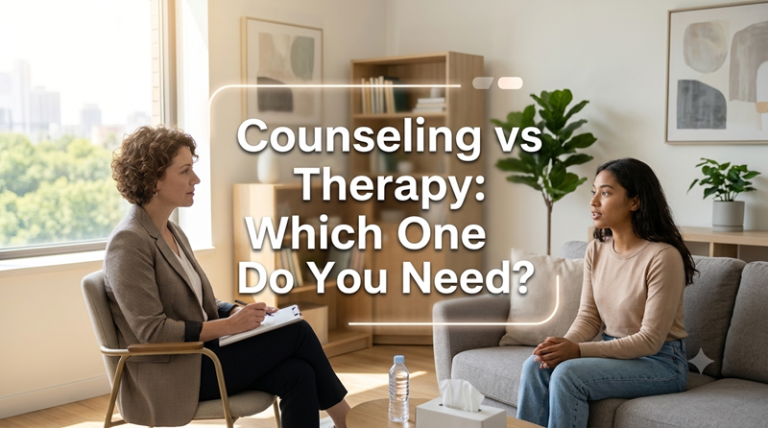
Quick Answer: Therapy is a planned, systematic treatment that involves meeting with a licensed mental health professional to change behaviors, thoughts and feelings. It is beneficial for mental health disorders, addictions, and grieving as well as daily stress.
Key Takeaways
- Therapy is a licensed clinical treatment, with goals and agreed-upon progress checks, not a conversation with someone who is listening.
- The names are important, but the treatment of the problem, which is CBT, DBT, ACT, group or family, is more important.
- According to the CDC, 14.0% of US adults were counseled or had therapy during the last 12 months from a mental health care provider in 2024.
Therapy is a type of mental health care that involves speaking with a trained health care provider about challenging thoughts, feelings, and behaviors. This can include cognitive behavioral therapy, group therapy, and family therapy. People usually attend for weeks or months and assess their progress against goals they have created with them.
You likely are here because you’ve noticed something is amiss for a time. Perhaps sleep went first. Or the drinking ascended. The questions are typically much the same: “Does it work? What happens in the room? When does something change?”.
Fact: In 2024, 14% of US adults received counseling or therapy (CDC).
What is Therapy in Simple Terms?
Therapy is treatment delivered through conversation and structured exercises with a trained professional. You talk, they guide, and you both work toward goals you agree on.
The word covers more than mental health, which is why search results feel scattered:
- Psychotherapy, or talk therapy, treats mental health and substance use problems.
- Physical therapy restores movement after an injury or surgery.
- Occupational therapy rebuilds daily living and work skills.
- Speech therapy improves communication and swallowing.
Everything below covers psychotherapy. The National Institute of Mental Health describes it as care that helps a person identify and change troubling emotions, thoughts and behaviors.
100% Confidential Support is Available 24/7
No matter what you’re going through, you’re not alone. Our dedicated team is here to provide a safe, judgment-free space where you can talk openly and honestly. Whether you need emotional support, resources, or just someone to listen.
We’re here for you—completely confidential and always respectful of your privacy. Call us today!
Therapy use in numbers
Measure | Figure | Source |
US adults who received counseling or therapy in the past 12 months | 14.0% | CDC, NCHS Data Brief 564 (2026, 2024 data) |
US adults who took prescription medication for mental health | 19.3% | CDC, NCHS Data Brief 564 (2026) |
Adults aged 18 to 29 who received counseling | 20.2% | CDC, NCHS Data Brief 564 (2026) |
People aged 12 and older with depression who got counseling | 39.3% | CDC, NCHS Data Brief 527 (2025) |
People worldwide living with a mental health condition | Over 1 billion | WHO (2025) |
Contact Solutions Healthcare
Battling with Drug and Alcohol Addition? Remember, you are not alone and we are here to help you!
What Are the Main Types of Therapy?
There is no single method. Good clinicians match the approach to the problem, and many blend two.
Approach | What it focuses on | Commonly used for |
Cognitive behavioral therapy (CBT) | Spotting and changing unhelpful thought patterns | Depression, anxiety, substance use |
Dialectical behavior therapy (DBT) | Handling intense emotions without acting on them | Emotional swings, self-destructive urges |
Acceptance and commitment therapy (ACT) | Accepting hard feelings while acting on your values | Anxiety, chronic stress, addiction |
Group sessions | Shared experience and honest peer feedback | Addiction recovery, isolation, shame |
Family work | Communication patterns and roles at home | Addiction, conflict, caregiver strain |
Trauma focused care | Processing memories that still feel present | PTSD, abuse history, grief |
Names matter less than fit. Someone with panic attacks and someone rebuilding after a relapse need different tools, even sitting in the same waiting room.
Expert Advice: Ask your therapist at session four whether your goals are measurably improving.
How Does Therapy Work in Practice?
Therapy works by making invisible patterns visible, then giving you something to do about them.
The mechanics are simple. You describe your week. Your clinician listens for the pattern underneath, names it, then tests it against evidence. You practice a different response before the next appointment.
Most change happens between sessions. Homework sounds unglamorous, but skills only stick when you use them on a bad Tuesday, not in a quiet office.
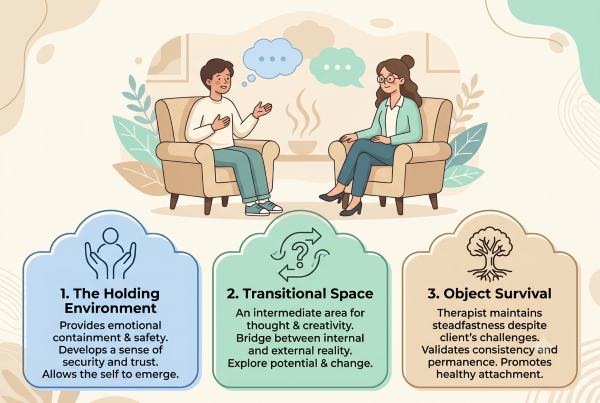
Trust does the heavy lifting. Researchers call the bond between client and clinician the therapeutic alliance, and it predicts outcomes across nearly every method.
Ask Solutions Healthcare which therapy setting suits you.
What Happens in Your First Therapy Session?
Your first appointment is mostly intake, not deep excavation. Expect questions, paperwork, and a plan you help shape.
- Background. Your history, current symptoms, medications, sleep, substance use and support at home.
- Goals. What you want is different in three months, stated in plain terms.
- Fit. How the clinician works, how often you will meet, and what happens in between.
- Next steps. A working plan, sometimes a referral, sometimes a small task.
Nobody will push you to relive your worst memory on day one. Good clinicians pace disclosure deliberately, because moving too fast leaves you raw with no time to recover.
100% Confidential Support is Available 24/7
No matter what you’re going through, you’re not alone. Our dedicated team is here to provide a safe, judgment-free space where you can talk openly and honestly. Whether you need emotional support, resources, or just someone to listen.
We’re here for you—completely confidential and always respectful of your privacy. Call us today!
What Are the Real Benefits of Therapy?
Treatment reduces symptoms, improves daily functioning, and raises quality of life, which is how NIMH frames its goals.
The gains people actually report tend to be smaller and more practical:
- Sleeping without rehearsing old conversations.
- Saying no without a two-day guilt hangover.
- Spotting a craving early enough to act.
- Recovering from an argument by evening, not by Friday.
Evidence-based approaches have been shown to reduce symptoms of depression, anxiety, and other mental disorders, although none carries formal approval the way a medication does. National Institute of Mental Health
Sessions also build what no prescription delivers: skills you keep after treatment ends.
What Are the Risks of Therapy?
Treatment carries real but manageable risks, and honest clinicians say so upfront.
Short-term discomfort is the common one. Painful material can stir up symptoms before they settle, which is why early weeks sometimes feel worse.
Poor fit is the underrated risk. A mismatched clinician wastes months and leaves people convinced treatment failed when the pairing failed.
Rarer problems exist too. Progress can stall unnoticed. Old conflicts can surface at home. None of this argues against getting help. All of it argues for reviewing progress out loud rather than drifting.
100% Confidential Support is Available 24/7
No matter what you’re going through, you’re not alone. Our dedicated team is here to provide a safe, judgment-free space where you can talk openly and honestly. Whether you need emotional support, resources, or just someone to listen.
We’re here for you—completely confidential and always respectful of your privacy. Call us today!
How Long Does Therapy Usually Take?
There is no fixed length, and any promise of a set session count should make you cautious.
Brief structured work on a single problem often runs a few months. Complex trauma, long-term substance use, or several conditions at once take longer. Severity, consistency, and effort between appointments all change the timeline.
The better question is whether anything is moving. Check at set intervals rather than waiting for a finish line that may never arrive.
What Is Therapy for Dual Diagnosis?
Dual diagnosis care treats a mental health condition and a substance use disorder together, in one plan, with one team.
Treating them separately rarely holds. Anxiety drives drinking, drinking worsens anxiety, and two disconnected providers leave that loop untouched. Integrated care breaks it by addressing both at once.
In practice, counseling runs alongside medical monitoring, medication management where appropriate, and family work. One hour can cover cravings, triggers, sleep, panic and grief, because for most people these are not separate problems.
Call Solutions Healthcare to discuss dual diagnosis treatment options.
How Do You Choose a Therapy Type?
Start with the problem, not the acronym. Match the method to what is actually getting in your way.
Racing thoughts and avoidance respond well to CBT. Emotional intensity suits DBT skills. Feeling stuck despite knowing better points toward ACT. Shame and isolation shift fastest in groups. Conflict at home calls for family work.
Ask three questions before committing. What approach will you use with me? How will we know it is working? What happens if it is not? A clinician who answers those clearly beats one with a longer certificate list.

Therapy Session at Solutions Healthcare?
Therapy at Solutions Healthcare starts with a conversation about what is actually going on, not a fixed package you get slotted into.
The therapies on offer
- Cognitive behavioral therapy, for thought patterns that keep repeating
- Acceptance and commitment therapy, when you feel stuck despite knowing better
- Group therapy, for shame and isolation
- Family therapy, when the strain sits at home
How often do you come in?
- Residential treatment, if you need to step away from everything for a while
- Intensive outpatient or standard outpatient, if you are holding down work and family
- Dual diagnosis care, if anxiety, depression, or trauma sits alongside substance use
- Aftercare, once the structured part ends
One team handles both mental health and substance use, so nobody sends you elsewhere halfway through.
Schedule your intake assessment with Solutions Healthcare
FAQs
What are three types of therapy?
Cognitive behavioral therapy, dialectical behavior therapy and acceptance and commitment therapy are three of the most widely used. CBT targets unhelpful thinking patterns, DBT builds skills for managing intense emotions, and ACT helps you act on your values while accepting difficult feelings. Group and family formats are also common.
Why do people go for therapy?
People start for long-running stress, grief, relationship problems, anxiety, depression, trauma, or substance use. Others go because symptoms have no physical explanation, such as poor sleep, low energy, or constant worry. Some are referred after a diagnosis. Wanting things to feel different is reason enough.
Can I cry during therapy?
Yes, and most clinicians expect it. Crying is a normal response to discussing painful material, not a sign you are doing something wrong. Sessions are private and paced so you are not left overwhelmed at the end. Many rooms have tissues within reach for exactly this reason.
Is therapy the same as counseling?
They overlap heavily, and the terms are often used interchangeably. Counseling sometimes describes shorter, more focused work on a specific issue, while treatment can run longer for diagnosed conditions. What matters more is the clinician’s training, licensing and experience with your particular problem.
How do I know if therapy is working?
Look for change you can name: better sleep, fewer panic episodes, easier conversations, and longer gaps between cravings. Progress rarely runs in a straight line, so judge across weeks rather than single sessions. If nothing has shifted after a reasonable stretch, raise it directly with your clinician.
Can therapy help with addiction?
Yes. Behavioral approaches are a core part of substance use treatment and are often combined with medical support and recovery services. Counseling targets the triggers, thinking patterns and emotional pain that keep us going. It works best alongside the right level of care rather than on its own.
What if I do not connect with my therapist?
Say so, then consider switching. Fit predicts outcomes strongly, and a mismatch is not a personal failure on either side. Raising it directly sometimes resolves the problem, because the clinician can adjust their approach. If it does not, asking for someone different is normal and reasonable.
Does therapy work without medication?
Often, yes. Psychotherapy can be used instead of medication or alongside it, depending on your situation and diagnosis. Some conditions respond well to talking treatment alone, while others improve faster with both. That decision belongs to you and a qualified clinician, not to a search result.
What should I talk about in my first session?
Start with what pushed you to book. Describe the last few weeks honestly, including sleep, mood, substance use and anything you are avoiding. You do not need a polished story or a diagnosis. Your clinician will ask questions to fill the gaps and shape a plan with you.
Is online therapy as good as in-person?
Telehealth has widened access, especially where local clinicians are scarce, and many people find it works well for talk-based care. In-person support still suits higher levels of need, medical monitoring, and group formats. Ask your provider which option matches your symptoms.
Who can provide therapy?
Licensed professionals include psychiatrists, psychologists, clinical social workers, licensed counselors, and psychiatric nurses. Credentials and scope vary by state. Only some, such as psychiatrists and psychiatric nurse practitioners, can prescribe medication. Always check licensing and whether the clinician has experience treating your specific condition.
References
- https://www.nimh.nih.gov/health/topics/psychotherapies
- https://www.cdc.gov/nchs/data/databriefs/db564.pdf
- https://www.cdc.gov/nchs/products/databriefs/db527.htm
- https://www.who.int/news/item/02-09-2025-over-a-billion-people-living-with-mental-health-conditions-services-require-urgent-scale-up
- https://www.who.int/publications/i/item/9789240113817
- https://www.nimh.nih.gov/health/topics/mental-health-medications
- https://www.nimh.nih.gov/health/publications/my-mental-health-do-i-need-help
- https://www.nimh.nih.gov/health/find-help
This article is for information only and is not a substitute for professional diagnosis or treatment. Speak with a licensed clinician, or visit Solutions Healthcare.