
Key Takeaways
- The co-occurring disorders entail an untimed presence of a mental health disorder and a substance use disorder.
- These disorders tend to be interrelated, not only with the symptoms of the first being more severe but also making the treatment more complicated.
- Popular mental health disorders encompass anxiety, depression, bipolar disorder and PTSD.
- Integrated treatment and early diagnosis show a significant impact on the result of the recovery process.
- Heavy and intensive treatment of both disorders provides the most promising opportunity of long-term stability.
When one is addicted or has a mental health issue, there is a larger story at hand than what one would expect. The two problems frequently coexist within a large number of people, and this is the reason why the theme of Co-Occurring Disorders Explained: Recognizing Symptoms and
Seeking Help has become so essential in modern behavioral health care. Being aware of co-occurring disorders may help people and their families to recognize the symptoms of the development at the first stage of their progression, get the treatment they need, and initiate the process of successful recovery, which is going to be long-term.
We understand that addictions can barely exist in a vacuum at Solutions Healthcare. When substance use and mental health issues are not only comorbid but also interacting conditions, their influence on each other is powerful. Being aware of the co-occurring disorder dynamics, in which it takes place and in which it is treatable, can go some distance in getting one to heal.
What are Co-Occurring Disorders?
Co-occurring disorders refer to diseases that occur when a person is suffering a mental illness and a substance use disorder. All these conditions might co-exist, or one of them might be implemented first and contribute to the development of others.
One of the examples would be that of a person who is anxious or depressed and would turn to using alcohol or drugs to enable him to overcome the emotional pain. In substance use, mental health symptoms might aggravate as time goes by. In other places, long-term substance abuse may also cause psychological symptoms, such as mood swings, paranoia or acute apprehension.
Mental health-addiction correlation can be complex. One ailment may indeed complicate the other, such that it would even be difficult to overcome without the assistance of a professional. It is this urge that causes the fact that the two conditions to be usually treated together and not separately through the medium of treatment programs.
100% Confidential Support is Available 24/7
No matter what you’re going through, you’re not alone. Our dedicated team is here to provide a safe, judgment-free space where you can talk openly and honestly. Whether you need emotional support, resources, or just someone to listen.
We’re here for you—completely confidential and always respectful of your privacy. Call us today!
Symptoms of Dual Diagnosis?
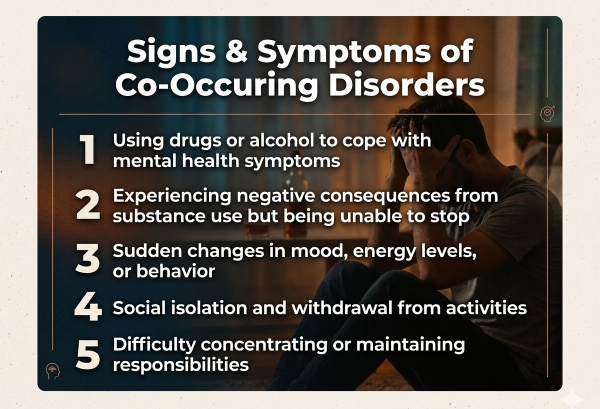
The symptoms of the co-occurring disorders may be rather different and depend on the type of mental disorder under consideration and the character of the substance used. However, several signs may be applied to show the presence of both conditions.
Some of these behavioral symptoms may involve the abrupt mood switch, the loss of interest in family or social life, the inability to proceed with the activities, and additional dependence on drugs or alcohol. Individuals also cannot fail to do something in an impulsive and poor judgment manner.
The attempts to feel sadness, anxiety, irritation, and hopelessness are typical symptoms of emotion. Patients are also capable of experiencing panic attacks, uncontrolled extreme mood swings or lack of concentration in other cases.
The physical symptoms may include sleeping problems, exhaustion, eating problems, or unexplained health conditions, which are related to substance consumption. The combination of these symptoms can be indicative of related yet separately occurring disorders which require singular attention.
Early identification of these red flags would help individuals to seek help before it is too late.
Contact Solutions Healthcare
Battling with Drug and Alcohol Addition? Remember, you are not alone and we are here to help you!
Long-Term Effects of Co-Occurring Disorders
The co-occurring disorders that are not managed could significantly impact the physical and mental health of a patient and his/her quality of life.
Deterioration in mental health is considered to be among the most egregious long-term effects. Use of substances may contribute to the worsening of depression, anxiety, or mood instability and make normal life more difficult.
The other influential effect is the relationships. The co-occurring disorder individuals may not have trust or communication and have no emotional control, therefore stressing the family and other family members.
Other dangers that extended use of substances has on an individual include the statistics of developing and maintaining medical diseases such as liver disease, cardiovascular-related issues and neurological damage. In addition, the mental health symptoms would expose the individual to the risk of self-injury or suicide, unless addressed.
They are preventable with proper early intervention since these ramifications are long-lasting and people are now capable of having healthier coping mechanisms.
Take the First Step Toward Recovery
It does not mean that you have to go it alone in case you or a loved one is presenting the symptoms of co-occurring disorders. Solutions Healthcare offers evidence-based therapy that is empathetic and should aim at addressing mental health and substance use separately or in combination.
We know about the problems of dual diagnosis, and our treatment plan has its own solution, which enables an individual to recover forever.
How is Dual Diagnosis Diagnosed?
Diagnosis of the co-occurring disorders entails a thorough evaluation of competent mental health and addiction practitioners.
A detailed clinical interview normally triggers it. Customers provide queries on the ways they use substances, mental health signs, and medical history, and lifestyle habits susceptible to affecting behavior.
An investigation and a screening instrument may also be used psychologically in defining the research behind mental disorders of depression, anxiety disorders, post-traumatic stress disorder, or bipolar disorder.
In the majority of cases, clinicians monitor the progression of a client in terms of the symptoms to determine whether the signs of mental health are directly linked to substance use or are a separate disorder.
It cannot be handled effectively to make the diagnosis, because the treatment must be executed in order to correct both diseases at the same time. As can be barely permanent, addiction treatment or treatment of mental health symptoms can proceed.
Risk Factors for Dual Diagnosis?
Certain situations can lead to the creation of co-occurring disorders. Being aware of such risk factors helps individuals to understand that they are in danger and seek help sooner.
Genetics may play a role. Individuals who are addicted or those with a family history of mental disorders have the risk of getting both conditions.
The other ones include the environmental factors. The exposure to a substance, in its turn, may predetermine co-occurring disorders, and exposure to trauma and exposure to stress and childhood trauma, as well as hardship, may lead to it.
Another risk factor is self-medication. Mentally ill persons who are not receiving adequate mental health care may resort to drugs in order to control their emotions.
Finally, brain chemistry and developing the brain can contribute to addiction, as well as mental issues; thus, early intervention is significantly important.
100% Confidential Support is Available 24/7
No matter what you’re going through, you’re not alone. Our dedicated team is here to provide a safe, judgment-free space where you can talk openly and honestly. Whether you need emotional support, resources, or just someone to listen.
We’re here for you—completely confidential and always respectful of your privacy. Call us today!
Common Mental Disorders
A number of mental disorders are also among the known disorders that can commonly be seen in people with co-occurring disorders.
Depression is one of the most prevalent ones. Individuals may turn to the consumption of substances so as to cope with frequent depression or numbness.
Addiction also goes along with anxiety disorders. The effects of drugs such as alcohol or tranquilizing drugs are an immediate reduction in anxiety but ultimately worsen the symptoms over time.
Post-traumatic stress disorder (PTSD) is another disorder that is usually associated with co-morbid conditions, particularly among individuals who have been exposed to trauma or long-term stress.
Bipolar disorder is further comorbid in terms of taking drugs or alcohol because an individual may want to cope with the excessive extremes of mood with drugs or alcohol.
Upon recognizing these relationships, clinicians are able to develop interventions to integrate the treatment of mental health and addiction.
Co-Occurring Disorders Treatment
Co-occurring disorders are treated using an integrated treatment; this involves mental illness and concomitant use of drugs.
The medical detox comes in when it is adequate and then the treatment programs incorporate the structured therapy and behavioral therapy. The single patient’s counseling will enable it to develop more in-depth emotional trigger dynamics, and the group therapy session will be supportive and empathetic.
Cognitive Behavioral Therapy (CBT) is an extremely popular intervention that is conducted to help an individual identify his/her self-destructive thinking and learning more health-promoting coping behavior.
There are also other mental health issues which can be prescribed since they help in stabilizing mood and anxiety or in dealing with depression by undergoing the recovery process.
In the Solutions healthcare case, the focus of the treatment programs is based on treating the whole person rather than the symptoms. By dwelling on two planes of co-occurring disorders, the patients will have an opportunity to have a stronger foundation for their long-term recovery.

100% Confidential Support is Available 24/7
No matter what you’re going through, you’re not alone. Our dedicated team is here to provide a safe, judgment-free space where you can talk openly and honestly. Whether you need emotional support, resources, or just someone to listen.
We’re here for you—completely confidential and always respectful of your privacy. Call us today!
Start Your Recovery with Solutions Healthcare
Through the use of proper support and guidance, co-occurring disorders are curable. It will be a good contribution when a professional treatment is made in any situation where you or a loved one is facing addiction and mental health problems.
The care provided by Solutions Healthcare is effective; it has qualified specialists and various forms of individual treatment that can reform the lives of the people.
You land the call today and chat with the staff members about how the therapy can help you move and start living with confidence and hope.
Disclaimer
This content is for informational and educational purposes only and should not be considered medical or mental health advice. Individuals experiencing symptoms related to mental health or substance use should seek evaluation and treatment from a qualified healthcare professional or licensed mental health provider.
Frequently Asked Questions
What is an example of a co-occurring disorder?
An example of co-occurring disorders is when someone experiences depression while also struggling with alcohol addiction. The person may drink to cope with emotional pain, but alcohol use can worsen depressive symptoms, creating a cycle that requires integrated treatment.
What is the difference between co-occurring and dual diagnosis?
The terms “co-occurring disorders” and “dual diagnosis” are often used interchangeably. Both describe the presence of a mental health disorder and a substance use disorder occurring together. The difference is primarily terminology rather than meaning in most clinical settings.
How to treat co-occurring disorders?
Treatment for co-occurring disorders typically involves integrated care that addresses both conditions simultaneously. This may include therapy, medication management, support groups, and addiction treatment programs designed to treat mental health and substance use together.
What is a co-occurring disorder pdf?
A co-occurring disorder PDF generally refers to educational resources or clinical guides explaining the relationship between mental health disorders and substance use. These documents often outline symptoms, risk factors, and treatment approaches used by mental health professionals.
Is OCD a co-occurring disorder?
Obsessive-compulsive disorder (OCD) can be part of co-occurring disorders when it occurs alongside substance use issues. Individuals with OCD may use drugs or alcohol to manage intrusive thoughts or anxiety, which can complicate both conditions.
What are the five most common mental disorders?
Five of the most common mental health disorders include depression, anxiety disorders, bipolar disorder, post-traumatic stress disorder (PTSD), and obsessive-compulsive disorder (OCD). These conditions may sometimes appear within co-occurring disorders when substance use is also present.
Sources
- Substance Abuse and Mental Health Services Administration (SAMHSA) – Co-Occurring Disorders
- National Institute on Drug Abuse (NIDA) – Common Comorbidities with Substance Use Disorders
- National Alliance on Mental Illness (NAMI) – Dual Diagnosis and Co-Occurring Disorders
- American Psychiatric Association (APA) – Diagnostic and Statistical Manual of Mental Disorders (DSM-5)