

Quick Answer: The calming effect of a single Klonopin dose can last for much of a day, and Klonopin’s concentration in the blood peaks in one to four hours. The drug itself is eliminated slowly, with a half-life of 30-40 hours. Daily doses accumulate, making it effective long after they have been administered.
Key Takeaways
- Klonopin peaks in the blood 1-4 hours following the administration of a dose and has a sedative effect for a large part of a day.
- It has a half-life of elimination of 30-40 hours, meaning that it remains in the body after the drug effect has subsided.
- If it’s taken daily, it will build up, since each dose will reach the body before the previous dose is eliminated.
- Abrupt withdrawal after prolonged use may cause life-threatening withdrawal reactions.
- How long Klonopin lasts depends on which part you mean. The calming effect covers most of the day. The drug itself takes far longer to leave.
That gap catches people out. You feel the edge come back by evening, so the dose seems finished. It is not. Still in your system days later? Solutions Healthcare can explain what that means for your taper. Call (386) 866-3600.
How Long Does Klonopin Last After One Dose?
A single dose works for most of a day. It reaches peak levels in the blood one to four hours after you take it, according to its FDA label. The calming effect fades well before the drug leaves your body, because its half-life runs 30 to 40 hours.
Those are two different clocks. One is how long you feel it. The other is how long it is measurably present.
What you are measuring | Timing |
Time to peak blood level. | 1 to 4 hours after the dose |
Elimination half-life | 30 to 40 hours |
Those figures come from the drug’s FDA prescribing information.
Fact: Klonopin’s elimination half-life runs 30 to 40 hours, per its FDA label.
What It Feels Like When Klonopin Starts Working
It is not a switch. People describe panic losing its edge, muscles letting go, and racing thoughts slowing down rather than anything sudden. Some notice drowsiness arriving alongside the calm.
For seizure control, there is often nothing to feel at all. That is normal, and it is one reason people wrongly assume a dose has failed and take more.
What Klonopin Treats and How Long It Lasts
What is Klonopin?
Klonopin is the brand name. Clonazepam is the drug inside it, and it belongs to the benzodiazepine family.
MedlinePlus also calls it habit-forming and tells patients not to stop taking it or cut doses without speaking to their doctor first.
What Is Klonopin Used For?
Doctors prescribe it for two things. MedlinePlus says clonazepam controls certain types of seizures and treats panic attacks. The FDA label lists seizure disorders, including Lennox-Gastaut syndrome, plus panic disorder with or without agoraphobia. It works by calming abnormal electrical activity in the brain.
Why Does Klonopin Last So Long?
Its half-life is unusually long for a benzodiazepine. Half-life means the time your body needs to clear half a dose. At 30 to 40 hours, a daily dose starts building up before the previous one clears. That build-up is why steady users feel groggy rather than calm.
Daily users are not starting from zero each morning. They are adding to what is already there, which is why the side effects grow while the relief shrinks.
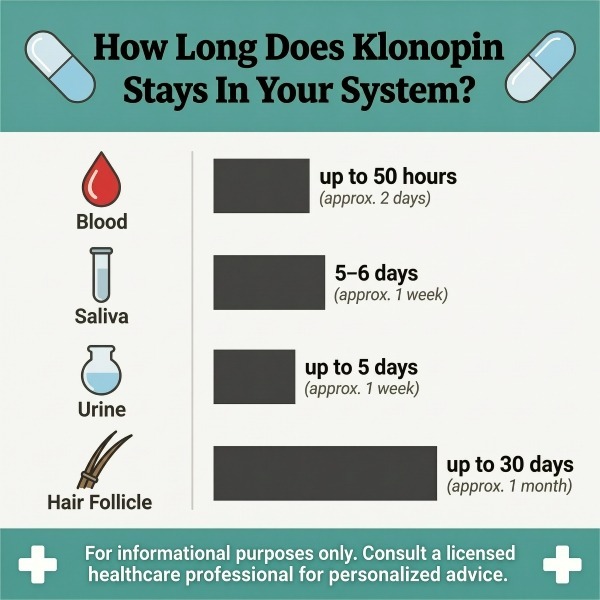
How Long Does Klonopin Stay in Your System?
Far longer than the calm lasts. A drug is generally treated as cleared after roughly five half-lives have passed. With a half-life of 30 to 40 hours, that puts full clearance somewhere around six to nine days after the final dose.
So a dose taken on Monday is still measurably present by Friday. The effect ended days earlier, which is the whole reason this question gets asked in two different ways.
It is also why clonazepam can appear on testing long after someone stopped feeling anything, though the window depends on the test used and the person being tested.
How Long Does Klonopin Last vs Other Benzos?
It sits at the long-acting end. Short-acting benzodiazepines clear fast and wear off sharply. It stays in the system far longer, which smooths the drop but stretches everything else: side effects, interactions, and withdrawal. Longer action is not the same as safer action.
What changes | Long-acting, like this one | Shorter-acting benzodiazepines |
Wearing-off feeling | Gradual, easy to miss | Sharp, obvious rebound |
Build-up on daily use | Accumulates between doses | Less accumulation |
Daytime grogginess | More likely | Less likely |
Withdrawal onset | Delayed, sometimes by days | Faster, often within a day |
What Changes How Long Clonazepam Lasts?
Several things stretch or shorten the effect. Liver function matters most, because the liver breaks the drug down. Age, dose, how long you have taken it, and other medications all shift the picture. People taking it daily hold more of the drug than occasional users do.
What moves the timeline?
Liver function. Reduced function slows clearance and stretches everything out
Age. Older adults often clear the drug more slowly
Dose and frequency. Higher and more frequent dosing builds higher levels
Length of use. Months of daily use leave more in the system than a week does.
Other medications. Some slow the enzymes that break clonazepam down.
Klonopin Side Effects That Run as Long as the Dose
The side effects keep the same clock as the calm does. If one dose stays active for most of the day, so does the drowsiness that comes with it.
Common side effects
- Drowsiness and tiredness
- Dizziness or unsteadiness on the feet
- Poor coordination
- Trouble concentrating or holding onto detail
- Slurred or slowed speech
For someone taking it daily, these do not reset overnight. What felt mild in the first week can feel like a permanent fog by the third month, and people usually blame sleep, stress or age before they blame the prescription.
Ask Solutions Healthcare about a dose review
Klonopin Abuse Signs: When Doses Last Too Long
Abuse shows up as taking more than prescribed or taking it for the feeling rather than the symptom. MedlinePlus warns against taking a larger dose, taking it more often, or taking it longer than prescribed. Watch for early refill requests, daytime sedation, and slurred speech.
Klonopin abuse often starts from a legitimate prescription rather than outside it.
What the body shows
- Daytime drowsiness that does not match the night’s sleep
- Slurred speech and unsteady movement
- Poor coordination and slowed reflexes
- Memory gaps around ordinary events
- What behavior and mood show
- Irritability or hostility that arrives between doses
- Vivid or disturbing dreams
- Requesting refills early, or using more than one prescriber
- Taking a dose for stress rather than the prescribed symptom
- Drinking alcohol or using opioids alongside it
The DEA’s benzodiazepine fact sheet lists amnesia, hostility, irritability, and disturbing dreams among the effects of this drug class.
Solutions Healthcare guides families through dependence and taper
Klonopin Risks From How Long It Lasts
Two warnings sit in a box at the top of its label. Combining it with opioids can cause profound sedation, respiratory depression, coma and death. Stopping it abruptly after continued use can trigger life-threatening withdrawal reactions. Both warnings reflect real, documented harm.
Klonopin Drug Interactions to Watch For
Opioids are the headline, but they are not the only problem. Alcohol and other sedatives push in the same direction and deepen the same effects. Some medications slow the enzymes that break clonazepam down, which raises the level in your blood without you changing anything about the dose. Others speed those enzymes up and leave the prescription working less well than it should.
Tell every prescriber you see that you take clonazepam. That includes the dentist, the urgent care clinic and anyone handing you something for sleep.
- Overdose signs that need emergency care
- Extreme drowsiness or inability to stay awake
- Confusion and impaired coordination
- Decreased reflexes
- Slowed or shallow breathing
- Unresponsiveness
Call 911 for any of those. The DEA lists them as overdose effects for this drug class, and notes that people using opioids often take benzodiazepines alongside them.
Expert Advice: Never reduce a benzodiazepine dose without a taper schedule your prescriber wrote.
How Long Does Klonopin Withdrawal Last?
Longer than most people expect. The FDA label describes withdrawal symptoms persisting beyond four to six weeks in some patients and lasting weeks to more than twelve months. Anxiety, insomnia, low mood, cognitive problems and tingling are the symptoms it names as protracted.
The long half-life delays the start, too. Withdrawal from a short-acting benzodiazepine arrives quickly. Here it can hold off for days, which makes people think they are through it.
Why stopping suddenly is dangerous
- The label warns that abrupt discontinuation can precipitate acute withdrawal reactions.
- Those reactions can be life-threatening rather than merely uncomfortable
- The medication guide states that stopping suddenly can cause seizures that will not stop
- Risk rises with longer treatment and higher daily doses.
A taper has to be written by a prescriber and followed, not improvised
“People taper themselves because the dose feels small. The dose is not the risk. The suddenness is.” Our clinical team at Solutions Healthcare
Klonopin Addiction Treatment After Long-Term Use
Treatment starts with a medically supervised taper, never an abrupt stop. The label calls for a gradual, patient-specific plan, pausing or restoring the previous dose if withdrawal appears. Therapy then addresses the anxiety or panic the drug was managing, so stopping does not simply return the original problem.
What a full plan covers
- A prescriber-written taper, adjusted as symptoms change
- Medical monitoring through the stretch when seizure risk is highest
- Therapy for the panic or anxiety underneath the prescription
- A plan for sleep, which stays disrupted after the taper ends
- Longer-term support, since symptoms can persist for months
Treating the withdrawal without treating the panic disorder underneath it returns the person to the same prescription within a year.
Klonopin Addiction Treatment at Solutions Healthcare
Benzodiazepine dependence rarely starts with misuse, which is why the taper and the original condition get treated together here.
Therapies that fit this prescription
- Cognitive behavioral therapy, for anyone whose panic or anxiety drove the prescription
The wider therapy program, for people needing more than one approach - Dual diagnosis treatment for those carrying a diagnosed condition alongside the dependence
- Medication-assisted treatment, where prescribing is part of the plan
Where the taper can happen - A medically supervised taper, run at the DeLand and Melbourne sites, for anyone whose dose needs monitoring
- Residential treatment, for anyone whose home setting makes a steady taper unrealistic
- Intensive outpatient stepping down to outpatient treatment for people staying at work throughout
If you are watching the clock between doses, or you tried cutting down on your own and it went badly, that is pharmacology, not willpower.

Solutions Healthcare runs supervised benzodiazepine tapers at our DeLand and Melbourne locations, handling the taper and the anxiety underneath it together. Call (386) 866-3600 and we will talk through what a safe reduction looks like for you.
Summary:
How long Klonopin lasts depends on the measure: a single dose calms for much of a day, peaking in the blood one to four hours after taking it. Its elimination half-life runs 30 to 40 hours, so the drug remains long after the effect fades.
How Long Does Klonopin Last? Common Questions
How quickly does Klonopin start working?
Klonopin (clonazepam) typically reaches peak blood concentrations within one to four hours after taking a dose. Some people notice effects sooner, but timing varies with dosage, metabolism, and other factors. Follow your prescription and never increase your dose without consulting your prescriber.
Is Klonopin addictive at prescribed doses?
Yes. Clonazepam can cause physical dependence even when taken exactly as prescribed. The risk generally increases with higher doses and longer treatment. Physical dependence differs from addiction, but both require careful monitoring. Discuss concerns about cravings, tolerance, or withdrawal with your healthcare provider.
Can I stop taking Klonopin on my own?
No. Suddenly stopping clonazepam after regular use can cause severe withdrawal, including potentially life-threatening seizures. Symptoms may also be delayed because the medication leaves the body slowly. Your prescriber should develop an individualized tapering plan and adjust it according to your response.
How is Klonopin different from Xanax?
Both Klonopin (clonazepam) and Xanax (alprazolam) are benzodiazepines, but they differ in duration of action and elimination. Clonazepam generally lasts longer, while alprazolam acts relatively quickly and clears sooner. Both carry dependence and withdrawal risks and should never be substituted without medical guidance.
Is Klonopin a strong benzodiazepine?
Clonazepam is a potent benzodiazepine, and therapeutic doses are commonly measured in fractions of a milligram. However, potency and duration are different properties. Because clonazepam clears slowly, repeated doses can accumulate. Never determine your dose based on how strong its effects seem.
What are Klonopin rebound symptoms?
Rebound symptoms occur when anxiety, panic, or insomnia temporarily returns more intensely after reducing or stopping clonazepam. These symptoms can resemble the original condition, making the distinction difficult. Your prescriber can assess whether symptoms reflect rebound, withdrawal, or relapse and adjust your treatment plan.
Can you drink alcohol while taking Klonopin?
No. Alcohol and clonazepam both depress the central nervous system, increasing the risk of extreme drowsiness, impaired coordination, and dangerously slowed breathing. Combining them can be life-threatening, especially alongside opioids or other sedatives. Avoid alcohol while taking Klonopin and consult your prescriber about safety.
What happens if I miss a Klonopin dose?
If you miss a clonazepam dose, contact your pharmacist or prescriber for instructions based on your schedule. Do not double your next dose unless specifically instructed. Because clonazepam remains in the body for an extended period, advice should reflect your treatment plan and dependence risk.
Can Klonopin be detected on a drug test?
Yes. However, standard drug screens vary in their ability to detect clonazepam, and specialized testing may be needed to identify its metabolite. Detection windows depend on the test method, dosage, frequency, and individual metabolism. A negative initial screening result does not always rule out use.
How long before Klonopin dependence develops?
There is no exact timeline for developing physical dependence on clonazepam. Dependence can develop during prescribed treatment, with risk generally increasing alongside dosage and treatment duration. Individual factors also matter. Discuss your personal risks with your prescriber before changing or discontinuing your medication.
Is Klonopin safe to take long-term?
Long-term clonazepam treatment requires regular medical review because dependence, memory difficulties, sedation, and withdrawal risks may become significant. Your prescriber can assess whether continued use remains appropriate and discuss alternatives if needed. Never reduce or discontinue long-term treatment abruptly without medical guidance.
Can you overdose on Klonopin alone?
Yes. A clonazepam overdose can cause severe drowsiness, confusion, impaired consciousness, and potentially life-threatening complications. Combining it with alcohol, opioids, or other sedatives increases the danger. If someone becomes unresponsive or experiences breathing difficulties, contact emergency services immediately and follow dispatcher instructions.
Does Klonopin cause memory problems?
Yes. Clonazepam can affect memory, attention, and concentration, while also causing daytime drowsiness in some people. Effects vary depending on dosage and individual sensitivity. If cognitive problems develop, discuss them with your prescriber rather than stopping suddenly, which can cause serious withdrawal complications.
How long should a Klonopin taper take?
Clonazepam tapering has no universal timeline. The appropriate pace depends on dosage, treatment duration, medical history, and withdrawal symptoms. A prescriber may recommend smaller reductions or pauses when necessary. Never stop suddenly or modify your taper independently, because withdrawal can become severe or dangerous.
Is Klonopin safe during pregnancy?
Discuss clonazepam use with your obstetric clinician and prescribing doctor before making changes. Potential medication risks must be balanced against the risks of untreated symptoms and withdrawal. Stopping suddenly can be dangerous, so any dose reduction or discontinuation should follow an individualized medical plan.
Medical Disclaimer: This blog is for informational purposes only and should not replace professional medical advice, diagnosis, or treatment. If you or someone you know is struggling with substance use, contact Solutions Healthcare or visit https://shc.health/ to learn about available treatment options.