
If you have smoked, vaped, or used any nicotine product, you may be asking yourself: Will it show up on a drug test? “Perhaps you have a job that requires testing. Maybe you’re applying for insurance. Maybe you’re just curious. The answer is simple but at the same time complicated. The easy part is this: conventional drug testing does not test for nicotine. However, some employers, insurance companies, and health care programs test for nicotine—and when they do, they’re not actually testing for nicotine.
They are testing for another substance (Methemoglobin) that your body produces in response to the breakdown of nicotine. Knowing the distinction between these tests can have a significant impact on your preparation and what you can count on. Let’s talk about some of the facts regarding the testing for nicotine.
Standard Drug Tests Don’t Look for Nicotine
When employers order a standard drug test, they’re usually looking for illegal drugs and some prescription drugs. The typical 5-panel test screens for marijuana, cocaine, amphetamines, opioids, and phencyclidine (PCP). Other companies may order a 10-panel test to include benzodiazepines, barbiturates, methadone, methaqualone, and propoxyphene. Neither of these includes nicotine.
Why? Because nicotine isn’t a controlled or illegal substance for adults. While it’s highly addictive, it’s legal to buy and use. The government doesn’t require employers to test for it. So most of them don’t, because it costs extra to add nicotine screening to drug tests.
This means if you’re taking a standard workplace drug test and you smoke or vape, you won’t fail because of nicotine use. You could smoke a cigarette right before your test, and it wouldn’t show up on a standard panel.
“Nicotine is not included in standard drug screening panels because it is not a controlled substance.” – Recovered.orgCotinine vs. Nicotine
Here’s the key to understanding how nicotine tests work: they’re not testing for nicotine itself. They’re testing for something your body makes from nicotine.
When you smoke, vape, or use any nicotine product, your body breaks it down in the liver. That process creates a chemical called cotinine. Cotinine is the metabolite, or byproduct, of nicotine. Think of it like this: nicotine is the ingredient that goes into your body. Cotinine is what’s left after your body processes it.
Why would tests look for cotinine instead of nicotine? Because cotinine stays in your body much longer than nicotine does. Nicotine itself has a half-life of about 1 to 2 hours. That means half of the nicotine leaves your system every 1 to 2 hours. So nicotine can become undetectable within just a few hours of use.
Cotinine, on the other hand, has a half-life of about 15 to 40 hours. That’s much longer. This extended half-life means cotinine stays detectable in your system for days, giving tests a much longer window to catch nicotine use.
“Cotinine is preferred in drug testing because it remains in the body longer than nicotine, making detection more reliable and practical.” – Choice DNA
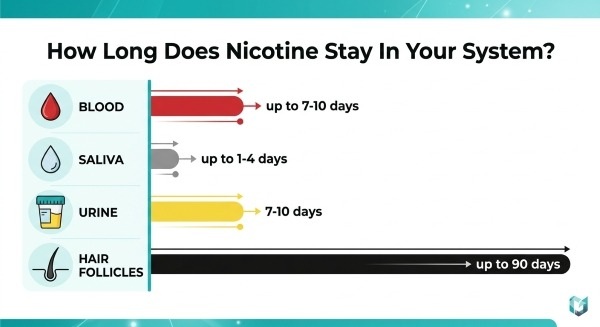
How Long Does Nicotine Stay in Your System?
The detection window depends on the type of test being used. Let’s break this down by test type.
- Urine Tests are the most common type of nicotine test. Cotinine can be detected in urine for 3 to 4 days after a single use in light users. For regular or heavy smokers, cotinine can be detected in urine for up to 3 weeks. That’s a significant difference. One cigarette leaves traces for a few days. Daily smoking leaves traces for weeks.
- Blood Tests are less common but very accurate. Nicotine itself can be detected in blood for 1 to 3 days after use. Cotinine can be detected in blood for up to 10 days. Blood tests are more invasive, so they’re usually only used in medical or forensic situations.
- Saliva Tests are quick and easy. Cotinine can be detected in saliva for 1 to 4 days after use. They’re often used for employment screening because they’re non-invasive and give results relatively quickly.
- Hair Tests have the longest detection window by far. Cotinine can be detected in hair for 1 to 3 months after use. In chronic heavy users, it can be detectable for up to 12 months. Hair tests are the most reliable way to determine long-term nicotine use, but they’re also the most expensive and aren’t as commonly used.
Types of Nicotine Tests
Here’s how the different nicotine testing methods compare:
Test Type | Detection Method | Detection Window | Accuracy | Cost | How Common |
Urine Test | Measures cotinine levels | 3-4 days (light), up to 3 weeks (heavy) | Very high | Low | Very common |
Blood Test | Measures nicotine and cotinine | 1-3 days (nicotine), up to 10 days (cotinine) | Highest | Moderate | Less common |
Saliva Test | Measures cotinine in oral fluids | 1-4 days | High | Low | Moderate |
Hair Test | Analyzes hair follicles | 1-3 months (sometimes up to 12 months) | Very high for long-term use | High | Least common |
Breath Test | Detects nicotine vapor | A few hours | Low | Very low | Rare |
Urine tests are the most practical because they’re cheap, reliable, and non-invasive. That’s why employers and insurance companies use them most often.
When Will Someone Test You for Nicotine?
Nicotine testing isn’t as routine as standard drug screening. But there are specific situations where it happens.
- Health and Life Insurance is one of the most common reasons. Insurance companies want to know if you use nicotine because smokers and vapers have higher health risks and higher insurance costs. When you apply for health or life insurance, you might get asked to take a nicotine test. If you use nicotine, your premiums will be significantly higher.
- Employment Screening sometimes includes nicotine testing, particularly for jobs where smoking is a safety concern or where employers want to maintain a smoke-free workplace. Some companies test for nicotine as part of their wellness programs.
- Before Surgery, some hospitals require nicotine screening before surgery. Smoking affects how your body heals and can increase surgery risks. They want to know if you’re a smoker so they can manage your care appropriately.
- Smoking Cessation Programs require testing to confirm you’re actually quitting and to measure your progress.
- Court-Ordered Testing in child custody cases sometimes includes nicotine screening. Some judges consider nicotine use when making custody decisions.
- Worker’s Compensation investigations sometimes include nicotine tests to determine if nicotine use contributed to injuries.
- Drug Court Programs may require nicotine testing as part of probation conditions.
If you’re required to take a test, the person or organization ordering it will tell you what to expect and why.
How Long Nicotine Stays in Your System
Not everyone’s body processes nicotine the same way. Several factors influence how long cotinine stays detectable.
- Frequency of Use is huge. A one-time smoker will clear cotinine from their urine in 3 to 4 days. Someone who smokes daily might test positive for weeks. Your body accumulates cotinine with repeated use.
- The type of Nicotine Product matters too. Cigarettes deliver a certain amount of nicotine. Cigars can deliver much more. Chewing tobacco is very concentrated. Vaping varies widely depending on the device and liquid strength. The more nicotine you ingest, the longer it takes to clear.
- Your metabolism affects how quickly your body processes substances. Some people naturally metabolize nicotine faster than others. This is partly genetic.
- Body Weight can influence detection times. Generally, heavier individuals may take longer to clear nicotine and cotinine.
- Liver Function affects your body’s ability to metabolize nicotine into cotinine. People with liver disease might have longer detection windows.
- Genetics plays a role. Research shows that different genetic groups metabolize cotinine at different rates. For example, some studies suggest non-Hispanic Black Americans may metabolize cotinine more slowly than non-Hispanic white Americans.
- Menthol Cigarette Use affects results. Studies show that people who smoke menthol cigarettes have higher cotinine levels that persist longer than people who smoke regular cigarettes.
- Second-Hand Smoke Exposure can also create detectable cotinine levels. If you’re in a room with smokers regularly, you might have low-level cotinine in your system even if you don’t smoke.
The Different Levels of Test Results
Nicotine tests can show different results that mean different things.
No Nicotine Detected means you haven’t had nicotine exposure for several weeks, including no secondhand smoke exposure.
Low-Level Nicotine Detection might mean you were exposed to secondhand smoke if you’re not a smoker yourself or you smoke occasionally and haven’t used nicotine recently.
Moderate Nicotine Levels typically mean you stopped smoking or vaping within the last few days or weeks. It shows past use but not current heavy use.
High Nicotine Levels indicate recent and significant nicotine use. If you’ve been smoking regularly and stopped within the last few hours or days, your levels will be high. If you’re a heavy smoker, your levels are likely in the range of 1,000 to 8,000 ng/mL (nanograms per milliliter).
Nicotine Replacement Therapy and Drug Tests
Here’s something important to know: nicotine replacement therapies like patches, gum, lozenges, and prescription nasal sprays will also show up on nicotine tests.
If you’re using these to quit smoking, and you’re going to be tested, you need to let the tester know beforehand. A positive result from nicotine replacement therapy is technically legitimate nicotine use, even though you’re using it to quit smoking, not to continue smoking.
Some testing organizations will account for this. Others might not. Transparency is important. Tell whoever is testing you that you’re using nicotine replacement therapy. Many insurance companies and employers understand that people using these tools to quit are making a positive choice.

Getting Help With Nicotine Dependence
If nicotine testing is prompting you to think about quitting, or if you’re struggling with nicotine dependence, help is available.
Solutions Healthcare in Central Florida offers comprehensive substance abuse treatment and counseling services. While nicotine addiction is different from addiction to other drugs, it’s still an addiction. If you’re ready to quit but struggling, treatment can help.
Our team provides:
- Counseling and therapy to address nicotine dependence
- Medication management for smoking cessation
- Behavioral support to break nicotine habits
- Group programs with others working to quit
- Relapse prevention strategies
- Integration with medical providers
Quitting nicotine is hard. Most people try multiple times before they successfully quit for good. That’s not failure; that’s normal. Professional support increases your chances of success.
If you’re interested in quitting nicotine or addressing substance use issues, call us at (386) 866-3600. We serve Central Florida with compassionate, evidence-based care. All conversations are confidential.
FAQs
Q: Will one cigarette show up on a nicotine test?
Yes, even a single cigarette can produce a detectable level of cotinine in urine. Sensitive tests can detect cotinine from a single puff. However, the level would be relatively low and might be distinguishable from active smoking.
Q: How can I pass a nicotine test?
The only reliable way to pass is to stop using all nicotine products and avoid secondhand smoke for at least 3 to 4 days before the test (for urine tests). For hair tests, you’d need to be nicotine-free for 1 to 3 months. There’s no way to “clean” your system faster through drinking water, exercising, or other methods.
Q: Can secondhand smoke cause me to fail a nicotine test?
Possibly, but unlikely with most tests. Heavy secondhand smoke exposure can produce detectable cotinine, but usually at lower levels. Some tests distinguish between active use and passive exposure. If you’re being tested and have had significant secondhand smoke exposure, mention it.
Q: What’s the difference between nicotine and cotinine testing?
Nicotine tests look for cotinine, not nicotine itself. Cotinine is what your body produces when it breaks down nicotine. Testing for cotinine is more practical because it stays in your system longer.
Q: If I fail a nicotine test, what happens?
That depends on the context. For employment, you might not get hired or might lose benefits. For insurance, your premiums will increase. For court-ordered testing, there could be legal consequences. For health programs, it might affect your care plan. The consequences depend on why you were tested.
Q: Can I test positive if I use nicotine gum or patches?
Yes. Nicotine replacement products contain nicotine that your body will process into cotinine, which will show up on tests. You need to disclose this before testing if possible.
Q: How accurate are nicotine tests?
Nicotine tests are generally very accurate, especially urine tests. False positives are rare. The main issue is that low-level exposure (secondhand smoke) can sometimes produce low-level positive results.
Q: Can I dilute my urine to pass a nicotine test?
No. Modern drug testing labs are sophisticated. They can tell if urine is diluted. Trying to dilute your urine to pass is usually counterproductive and can be flagged as suspicious.
Q: How long after quitting will I test negative?
For light users, urine tests will be negative 3 to 4 days after quitting. For heavy users, it might take 2 to 3 weeks. For hair tests, it could take 1 to 3 months.
Q: Is nicotine addiction treated the same as drug addiction?
Nicotine addiction involves similar brain chemistry changes as other addictions. Treatment approaches overlap, including counseling, medication, and behavioral support. However, nicotine-specific treatments are available and often more effective for tobacco addiction.
Q: What if I’m pregnant and use nicotine?
Nicotine is harmful during pregnancy. If you’re pregnant or planning pregnancy, quitting nicotine is crucial. Talk to your doctor about smoking cessation programs. Many are available specifically for pregnant women.
Q: Can I use mouthwash to pass a saliva test?
No. Mouthwash doesn’t eliminate cotinine from your saliva. Trying to cheat on drug tests is generally not effective and can have consequences.
References
- Recovered.org, “How Long Does Nicotine Stay in Your System?”
- Choice DNA, “Does Nicotine Show Up in a Drug Test?”
- Drug Rehab, “How Long Does Nicotine Stay in Your System?”
- Healthline, “How Long Does Nicotine Stay in Your System?”
- TestClear, “Does Nicotine Show Up on a Drug Test?”
- Health Street, “Cotinine (Nicotine) Drug Test”
- Countrywide Testing, “Do Drug Tests Check for Nicotine?”
- Ovus Medical, “Does Nicotine Show Up in a Drug Test?”
- MD Spiro, “How Long Does Nicotine Stay in Your System?”
- WebMD, “Taking a Nicotine Test”
This content is for informational purposes only and does not constitute medical advice or a clinical recommendation. For a personalized assessment, please consult a licensed mental health professional. To learn more about evidence-based mental health and addiction treatment in Florida, visit shc.health or call (386) 866-3600.