
If addiction is in your family history, you have likely questioned yourself about the prospect that it might also be genetically predetermined for you. This question has importance and it has a real answer beyond the two polar reactions that people typically choose. It is not “addiction is totally genetic; there is nothing anyone can do” and it’s not “addiction is totally a choice; there is no genetic story. The reality is somewhere not as straightforward, yet more effective, in the middle.
Now, let’s explore the actual genetic research that has been conducted in the past, the implications it has for those with a family history of addiction, and why knowledge can truly make a difference in addiction prevention or recovery.
What is Drug Addiction
A drug addiction occurs when a person is unable to stop using a substance even though it hurts their body or relationships. This is a clinical diagnosis called a substance use disorder, and is a chronic disorder of the brain.
“Compulsive drug seeking and use, despite harmful consequences, is the defining characteristic of addiction.” (National Institute on Drug Abuse)
Addiction changes brain circuits involved in reward, motivation, memory, and self-control. This is exactly why willpower alone rarely resolves it, whether genetics play a large role in a given case or not.
Is Drug Addiction Genetic?
Yes, genetics plays a substantial role in addiction risk, with research estimating that 40 to 60 percent of a person’s vulnerability to addiction can be attributed to genetic factors.
That percentage is not a life sentence, and it is not the whole story either. It describes population-level risk, not a guarantee for any one individual.
“Addiction is a chronic, relapsing disorder, and like other chronic diseases, it involves a combination of genetic, environmental, and developmental factors that interact over time.” (National Institute on Drug Abuse)
Having a genetic predisposition means your baseline risk is higher than that of someone without that background, not that addiction is inevitable.
FACT: Genetics account for roughly 40 to 60 percent of addiction risk.
Is Drug Addiction Genetically Inherited From Parents
Genetic risk for addiction can be passed down from parents, but it works through inherited vulnerability, not a single addiction gene that guarantees the outcome.
Multiple types of studies point to this same conclusion:
- Family studies consistently show that close relatives of people with substance use disorders face a higher risk than more distant relatives
- Adoption studies find that adopted individuals more closely resemble their biological relatives in substance use patterns than their adoptive family, even without a shared environment
- Twin studies show higher concordance rates between identical twins than fraternal twins, a strong signal of genetic influence
This inherited vulnerability can affect how your brain responds to substances, how intensely you experience reward, and even how your body processes certain drugs.
Genes and Drug Addiction
No single gene causes addiction. Instead, researchers have identified many genes that each contribute a small piece to overall risk, particularly genes involved in the brain’s dopamine and reward systems.
Research has focused on several areas where genetics and addiction intersect:
- Dopamine receptor genes, which influence how strongly the brain responds to rewarding experiences, including drug use
- Genes affecting drug metabolism, which change how quickly or intensely a person experiences a substance’s effects
- Genes tied to impulsivity and stress response, which shape vulnerability to substance use as a coping mechanism
This is genuinely complex science, and no widely available genetic test can currently predict individual addiction risk with meaningful accuracy.
Is Drug Addiction Genetic or Environmental
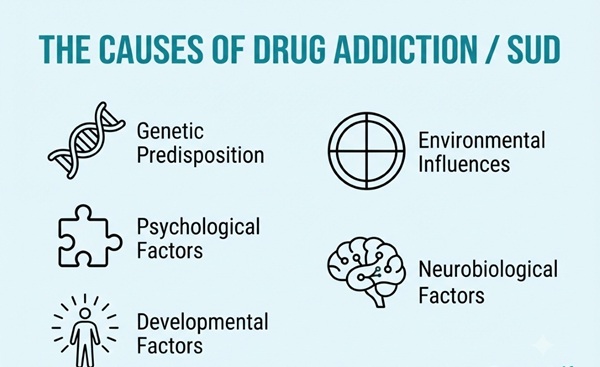
Drug addiction develops through the interaction of both genetic and environmental factors, not one or the other in isolation.
Environmental factors that interact with genetic risk include:
- Childhood trauma or adverse experiences
- Exposure to substance use at a young age
- Chronic stress
- Mental health conditions like anxiety, depression, or ADHD
- Peer influence and social environment
- Access and availability of substance
This interaction works both ways. Someone with lower genetic risk can still develop addiction under significant environmental pressure, and someone with high genetic risk may never develop a substance use disorder if protective factors are strong enough.
Drug Addiction Symptoms
Common symptoms of drug addiction include loss of control over use, continued use despite negative consequences, and withdrawal symptoms when substance use stops.
Signs to watch for in yourself or a loved one:
- Using more of a substance or for longer than intended
- Repeated unsuccessful attempts to cut back or stop
- Spending significant time obtaining, using, or recovering from use
- Cravings strong enough to interfere with daily thoughts
- Continuing use despite problems at work, school, or home
- Giving up activities once enjoyed in favor of substance use
- Developing tolerance, needing more to achieve the same effect
- Experiencing withdrawal symptoms when not using
If several of these symptoms are present, professional evaluation is worth pursuing regardless of family history.
Recognizing several of these symptoms in yourself or a loved one? Call Solutions Healthcare regardless of what your family history looks like.
Is Drug Addiction Hereditary Across Generations
Yes, addiction risk can be observed across multiple generations within a family, though this reflects a combination of inherited genetic vulnerability and shared environmental patterns, not a fixed outcome.
Families often see addiction patterns repeat, and both nature and nurture typically play a role. A child raised in a household affected by substance use may inherit genetic risk factors and also be exposed to environmental patterns like normalized substance use or unaddressed trauma, compounding the overall risk.
This is precisely why understanding family history matters. It is not about assigning blame or accepting inevitability. It is about recognizing risk early enough to act on it.
Watching addiction repeat across your family and want to break the cycle? Solutions Healthcare can help you build a different path.
How Genes and Environment Interact in Addiction
Genetic risk generally acts by lowering the threshold at which environmental triggers lead to problematic substance use, rather than directly causing addiction on its own.
Think of genetic predisposition as something that shapes vulnerability, similar to how genetics influence risk for conditions like heart disease or diabetes. Genes alone rarely tell the whole story, but they meaningfully shift the odds depending on what environmental factors a person encounters.
This is also why prevention and early intervention matter so much for people with a known family history. Reducing environmental risk factors, building coping skills, and addressing mental health early can meaningfully offset genetic vulnerability.
Experts Advice: Address environmental risk factors early to help offset genetic vulnerability.
Drug Addiction and Treatment Options That Work
Effective drug addiction treatment addresses both the biological and environmental dimensions of the condition, typically combining medical care, therapy, and ongoing support.
Evidence-based treatment components include:
- Medical detox, when needed, to safely manage withdrawal
- Behavioral therapy, such as cognitive behavioral therapy, to address thought patterns and triggers
- Medication-assisted treatment, for certain substance use disorders, where appropriate
- Dual diagnosis care, addressing co-occurring mental health conditions that often accompany addiction
- Family involvement, since addiction affects the whole household, not just the individual
- Ongoing aftercare, since addiction is a chronic condition that benefits from long-term support, similar to other chronic health conditions
Knowing that genetics plays a role does not change the fundamentals of effective treatment. It simply reinforces why treating addiction as a medical condition, rather than a moral failing, leads to better outcomes.

Getting Support at Solutions Healthcare
Whether addiction runs in your family or this is the first time anyone has faced it, understanding the “why” does not have to come before getting help. Both can happen at the same time.
At Solutions Healthcare, our Central Florida treatment network provides evidence-based, individualized care that treats addiction as the complex medical condition it is, considering genetics, environment, and everything in between.
Depending on your needs, our team may recommend the following:
- Substance Use Disorder Treatment tailored to your specific history and circumstances
- Dual Diagnosis Program for co-occurring mental health conditions that often intersect with genetic risk
- Medical Detox for safe, supervised support at the start of recovery
- Family Therapy Program to help address generational patterns and build a healthier path forward together
Our programs are accredited by The Joint Commission and licensed by Florida’s Department of Children and Families and Agency for Health Care Administration, with locations across Central Florida, including Orlando, DeLand, Palm Coast, and Melbourne.
Call us or visit our contact page to speak with someone who understands, confidentially and at any time of day.
FAQs
Q: Is drug addiction genetic?
Yes. Research suggests genetics account for approximately 40% to 60% of a person’s overall risk of developing a substance use disorder. However, genes alone do not determine addiction. Environmental influences, personal experiences, and lifestyle factors also play major roles in whether addiction develops.
Q: Is drug addiction genetically inherited from parents?
A genetic vulnerability to addiction can be inherited from parents, increasing a child’s statistical risk of developing a substance use disorder. However, inherited risk is not a guarantee. Many people with a family history never develop addiction, while others without one still can.
Q: Is drug addiction genetic or environmental?
Both. Addiction develops through a complex interaction between inherited genetic susceptibility and environmental influences such as trauma, chronic stress, early substance exposure, peer influences, and mental health conditions. Neither genetics nor environment alone fully explains why addiction develops in one person but not another.
Q: Is drug use genetic in the same way addiction is?
Genetics influence both the likelihood of trying substances and the risk of progressing to addiction. However, occasional drug use and substance use disorder are different outcomes. Environmental circumstances, personal choices, and repeated exposure strongly influence whether experimentation develops into addiction.
Q: Is drug addiction hereditary across multiple generations?
Yes. Addiction often appears across multiple generations within families because genetic vulnerability can be inherited alongside shared environmental factors, including childhood experiences, family attitudes toward substances, trauma, and stress. These combined influences help explain recurring patterns without making addiction inevitable.
Q: Is there a specific gene that causes drug addiction?
No. There is no single addiction gene. Instead, hundreds of genes each contribute a small amount to overall risk, particularly those involved in dopamine signaling, reward processing, stress response, impulse control, and how the brain responds to addictive substances over time.
Q: What are common drug addiction symptoms?
Common symptoms include losing control over substance use, continuing despite negative consequences, developing tolerance, experiencing withdrawal symptoms, spending increasing time obtaining or using drugs, and making repeated unsuccessful attempts to reduce or stop despite wanting to quit.
Q: Does having a family history of addiction mean it is inevitable?
No. A family history increases risk but does not determine the future. Healthy relationships, supportive environments, effective stress management, early intervention, and avoiding substance misuse can all reduce the likelihood that inherited genetic vulnerability develops into addiction.
Q: How do genes and environment interact in addiction risk?
Genetic factors can increase sensitivity to environmental influences such as trauma, chronic stress, peer pressure, or early substance exposure. Together, these factors shape addiction risk, with genetics affecting vulnerability while environmental experiences often determine whether that vulnerability becomes clinically significant.
Q: Can understanding genetic risk help with prevention?
Yes. Knowing there is a family history of addiction encourages earlier awareness, healthier coping strategies, careful prescribing of potentially addictive medications, and prompt intervention if warning signs appear. These proactive steps can reduce risk despite an inherited genetic predisposition.
Q: Does genetic risk affect how addiction is treated?
Not substantially. Evidence-based treatment approaches, including behavioral therapy, medication-assisted treatment when appropriate, family involvement, and ongoing recovery support, remain effective regardless of whether a person’s addiction is influenced more strongly by genetics, environment, or a combination of both.
Q: When should someone seek treatment for drug addiction?
Professional treatment is recommended whenever substance use begins affecting health, work, school, relationships, or daily responsibilities, or when tolerance, withdrawal, cravings, or repeated unsuccessful attempts to quit develop. Early intervention improves recovery outcomes regardless of family history or genetic risk.
References
- National Institute on Drug Abuse: Genetics and Epigenetics of Addiction
- National Institute on Drug Abuse: Understanding Drug Use and Addiction
- PMC, National Library of Medicine: “Higher Order” Addiction Molecular Genetics
- PMC, National Library of Medicine: Genetics of Substance Use Disorders, a Review
- Nature, Translational Psychiatry: The Genetics of Addiction, a Translational Perspective
- ScienceDirect: Understanding Genetic Risk for Substance Use and Addiction
- Mayo Clinic: Drug Addiction Symptoms and Causes
- American Psychiatric Association: What Is Addiction
- Solutions Healthcare: Dual Diagnosis Program
- Solutions Healthcare: Family Therapy Program
This article is for informational purposes only and is not a substitute for professional medical advice. If you or a loved one needs support, Solutions Healthcare is available to help.