
Perhaps there’s a test scheduled on the calendar. Perhaps you’re trying to decipher a lab value that just doesn’t make sense at the moment. Perhaps a friend or family member is using marijuana every day and you’re wondering if “just weed” has turned into more.
Unlike some drugs, cannabis is not eliminated from your system on a fixed schedule but rather through the process of THC being metabolized by your body. But it persists; it is stored in fat and there isn’t a simple answer to how long it remains. After all, how long it remains depends on more than most people realize; it depends on the type of test and so on, what the test is actually measuring.
Let’s go through how THC travels through your body, what a quantitative THC test actually represents and at what frequency of use do you consider it something that you need to pay attention to?
What Is THC and How Does It Affect the Body
THC, or tetrahydrocannabinol, is the primary psychoactive compound in marijuana, responsible for the high and many of the drug’s effects on mood, perception, and coordination.
THC is fat-soluble, meaning your body stores it in fatty tissue rather than processing it quickly the way it does with water-soluble substances. This single characteristic explains why THC detection windows run so much longer than those of most other commonly used drugs.
“THC’s lipophilic nature allows it to accumulate in fat tissue, from which it is gradually released back into the bloodstream, contributing to prolonged detectability compared to water-soluble substances.” (National Institute on Drug Abuse)
Your liver eventually converts THC into metabolites, primarily THC-COOH, which is what most standard drug tests are actually designed to detect.
FACT: THC is fat-soluble, allowing it to accumulate in body fat tissue.
How Long Does THC Stay in Your Body
For occasional users, THC typically clears the body within about a week, while regular or heavy users may take several weeks, and in some cases over a month, to fully clear it.
- Single or occasional use: generally clears within 3 to 7 days
- Moderate use, a few times weekly: generally clears within 1 to 2 weeks
- Daily use: can take 2 to 4 weeks or longer to fully clear
- Heavy, chronic daily use: research has documented detectable THC persisting beyond 30 days in some frequent users
This range is wide on purpose. THC clearance genuinely varies more between individuals than most substances, largely because of how it interacts with body fat.
100% Confidential Support is Available 24/7
No matter what you’re going through, you’re not alone. Our dedicated team is here to provide a safe, judgment-free space where you can talk openly and honestly. Whether you need emotional support, resources, or just someone to listen.
We’re here for you—completely confidential and always respectful of your privacy. Call us today!
Is There a Test to See How Much THC Is in Your System
Yes, quantitative THC tests exist and measure the exact concentration of THC or its metabolites in nanograms per milliliter, rather than simply returning a positive or negative result.
Quantitative testing is more common in specific situations, including legal cases, certain medical settings, and driving under the influence investigations, since it provides an actual measured level rather than a threshold pass or fail.
This is different from a standard workplace drug screen, which typically only confirms whether THC metabolites are present above a set cutoff, not the precise concentration.
Experts Advice: Weigh frequency of use most heavily, since it predicts detection time best.
Contact Solutions Healthcare
Battling with Drug and Alcohol Addition? Remember, you are not alone and we are here to help you!
Types of THC Drug Tests Explained
Different THC tests measure different things, using different windows of detection, and understanding which type you are dealing with changes how to interpret the result.
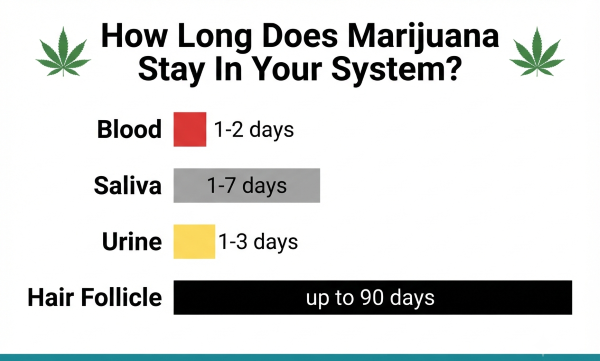
- Urine tests detect THC-COOH metabolites and are the most common method for standard drug screening, with the longest typical detection window
- Blood tests measure active THC directly and are most useful for identifying very recent use, since levels drop quickly after the first few hours
- Saliva tests detect recent use, generally within the past 24 to 72 hours, making them useful for roadside or workplace testing
- Hair follicle tests detect THC metabolites incorporated into hair over time, offering a detection window of up to 90 days
Why a Positive THC Test Doesn’t Mean You’re Impaired
A positive or elevated THC test does not reliably indicate current impairment, since THC blood concentrations do not correlate consistently with cognitive or motor impairment in research studies.
This is one of the more surprising and important findings in recent cannabis research. Some regular users show measurable THC levels well above legal per se limits even after days of abstinence, without any measurable impairment.
This distinction matters enormously for families trying to understand a test result. A number on a lab report tells you THC is present, not necessarily how recently someone used or how affected they currently are.
Confused by a test result that doesn’t match what you actually know? Solutions Healthcare can help you look at the full picture.
THC Detection Windows by Usage Pattern
THC detection windows shift substantially based on usage frequency, body composition, and the specific test used.
Test Type | Occasional Use | Regular or Heavy Use |
Blood | A few hours | Up to several days |
Saliva | 24 to 72 hours | Up to a week or more |
Urine | 3 to 7 days | 2 to 4 weeks, sometimes longer |
Hair | Up to 90 days | Up to 90 days |
Frequency of use remains the single strongest predictor of detection time across nearly every test type.
100% Confidential Support is Available 24/7
No matter what you’re going through, you’re not alone. Our dedicated team is here to provide a safe, judgment-free space where you can talk openly and honestly. Whether you need emotional support, resources, or just someone to listen.
We’re here for you—completely confidential and always respectful of your privacy. Call us today!
Is THC Addictive
Yes, THC can lead to a diagnosable condition called cannabis use disorder, and research indicates that roughly 3 in 10 people who use marijuana experience some degree of this disorder.
Contrary to a common misconception, marijuana is not risk-free simply because it is legal in many places or perceived as milder than other substances.
“The risk of developing cannabis use disorder is higher among those who begin using at a younger age, and daily users face significantly elevated risk compared to occasional users.” (National Institute on Drug Abuse)
THC’s addictive potential works through the same brain reward pathways involved in other substance use disorders, even though its physical withdrawal profile looks different from substances like opioids or alcohol.
Signs of THC Addiction to Look For
Signs of THC addiction include needing more to achieve the same effect, unsuccessful attempts to cut back, and continuing use despite it clearly causing problems.
Watch for:
- Increased tolerance, requiring more THC to get the same effect
- Repeated unsuccessful attempts to stop or cut back
- Prioritizing use over responsibilities, relationships, or activities once enjoyed
- Continuing use despite it causing problems at work, school, or home
- Irritability, anxiety, or sleep disruption when not using
- Spending significant time obtaining, using, or recovering from use
Families often notice these patterns before the person using it is ready to acknowledge them, particularly since marijuana’s reputation as low risk can make denial easier to maintain.
Recognizing tolerance or failed attempts to cut back in yourself or someone close? Solutions Healthcare can help you take it seriously.
100% Confidential Support is Available 24/7
No matter what you’re going through, you’re not alone. Our dedicated team is here to provide a safe, judgment-free space where you can talk openly and honestly. Whether you need emotional support, resources, or just someone to listen.
We’re here for you—completely confidential and always respectful of your privacy. Call us today!
THC Withdrawal and Recovery Timeline
THC withdrawal symptoms typically begin within 24 to 72 hours of stopping regular use, peak around days 2 to 6, and generally ease within 1 to 2 weeks.
Common withdrawal symptoms include:
- Irritability and mood swings
- Anxiety
- Sleep difficulties, including vivid dreams
- Decreased appetite
- Restlessness and cravings
For heavier, longer term users, milder symptoms like disrupted sleep and low mood can persist for several weeks beyond the acute withdrawal phase.
Getting Support at Solutions Healthcare
If a test result, a withdrawal symptom, or a pattern you recognized in this article brought you here, that recognition is worth taking seriously, even if marijuana feels like a smaller concern than other substances.
At Solutions Healthcare, our Central Florida treatment network provides evidence-based care for individuals whose marijuana use has grown into something they want real support to address.
Depending on your needs, our team may recommend:
- Substance Use Disorder Treatment tailored to your specific use patterns and history
- Dual Diagnosis Program for those whose cannabis use overlaps with anxiety, depression, or another mental health condition
- Intensive Outpatient Program for flexible, ongoing support that fits around work and family life
- Family Therapy Program to help loved ones understand what is happening and how to support recovery.
You do not have to wait for a bigger crisis to reach out. Call us at (386) 866-3600 or visit our contact page to speak with someone who understands, confidentially and at any time of day.
FAQs
Q: How long does THC stay in your body?
For occasional users, THC typically clears within 3 to 7 days. Daily or heavy users may require 2 to 4 weeks or even longer because THC accumulates in fat tissue and is released gradually, extending detection times across several types of drug tests.
Q: What is THC and how does it work in the body?
THC, or tetrahydrocannabinol, is the primary psychoactive compound in cannabis. After use, it binds to cannabinoid receptors in the brain and body. Because it is fat-soluble, THC is stored in fat tissue and released slowly over time, prolonging detectability.
Q: Is there a test to see how much THC is in your system?
Yes. Quantitative THC tests measure the exact concentration of THC or its metabolites, typically reported in nanograms per milliliter. These tests are commonly used in legal, medical, and forensic settings rather than routine workplace drug screening programs.
Q: What is the difference between a standard THC test and a quantitative test?
A standard THC test simply determines whether THC or its metabolites exceed a preset cutoff level. A quantitative test measures the precise concentration present in the sample, providing more detailed information that may be useful for medical or legal evaluations.
Q: Does a positive THC test mean someone is currently impaired?
Not necessarily. A positive THC test indicates recent or past cannabis exposure but does not reliably show current impairment. Regular users may continue testing positive long after intoxicating effects have ended because THC metabolites remain in the body for extended periods.
Q: Is THC addictive?
Yes. THC can lead to cannabis use disorder, a recognized medical condition characterized by problematic cannabis use despite harmful consequences. Research suggests that about 3 in 10 people who use marijuana develop some degree of cannabis use disorder during their lifetime.
Q: What are signs of THC addiction?
Common signs include developing tolerance, experiencing cravings, unsuccessful attempts to reduce or stop use, continuing despite negative consequences, neglecting responsibilities, and feeling irritable, anxious, or restless when not using cannabis. These symptoms may indicate cannabis use disorder requiring professional evaluation.
Q: What does THC withdrawal feel like?
THC withdrawal often includes irritability, anxiety, sleep disturbances, decreased appetite, mood changes, restlessness, and cravings. While generally not medically dangerous, these symptoms can be uncomfortable enough to interfere with daily functioning and increase the likelihood of returning to cannabis use.
Q: How long does THC withdrawal usually last?
Withdrawal symptoms generally begin within 24 to 72 hours after stopping cannabis, peak between days 2 and 6, and improve within 1 to 2 weeks. Some people, especially heavy users, may experience lingering sleep or mood changes for several weeks afterward.
Q: Why does THC take longer to leave your system than other drugs?
Unlike many water-soluble substances, THC is fat-soluble and becomes stored in body fat after use. It is then released slowly into the bloodstream over time, making cannabis detectable much longer than many other drugs, particularly in frequent or long-term users.
Q: Can secondhand marijuana smoke cause a positive THC test?
Under normal circumstances, secondhand marijuana smoke is very unlikely to produce a positive THC test. Only extreme exposure in a poorly ventilated environment for an extended period has been shown to occasionally produce detectable levels in some individuals.
Q: When should someone seek help for THC use?
Professional support should be considered if cannabis use begins interfering with work, school, relationships, finances, or daily responsibilities, or if repeated efforts to reduce or stop using have been unsuccessful. Early treatment can help prevent cannabis use disorder from becoming more severe.
References
- National Institute on Drug Abuse: Marijuana DrugFacts
- National Institute on Drug Abuse: Is Marijuana Addictive?
- PMC, National Library of Medicine: Indeterminacy of Cannabis Impairment and THC Levels
- ScienceDirect: Residual Blood THC Levels in Frequent Cannabis Users
- Mayo Clinic: Drug Addiction Symptoms and Causes
- MedlinePlus: Marijuana
- Cleveland Clinic: Cannabis Use Disorder
- Solutions Healthcare: Dual Diagnosis Program
- Solutions Healthcare: Family Therapy Program
This article is for informational purposes only and is not a substitute for professional medical advice. If you or a loved one needs support, Solutions Healthcare is available to help.