
Perhaps you took a 10mg dose this morning and have a drug test scheduled, which you’re looking to get around. Perhaps you do have a prescription, and you’re simply looking to see what workplace screening truly might reveal. Or perhaps that’s because “just a little” has crept into your routine lately and you’re seeking numbers, not a best guess.
The 10mg dose is one of the most common doses to start with for Adderall and is the range that is fairly predictable when it comes to how long it stays in your system, but “predictable” is not “the same for everyone.” There’s one more layer, and this one is just as tricky: the drug testing system, and all of its cutoffs, types of tests, and ways of dealing with legit prescriptions.
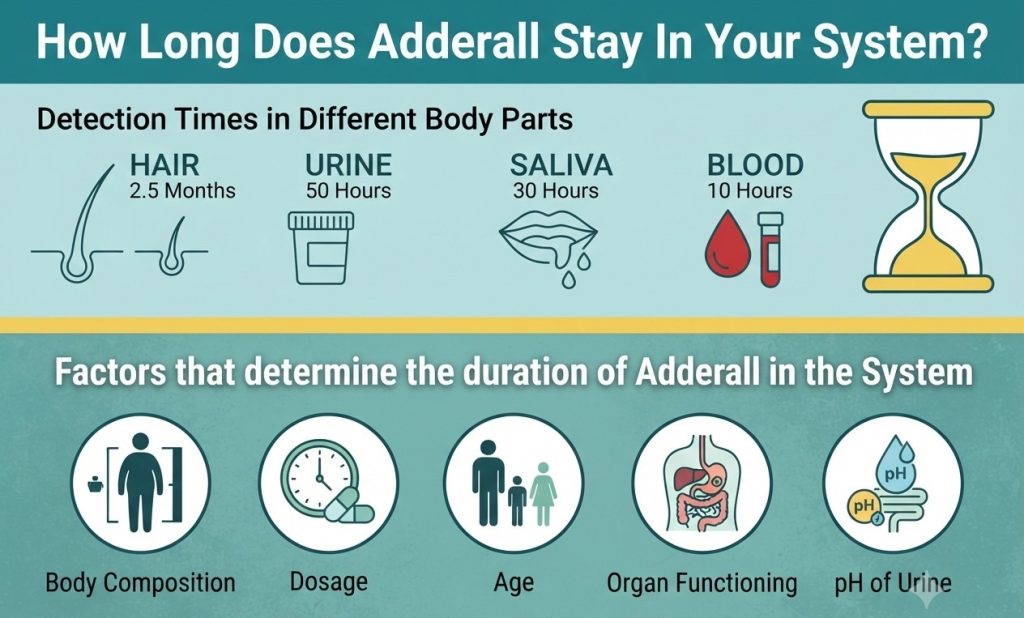
A single 10mg dose of Adderall typically clears the body within 2 to 3 days, though its effects last only 4 to 6 hours. In urine, the most common drug test type, it’s usually detectable for 1 to 4 days, while blood shows it for up to 46 hours and hair follicle tests can detect use for up to 90 days. Actual timing depends on metabolism, urine pH, hydration, and whether use is occasional or regular.
What a 10mg Adderall Dose Actually Is
A 10mg dose of Adderall is a common starting or lower-range dose, often used when a doctor is beginning treatment for ADHD or narcolepsy and adjusting upward based on response.
“The recommended initial oral dose of Adderall for adults is often 10 mg daily, with increases in 10 mg increments at weekly intervals until an optimal response is achieved, up to a maximum daily dose determined by a physician.” (Clinical pharmacology research)
Because 10mg sits on the lower end of typical dosing, it generally produces a shorter, milder duration of effect and a somewhat shorter detection window compared to higher prescribed doses, though the difference is a matter of degree, not an entirely different timeline.
Experts Advice: Take Adderall only as prescribed and discuss concerns with your healthcare provider
How Long Does Adderall Stay in Your System After a 10mg Dose?
A single 10mg dose of Adderall typically clears the body within about 2 to 3 days, though it remains active and felt for only about 4 to 6 hours if taken in immediate-release form.
Adderall’s elimination half-life averages around 10 to 13 hours in most adults, meaning it takes roughly two to three half-lives, about 20 to 39 hours, for the majority of the dose to clear, with trace amounts detectable somewhat longer depending on the test used.
“The average plasma half-life of Adderall is approximately 12 hours, with peak plasma concentrations occurring around 3 hours after ingestion, and up to 80 percent is excreted unchanged in urine.” (Clinical pharmacokinetics reference)
- Felt effects (IR 10mg): approximately 4 to 6 hours
- Blood detection: up to roughly 46 hours
- Urine detection: generally 2 to 3 days for a single 10mg dose
Questions about Adderall use or prescription stimulant concerns? Contact Solutions Healthcare for confidential, evidence-based guidance.
How Long Does Adderall Stay in Your System for a Drug Test?
For a standard urine drug test, Adderall is typically detectable for 1 to 4 days after a single dose, with most single low-dose instances, like 10mg, falling closer to the 2 to 3 day range.
This window shifts based on several factors beyond dose alone:
- Testing method sensitivity: more sensitive assays can detect lower concentrations for slightly longer
- Urine pH: significantly affects elimination speed, discussed in detail below
- Individual metabolism and kidney function: faster processing generally shortens the detection window
- Hydration: normal hydration supports elimination, though very dilute samples can sometimes trigger a retest requirement
“A single therapeutic dose typically clears within roughly 72 to 78 hours at standard testing cutoffs, while higher or repeated doses extend detection considerably further.” (Clinical toxicology reference)
FACT: Urine pH significantly influences how quickly amphetamines are eliminated from the body
What Happens If You Test Positive With a Prescription?
A valid Adderall prescription does not prevent a positive amphetamine result, but it does provide the explanation needed to resolve it through standard verification procedures.
The typical process looks like this:
- The lab reports an initial positive result for the amphetamine drug class
- A Medical Review Officer contacts the individual to ask about legitimate prescription medications
- The individual provides prescription documentation
- The MRO reports the final result to the employer as “negative” or “negative with explanation”
This process exists specifically because standard immunoassay screening cannot distinguish a prescribed dose from unprescribed or illicit amphetamine use on its own. Bringing documentation to a scheduled test, or having it readily available, generally streamlines this process considerably.
Urine pH and Why It Changes Everything
Urine pH has one of the most significant effects on how long Adderall remains detectable, sometimes shifting the detection window by several days in either direction.
“Acidic urine, below pH 7, causes amphetamines to be eliminated much faster, sometimes reducing the detection window to as little as 24 to 48 hours, while alkaline urine, above pH 7, causes amphetamines to be reabsorbed and eliminated far more slowly, potentially extending detection to a week or more.” (Clinical toxicology reference)
This means two people who took the exact same 10mg dose at the exact same time could have meaningfully different test results purely based on diet, hydration, medications, and individual urine chemistry, factors mostly outside conscious control.
Adderall Detection by Test Type
Detection windows vary considerably depending on which type of test is used, not just the dose taken.
Test Type | Typical Detection Window |
Blood | Up to 46 hours |
Saliva | 20 to 50 hours |
Urine | 1 to 4 days for a single dose, longer with repeated use |
Hair | Up to 90 days |
Urine remains the most common method for employment and clinical screening specifically because it offers a longer, more practical detection window than blood or saliva while remaining considerably less invasive than hair testing.
Does Adderall Stay in Your System Longer With Regular Use?
Yes, regular or daily Adderall use extends detection windows considerably beyond single-dose timelines, since the body cannot fully clear each dose before the next one is taken.
“Chronic users accumulate higher concentrations of amphetamines in body tissue, which are released back into the bloodstream over time, extending detection windows substantially beyond single-use timeframes, sometimes to a week or longer.” (Clinical toxicology reference)
This is an important distinction for anyone comparing their own situation to a single 10mg reference point. A single 10mg dose and a daily 10mg regimen taken for months produce meaningfully different detection timelines, even at the exact same dose amount.
When Adderall Use Needs a Closer Look
Even a low, seemingly manageable dose like 10mg can develop into a pattern worth examining honestly, particularly if use is happening outside a prescription or beyond what was originally prescribed.
Worth considering:
- Has your use increased beyond what was originally prescribed?
- Are you using Adderall that was not prescribed to you, even occasionally?
- Do you feel unable to function, focus, or get through a day without it?
- Have you found yourself hiding or minimizing how often you actually use it?
“Nonmedical use of prescription stimulants, including taking higher doses or using without a prescription, significantly increases the risk of adverse cardiovascular and psychiatric effects.” (National Institute on Drug Abuse)
A low dose does not mean low risk if the pattern around it has changed.
Getting Support at Solutions Healthcare
Whether this question started with a drug test, a prescription concern, or a pattern that has quietly shifted, you deserve real answers and real support, not just a detection chart.
At Solutions Healthcare, our Central Florida treatment network provides evidence-based, individualized care for individuals navigating prescription stimulant use, misuse, or dependence.
Depending on your needs, our team may recommend the following:
- Substance Use Disorder Treatment tailored to your specific use patterns and history
- Dual Diagnosis Program for those whose stimulant use overlaps with ADHD, anxiety, or another condition
- Intensive Outpatient Program for flexible, ongoing support that fits around work and family life
- Family Therapy Program to help loved ones understand what is happening and how to support recovery
Our programs are accredited by The Joint Commission and licensed by Florida’s Department of Children and Families and Agency for Health Care Administration, with locations across Central Florida including Orlando, DeLand, Palm Coast, and Melbourne.
If Adderall use is becoming difficult to manage, call Solutions Healthcare to discuss personalized treatment and recovery options.
FAQs
Q: How long does Adderall stay in your system after a 10mg dose?
A single 10mg immediate-release Adderall dose typically clears the body within about 2 to 3 days, although its noticeable effects usually last only 4 to 6 hours. Individual factors such as metabolism, urine pH, kidney function, and overall health can influence how quickly the medication is eliminated.
Q: How long does Adderall stay in your system for a drug test?
Adderall is generally detectable in urine for 1 to 4 days after a single dose, with a 10mg dose often remaining detectable for approximately 2 to 3 days. Detection windows vary based on metabolism, frequency of use, hydration, urine pH, and individual health factors.
Q: Does Adderall stay in your system longer with regular daily use?
Yes. Regular daily use can extend Adderall’s detection window because repeated dosing allows amphetamine metabolites to accumulate before the body fully clears them. People taking Adderall consistently may remain detectable for a week or longer, depending on dosage, metabolism, and overall health.
Q: What is Adderall classified as on a standard drug test?
Adderall contains mixed amphetamine salts and is classified under the amphetamines drug category during standard drug screening. Initial tests identify the drug class rather than the specific medication, with laboratory confirmation distinguishing prescription amphetamine products from other substances when necessary.
Q: What cutoff levels are used for Adderall drug tests?
Most workplace urine drug screens use an initial cutoff between 500 and 1,000 nanograms per milliliter for amphetamines. If a sample exceeds that threshold, confirmatory testing uses lower, more specific cutoffs to accurately verify the presence of prescription amphetamine compounds or other amphetamines.
Q: What happens if I test positive for amphetamines but have a valid prescription?
If you have a legitimate Adderall prescription, a Medical Review Officer typically contacts you to verify it before reporting results. After confirming valid documentation, the positive screening is generally reported as a negative or medically explained result to the requesting organization.
Q: Does urine pH really affect how long Adderall stays in your system?
Yes. Urine pH significantly influences amphetamine elimination. Acidic urine increases excretion, sometimes shortening detection to 24 to 48 hours, while alkaline urine slows elimination and may extend detection for several days or, in some cases, up to about one week after use.
Q: How does Adderall detection in urine compare to blood, saliva, and hair?
Adderall is typically detectable in blood for up to 46 hours, saliva for approximately 20 to 50 hours, urine for 1 to 4 days, and hair for up to 90 days. Hair testing provides the longest detection window because drugs become incorporated into growing hair.
Q: Can a low 10mg dose still show up on a hair follicle test?
Yes. Hair follicle testing can detect Adderall exposure for up to 90 days regardless of whether the dose was relatively low. While higher or repeated doses may produce stronger signals, even a single prescribed 10mg dose can sometimes be identified by sensitive laboratory testing.
Q: Is a 10mg dose of Adderall considered high risk for misuse?
A prescribed 10mg dose is not inherently high risk when taken exactly as directed. However, misuse can occur at any dosage if Adderall is taken without a prescription, in larger amounts than prescribed, or for nonmedical reasons such as improving performance or staying awake.
Q: Can hydration affect an Adderall urine test result?
Normal hydration supports healthy kidney function but does not significantly speed Adderall elimination. Drinking excessive amounts of water mainly dilutes the urine sample rather than removing amphetamines faster, and unusually diluted samples may require repeat testing or additional laboratory evaluation.
Q: When should someone be concerned about their Adderall use, even at a low dose?
If Adderall use increases beyond the prescribed amount, occurs without a prescription, causes cravings, or begins affecting health, work, relationships, or daily functioning, it is important to seek professional guidance. Early intervention can help prevent dependence and support healthier long-term outcomes.
References
- National Institute on Drug Abuse: Prescription Stimulants DrugFacts
- MedlinePlus: Amphetamine
- Mayo Clinic: Amphetamine and Dextroamphetamine (Oral Route)
- SAMHSA: Drug Testing Resources
- Drug Enforcement Administration: Amphetamines Drug Fact Sheet
- Cleveland Clinic: Amphetamine Use Disorder
- FDA: Adderall Prescribing Information
- American Heart Association: Stimulant Medications and Cardiovascular Health
- Solutions Healthcare: Dual Diagnosis Program
- Solutions Healthcare: Family Therapy Program
This article is for informational purposes only and is not a substitute for professional medical advice. If you or a loved one needs support, Solutions Healthcare is available to help.