Quick Answer: Acceptance and Commitment Therapy (ACT) for Addictions is a psychotherapy designed to invite the person suffering from addiction to acknowledge cravings, open up to uncomfortable feelings, and choose healthful habits that help us stay clean, sober, and present. Rather than attempting to engage in battling against unwanted thoughts, ACT teaches a practical set of skills to respond to those thoughts in a different way and to live a life in accordance with values.
Key Takeaways
Acceptance and commitment therapy for substance use disorders is a kind of behavioral therapy that assists individuals in altering their association with cravings, thoughts, and unpleasant sensations.
ACT emphasizes the value of taking behaviors in the direction of one’s values rather than the orientation of living an “endlessly unhelpful life”.
It might support in the management of triggers, minimization of avoidances, and continuing to maintain their engagement with recovery.
ACT can be used in conjunction with other addiction treatment methods such as cognitive behavioral therapy (CBT), dialectical behavior therapy (DBT), medication and peer support.
Treatment plans must take into consideration each individual’s substance use history, mental health needs, and recovery goals.
ACT doesn’t say that someone should ignore their cravings or put up with the destructive behavior. Helps them understand how to deal with challenges better.
What is Acceptance and Commitment Therapy (ACT)?
ACT is a type of behavioral therapy that assists an individual in dealing with challenging thoughts and emotions and taking significant action. ACT in addiction recovery can help individuals recognize when they’re craving, feeling stressed, shameful or anxious to use a substance or stop drinking without taking another drink or trigger. The aim is to build healthier responses and make decisions that help promote recovery.
An important aspect of acceptance and commitment therapy (ACT) for substance use disorders is psychological flexibility, or adjusting to difficult experiences without sacrificing one’s values and focus. As opposed to attempting to press upset ideas aside, one can learn to see the principle, allow it room and choose a healthful subsequent pastime. ACT is skills-based, practical and frequently individual or group therapy.
100% Confidential Support is Available 24/7
No matter what you’re going through, you’re not alone. Our dedicated team is here to provide a safe, judgment-free space where you can talk openly and honestly. Whether you need emotional support, resources, or just someone to listen.
We’re here for you—completely confidential and always respectful of your privacy. Call us today!
What Are Substance Use Disorders?
Substance use disorders (SUDs) are medical syndromes involving problematic substance use that results in distress and/or impairs functioning. Health, relationships, work, education and personal responsibilities can be impacted. Continue using a substance when it is causing harm or have trouble controlling use of the substance.
Substance use disorders encompass alcohol use disorder, opioid use disorder, cannabis use disorder, stimulant use disorder and sedative or tranquilizer use disorder. Others have developed more than one addiction or a combination of mental health problem(s) (e.g., depression or anxiety) and substance use. This may involve behavioral therapies, appropriate medication, recovery support and follow-up care.
Contact Solutions Healthcare
Battling with Drug and Alcohol Addition? Remember, you are not alone and we are here to help you!
How Does ACT Help With Substance Use Disorders and Addiction?
ACT for substance use disorders and addiction assists individuals in learning how their thoughts, emotions, situations and substance use are linked together. For instance, if they feel anxious, they might think, “I can’t face it if I don’t drink.” ACT helps them learn to pay attention to thoughts, not mandating they do something, but rather making a response choice that will further them along their recovery path.
This technique can also be helpful for situations where using substances can be prompted by stress, shame, loneliness, or cravings. A therapist can assist someone practice mindfulness, discovering a person’s worth, and creating a strategy to react to challenging situations. Again, ACT does not claim to eradicate cravings by itself, but it can lead individuals to be more aware of and to have better control over their cravings.
Call Solutions Healthcare to get information on addiction treatment and therapy; it could help with your recovery
What Are the Six Principles of Acceptance and Commitment Therapy?
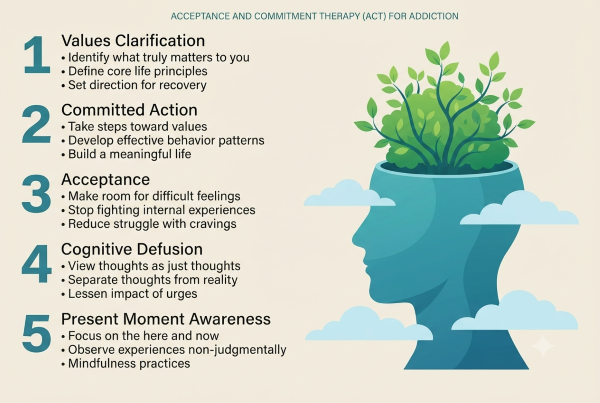
ACT is a theory comprised of 6 core principles; all combined are aimed at creating psychological flexibility. They can assist individuals to react to cravings and challenging emotions without being pushed by them. In substance use treatment, the therapist might use exercises, discussions, and in real life-practice guide the person to apply these principles when it is time to use coping skills when stress is happening.
These six principles are acceptance, cognitive defusion, present-moment awareness, self-as-context, values and committed action. They all target a different aspect to the recovery process. They work together so that individuals can understand what they are feeling, to identify their priorities, and engage in realistic activities to move toward better behaviors.
ACT principle | What it means in recovery |
Acceptance | Allow uncomfortable feelings without automatically escaping through substance use. |
Cognitive defusion | Recognize thoughts as thoughts, not instructions you must follow. |
Present-moment awareness | Pay attention to what is happening right now. |
Self-as-context | Understand that you are more than your thoughts, feelings, or past mistakes. |
Values | Identify what matters most, such as family, health, or independence. |
Committed action | Take realistic steps that support those values, even when recovery feels difficult. |
What Are the Benefits of ACT for Substance Use Disorders?
Acceptance and commitment therapy can be used to help someone learn to identify triggers, tolerate cravings, be more mindful of stressors, and make sustainable decisions that benefit recovery. It can also help with the shameful feelings of addiction by learning to accept and not pass judgment about challenging experiences. These skills can be particularly useful when the negative feelings are tightly coupled with drug and alcohol use.
ACT cannot guarantee a cure or it is not the same for everyone. Using a systematic review with meta-analysis methodology, 28 studies were included, of which 22 were analyzed. It did result in an increase in abstinence rates at the end of treatment and at brief follow-up, the longer term benefit was not statistically proven.
Talk with Solutions Healthcare about treatment options that meet your recovery goals and mental health needs.
100% Confidential Support is Available 24/7
No matter what you’re going through, you’re not alone. Our dedicated team is here to provide a safe, judgment-free space where you can talk openly and honestly. Whether you need emotional support, resources, or just someone to listen.
We’re here for you—completely confidential and always respectful of your privacy. Call us today!
What Does an ACT Session for Addiction Look Like?
During an ACT session, people typically discuss with a therapist what is happening in their life, substance use patterns, and engage in practicing an alternative response. Some of the questions that the therapist may ask include: What does it feel like before the urge to use drugs or alcohol? What are the emotions that are becoming difficult to tolerate? What does the person feel their life would be like if they did not have to use drugs or alcohol to make decisions?
Mindfulness exercises, guided breathing, values check, roleplaying, and/or plans for dealing with high risk situations may be incorporated into sessions. For instance, a person who has developed cravings as a result of an argument can now learn to recognize the craving, to release the emotion and to call a well-known person rather than using a substance. The exercises are modified for individual needs and capabilities.
ACT vs. CBT vs. DBT for Substance Use Disorders
ACT, cognitive behavioral therapy (CBT) and dialectical behavior therapy (DBT) are behavioral therapies that can all address addiction recovery, with different skill sets. ACT involves learning how to accept what is going on in the mind, and then act consistently with personal values. CBT can be an effective way to identify and modify negative thinking styles and behaviors. DBT focuses on skills like regulating emotions, tolerating distress, being mindful and interpersonal effectiveness.
There isn’t a single therapy that will work for everybody. ACT, CBT, DBT, or a mix of these therapies might be suggested by a clinician in consideration of a person’s treatment goals, preferences, and symptoms. These treatments can be used in conjunction with medication and other recovery services, as appropriate.
Therapy | Main focus | Potential use in recovery |
ACT | Acceptance, mindfulness, and values-based action | Responding differently to cravings and uncomfortable emotions |
CBT | Recognizing and changing unhelpful thoughts and behaviors | Identifying triggers and developing alternative coping strategies |
DBT | Emotion regulation, distress tolerance, and relationship skills | Managing intense emotions and improving communication |
100% Confidential Support is Available 24/7
No matter what you’re going through, you’re not alone. Our dedicated team is here to provide a safe, judgment-free space where you can talk openly and honestly. Whether you need emotional support, resources, or just someone to listen.
We’re here for you—completely confidential and always respectful of your privacy. Call us today!
Who Can Benefit From ACT for Addiction?
ACT can be helpful for individuals who are addicted or struggling with habits, stress, feelings of shame, anxiety, and repeated attempts to change substance use. Also, it can be helpful for those individuals who could have co-occurring mental health issues (where treatment is targeting both the mental health issues as well as addictions). The clinician can determine if ACT should be used as a stand-alone treatment or an adjunct treatment.
ACT is not just about any particular substance or any one stage of recovery. Can be administered in outpatient counseling, in residential treatment or other structured settings. However, for individuals who have suffered from a severe withdrawal or over time, an overdose, or have an immediate mental health issue, the first one who must receive proper medical or emergency care is the the first one they must receive. Treatment should be commensurate with the individual’s risk of falls and clinical status.
Contact Call Solutions Healthcare about individualized options for addiction treatment & behavioral therapy.
Is ACT Covered by Insurance?
Acceptance and commitment therapy is potentially covered by a health insurance plan when applied by a qualified mental health professional as part of a covered treatment plan. Coverage: Based on your insurance agreement, provider network, diagnosis, medical need requirements, and whether the service is provided in an approved setting. ACT per se is not necessarily covered individually from general psychotherapy.
Be sure to check with your insurance provider prior to entering treatment to understand if behavioral therapy for substance use disorders will be covered, if a referral is required and what the copayments or deductibles will be. Talk to Solutions Healthcare about the type of services and payment options. Don’t assume coverage until your insurer verifies your benefits.
How ACT Fits Into a Complete Addiction Treatment Plan
ACT may be just one aspect of a complete substance use treatment plan. Some may require more needs to be addressed, and medical assessment, alcohol/opioid use disorder medication, individual counseling, group therapy, family support, and relapse prevention plans may also be provided as a part of treatment. These services can speak to various parts of recovery, ranging from a safe haven to more lasting behavioral alterations.
For instance, medical treatment and counseling combined with ACT skills might be helpful for a person working on their opioid use disorder. The person who is suffering from alcohol use disorder may require medically supervised withdrawal management prior to starting intensive therapy. Depending on the clinical assessment, the individual’s goals and the nature of the substance the patient is taking, a combination of these is appropriate.
What Does Research Say About ACT for Substance Use Disorders?
ACT-related research indicates that ACT may help recovery, although evidence varies depending on the type of substance(s), treatment settings, and study design. The Cochrane review compared ACT with other active treatments in 10 RCTs and concluded that, after treatment, there is a small to medium benefit for ACT. In addition, the researchers pointed out that more research was required to help them better understand its effectiveness.
One 2020 review of 22 studies found promising results that ACT can reduce substance use, even when used in conjunction with other therapies. Some studies, however, lacked methodological aspects, small sample size, or short follow-ups. These results indicate that ACT can be an effective tool, certainly not a cure for addiction or evidence about it is better than all other treatments.

Finding ACT and Addiction Treatment at Solutions Healthcare
Getting started with treatment can be challenging, particularly if substance consumption has developed into a way to manage stress or uncomfortable emotions. ACT provides a way to acquire new responses, clarify personal goals and create habits consistent with the life desired. Don’t wait for running out of answers to ask for help from professionals.
Solutions Healthcare can be the starting point in finding a way to explore addiction treatment and mental health support. Inquire about any treatment services available, the treatment process, and the ways that care could be tailored to your needs. However, if you are worried about your own or someone’s substance abuse, an appropriate evaluation will help you understand what to do next.
Looking for rehab options? Call Solutions Healthcare for information on available services and to get started.
Frequently Asked Questions About ACT for Substance Use Disorders
1. What is DBT for substance abuse?
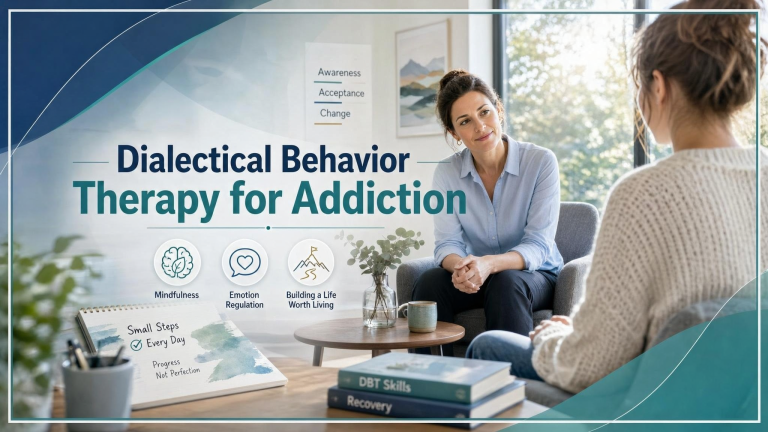
Dialectical behavior therapy (DBT) teaches mindfulness, emotion regulation, distress tolerance, and interpersonal skills. For substance use disorders, it can help people manage intense emotions, respond to cravings, improve relationships, and develop safer coping strategies.
2. Can you give me some examples of dual diagnoses?
Dual diagnosis means having a substance use disorder and another mental health condition at the same time. Examples include alcohol use disorder with depression, opioid use disorder with anxiety, or stimulant use disorder with post-traumatic stress disorder.
3. What are the criteria for substance use disorders according to the DSM-5?
The DSM-5-TR identifies 11 symptoms involving impaired control, social impairment, risky use, and pharmacological effects. Two or more symptoms within 12 months may indicate a substance use disorder, with severity determined by symptom count.
4. What are the six principles of acceptance and commitment therapy?
The six ACT principles are acceptance, cognitive defusion, present-moment awareness, self-as-context, values, and committed action. Together, they help people handle difficult thoughts and feelings while making choices that align with meaningful personal goals.
5. Who is DBT not appropriate for?
DBT is not automatically unsuitable for any particular diagnosis. However, its format or intensity may need adjustment for someone experiencing an acute medical crisis, severe cognitive difficulties, or needs requiring a different immediate level of care.
6. What is the 3-3-3 rule for addiction?
The 3-3-3 rule is an informal grounding technique, not a standardized addiction treatment method. One version involves naming three things you see, three sounds you hear, and moving three body parts to refocus attention.
7. What are the four C’s of substance use disorder?
The four C’s are commonly described as craving, loss of control, compulsion, and continued use despite consequences. This is an informal educational framework, not a formal diagnostic tool. A qualified clinician assesses symptoms and impairment.
8. What are the 11 symptoms of substance use disorder?
The 11 DSM-5-TR criteria include impaired control, unsuccessful efforts to cut down, excessive time spent using, cravings, neglected responsibilities, relationship problems, reduced activities, hazardous use, continued use despite harm, tolerance, and withdrawal.
9. Is substance use disorder a psychiatric diagnosis?
Yes. Substance use disorder is a recognized mental health diagnosis in the DSM-5-TR. It can affect behavior, emotions, relationships, and physical health. Treatment may combine behavioral therapy, medication, medical care, and recovery support.
Expert References and Medical Sources
The following sources support the information in this article and provide further reading about ACT and addiction treatment.
- Osaji J, Ojimba C, Ahmed S. The Use of Acceptance and Commitment Therapy in Substance Use Disorders: A Review of Literature. Journal of Clinical Medicine Research, 2020. Read the peer-reviewed review.
- American Addiction Centers. Acceptance and Commitment Therapy (ACT) for Substance Use Disorders. Read the clinical overview.
- Lee EB, An W, Levin ME, Twohig MP. An Initial Meta-Analysis of Acceptance and Commitment Therapy for Treating Substance Use Disorders. Read the PubMed record.
- Krotter A, Aonso-Diego G, González-Menéndez A, et al. Effectiveness of Acceptance and Commitment Therapy for Addictive Behaviors: A Systematic Review and Meta-Analysis. Journal of Contextual Behavioral Science, 2024. Read the research summary.
Medical Disclaimer
This blog is intended for educational purposes only. It does not replace professional medical advice, diagnosis, or treatment. ACT may be helpful for some people with substance use disorders, but results vary and treatment should be individualized.
Do not stop alcohol, benzodiazepines, or other substances associated with potentially dangerous withdrawal without appropriate medical guidance. If you suspect an overdose, severe withdrawal, or an immediate mental health crisis, seek emergency assistance.
Solutions Healthcare encourages individuals experiencing substance-related difficulties to consult qualified healthcare professionals about appropriate treatment options.