
Xanax has been casually mentioned in association with “narcotics” by friends, in television commercials, or just generally in conversation. It’s pretty common to get mixed up on the classification but it’s more important than most realize, particularly if you or someone you love is taking it.
Nope, Xanax is not a narcotic. Xanax belongs to a class of medications called benzodiazepines, which work differently in the brain than narcotics, also known as opioids. Xanax is not an opioid but is a Schedule III controlled substance for this reason. It does have a real potential for misuse, dependence, and addiction, especially when combined with other substances; therefore, Xanax is classified as a Schedule III controlled substance.
This difference is nothing like a feature of the software’s technical specifications. It doesn’t matter to anyone who wants to know what Xanax is and what it is not.
Concerned about Xanax use in your family? Call Solutions Healthcare for confidential guidance.
What is Xanax?
Xanax is the brand name for alprazolam, a prescription medication used to treat anxiety and panic-related conditions. It works by calming activity in the central nervous system.
According to Drugs.com, Xanax is typically prescribed to relieve anxiety disorders, panic attacks, or depression, and it works by calming the central nervous system and lowering overexcitement in the brain.
Xanax doesn’t cure anxiety, but it can reduce symptoms quickly, which is part of why it’s so widely prescribed and, at times, misused.
What Kind of Drug Is Xanax Exactly?
Xanax is a benzodiazepine, a class of medications distinct from opioids, stimulants, or other narcotics. Understanding this classification clears up a lot of confusion around how the drug actually works and what risks it carries.
Xanax’s active ingredient, alprazolam, is classified as a Schedule IV controlled substance, meaning it’s considered less likely to be abused than a Schedule III drug, but it still carries real potential for misuse and dependence.
This classification places Xanax in the same broad category as other benzodiazepines like Valium, Ativan, and Klonopin, not alongside opioids like oxycodone or heroin.
100% Confidential Support is Available 24/7
No matter what you’re going through, you’re not alone. Our dedicated team is here to provide a safe, judgment-free space where you can talk openly and honestly. Whether you need emotional support, resources, or just someone to listen.
We’re here for you—completely confidential and always respectful of your privacy. Call us today!
What is Xanax Used For?
Xanax is primarily used to treat generalized anxiety disorder and panic disorder, and it’s sometimes prescribed short-term for anxiety related to depression. It’s not typically intended for long-term daily use.
Common uses include:
- Generalized anxiety disorder
- Panic attacks and panic disorder
- Short-term anxiety related to depression
- Situational anxiety in specific circumstances
Xanax’s sedative effects can also cause drowsiness, which is why it’s sometimes misused for sleep, even though it isn’t approved for that purpose.
Not sure if a prescription has turned into something more? Solutions Healthcare can help.
Contact Solutions Healthcare
Battling with Drug and Alcohol Addition? Remember, you are not alone and we are here to help you!
Why People Confuse Xanax With Narcotics
The confusion between Xanax and narcotics often comes from how loosely the term “narcotic” gets used in everyday conversation, legal settings, and media coverage. Technically, “narcotic” refers specifically to opioids.
Term | What It Actually Means |
Narcotic/Opioid | Drugs like heroin, oxycodone, fentanyl |
Benzodiazepine | Drugs like Xanax, Valium, Ativan |
Controlled Substance | Broader legal category covering both |
Xanax is a controlled substance, which is likely where the “narcotic” label gets mistakenly applied, but its classification and how it works in the brain are entirely different from opioids.
Side Effects of Xanax to Know
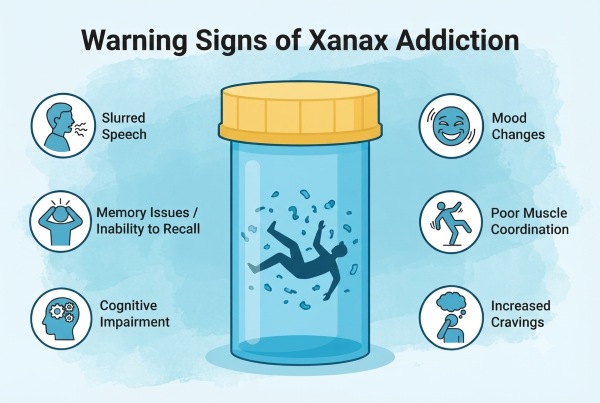
Common side effects of Xanax include drowsiness, dizziness, and impaired coordination, even when taken exactly as prescribed. Higher doses or misuse significantly increase these risks.
Common side effects include:
- Drowsiness and fatigue
- Dizziness or lightheadedness
- Impaired coordination or reaction time
- Memory or concentration difficulties
- Slurred speech at higher doses
Fact: Mixing Xanax with opioids raises overdose death risk tenfold, research shows.
Xanax and Opioids: A Dangerous Combination
Combining Xanax with opioids is one of the most dangerous drug interactions in modern medicine, significantly raising the risk of fatal overdose. This risk exists specifically because Xanax is not itself an opioid, yet it dramatically amplifies opioid-related respiratory depression.
A 2016 study published in Pain Medicine found that overdose death rates among patients taking opioids and benzodiazepines together were ten times higher than among those taking opioids alone.
The FDA began requiring boxed warnings on benzodiazepine and opioid labels in 2020 specifically to highlight the dangers of using these medications together, and the CDC recommends that doctors avoid prescribing them concurrently whenever possible.
Expert Advice: Never combine Xanax with opioids without direct medical supervision and guidance.
100% Confidential Support is Available 24/7
No matter what you’re going through, you’re not alone. Our dedicated team is here to provide a safe, judgment-free space where you can talk openly and honestly. Whether you need emotional support, resources, or just someone to listen.
We’re here for you—completely confidential and always respectful of your privacy. Call us today!
Signs of Xanax Addiction
Recognizing Xanax addiction early can prevent more serious complications later. The signs often develop gradually, especially when use started with a legitimate prescription.
Warning signs include:
- Taking more than prescribed or running out early
- Feeling unable to function without the medication
- Seeking prescriptions from multiple doctors
- Anxiety specifically about running out
- Continuing use despite negative consequences
Not sure if what you’re seeing points to dependence? Solutions Healthcare can help you figure it out.
Symptoms of Xanax Withdrawal
Xanax withdrawal can range from uncomfortable to medically serious, depending on dosage and duration of use. Because Xanax is short-acting, withdrawal symptoms can appear relatively quickly after stopping.
Common withdrawal symptoms include:
- Rebound anxiety and panic
- Insomnia and restlessness
- Muscle tension or tremors
- Sweating and irritability
- Seizures in severe cases
Because sudden discontinuation carries real risk, a medically supervised taper is strongly recommended rather than stopping abruptly.
100% Confidential Support is Available 24/7
No matter what you’re going through, you’re not alone. Our dedicated team is here to provide a safe, judgment-free space where you can talk openly and honestly. Whether you need emotional support, resources, or just someone to listen.
We’re here for you—completely confidential and always respectful of your privacy. Call us today!
Treatment Options for Xanax Addiction
Effective Xanax addiction treatment almost always requires a slow, medically supervised taper rather than sudden discontinuation. Attempting to quit alone significantly increases health risks.
Helpful treatment options include:
- Medically supervised tapering schedules
- Inpatient monitoring for higher-risk cases
- Cognitive behavioral therapy (CBT) for anxiety management
- Treatment for underlying anxiety or panic disorders
- Ongoing counseling to prevent relapse

Get Help for Xanax Addiction Today
Solutions Healthcare connects individuals and families across Central Florida with a trusted network of treatment centers, including Palm Coast Treatment Solutions, DeLand Treatment Solutions, Florida Atlantic Coast Treatment Solutions, and Orlando Treatment Solutions, each offering evidence-based care for benzodiazepine dependence and co-occurring mental health needs.
Our residential treatment programs provide medically supervised tapering and structured support for Xanax dependence, guided by licensed clinicians throughout every stage of recovery.
What makes our network different:
- Multiple licensed facilities across Central Florida
- Medically supervised tapering plans built around your history
- Dual-diagnosis treatment for co-occurring anxiety or mood conditions
- Family-inclusive treatment planning
- Individualized care instead of a one-size-fits-all program
If Xanax use has quietly become dependent, you don’t have to face it alone. Call Solutions Healthcare at (386) 866-3600 or visit our contact page to get started.
FAQs
Is Xanax a narcotic?
No. Xanax is not a narcotic. It belongs to the benzodiazepine class of medications, while the term “narcotic” generally refers to opioid drugs. Although Xanax is a controlled substance, it works differently from opioids and is prescribed primarily to treat anxiety and panic disorders.
What is Xanax exactly?
Xanax is the brand name for alprazolam, a prescription benzodiazepine medication that slows activity in the central nervous system. Doctors commonly prescribe it to relieve anxiety and panic symptoms by enhancing the calming effects of the neurotransmitter gamma-aminobutyric acid (GABA).
What is Xanax used for?
Xanax is most commonly prescribed to treat generalized anxiety disorder and panic disorder. In some cases, it may also be used short-term for anxiety associated with depression. Because of its dependence potential, treatment is usually limited to the shortest effective duration.
What kind of drug is Xanax classified as?
Xanax is classified as a Schedule IV controlled substance under the Controlled Substances Act and belongs to the benzodiazepine drug class. It is distinct from opioid medications and functions by reducing excessive activity in the brain and nervous system.
What are common side effects of Xanax?
Common side effects include drowsiness, dizziness, slowed reaction time, impaired coordination, memory problems, and difficulty concentrating. These effects are often more noticeable at higher doses or when Xanax is combined with alcohol or other medications that cause sedation.
Why do people think Xanax is a narcotic?
Many people mistakenly believe Xanax is a narcotic because it is a controlled prescription medication with misuse potential. However, controlled substances include several drug classes, and Xanax is a benzodiazepine rather than an opioid or narcotic medication.
Is it dangerous to combine Xanax with opioids?
Yes. Combining Xanax with opioids can dangerously slow breathing and increase the risk of overdose. Research shows this combination is associated with a substantially higher risk of fatal overdose than using opioids alone, making medical supervision essential whenever both are prescribed.
What are signs of Xanax addiction?
Warning signs include taking larger doses than prescribed, requesting early refills, feeling anxious about running out, doctor shopping, unsuccessful attempts to stop, and continuing to use Xanax despite problems affecting work, relationships, finances, or overall health.
What are symptoms of Xanax withdrawal?
Xanax withdrawal may cause rebound anxiety, insomnia, irritability, sweating, muscle tension, tremors, difficulty concentrating, and panic attacks. In severe cases, abruptly stopping Xanax can trigger seizures, making medical supervision strongly recommended when discontinuing long-term use.
Is Xanax addictive even when prescribed correctly?
Yes. Physical dependence can develop even when Xanax is taken exactly as prescribed, particularly with regular use over several weeks. For this reason, healthcare providers generally recommend using the medication for the shortest appropriate period and tapering gradually when stopping.
How is Xanax addiction typically treated?
Treatment usually begins with a medically supervised taper to reduce withdrawal symptoms safely. Ongoing care often includes individual therapy, cognitive behavioral therapy, treatment for underlying anxiety disorders, relapse prevention planning, and continued support to promote long-term recovery.
Where can I get help for Xanax addiction in Florida?
Solutions Healthcare provides comprehensive addiction treatment throughout its Central Florida network, including care for benzodiazepine dependence and co-occurring mental health conditions. Call (386) 866-3600 to speak confidentially with an admissions specialist about available treatment programs.
References
- Drugs.com: Is Xanax a Narcotic (Opioid) Drug / Controlled Substance?
- Dasgupta N, et al: Cohort Study of the Impact of High-Dose Opioid Analgesics on Overdose Mortality, Pain Medicine, 2016
- U.S. Food and Drug Administration: Boxed Warning for Benzodiazepines
- CDC: Clinical Guidance for Prescribing Opioids
- Drug Enforcement Administration: Controlled Substance Schedules
- National Institute on Drug Abuse: Benzodiazepines and Opioids
- Mayo Clinic: Benzodiazepines
Medical Disclaimer: This blog is for informational purposes only and is not a substitute for professional medical or mental health advice; please consult a qualified provider or contact Solutions Healthcare for personalized guidance.