
You’ve no doubt heard of a “textbook narcissistic” person, but there is a textbook, and it’s more specific than you think. When trying to make sense of a diagnosis, or when wondering if a loved one’s behavior is real or not, the official criteria can provide some unexpected clarity.
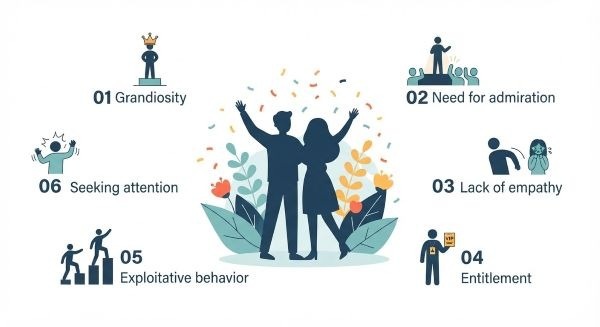
The nine specific criteria in the DSM-5 are used to diagnose narcissistic personality disorder, and the person must exhibit a persistent pattern of at least five of these to be considered formally as having this personality disorder. These include grandiosity, a need for excessive admiration, lack of empathy, a sense of entitlement, among others. Achievement of some criteria at some time is not equal to meeting the clinical threshold.
Perhaps you’re looking to understand a relationship that just never seems to make sense. Perhaps you are a family member and are not sure whether the behaviors you observe are “just” personality or something with a real clinical diagnosis.
Let’s walk through what the nine criteria are, how diagnosis actually works and whether or not treatment is realistically possible.
What is Narcissistic Personality Disorder
Narcissistic personality disorder is a diagnosable mental health condition marked by a pervasive pattern of grandiosity, a constant need for admiration, and a limited ability to empathize with others.
Cleveland Clinic describes narcissistic personality disorder as more than everyday self-centered behavior, noting it’s a recognized mental health condition with specific diagnostic criteria, not just a personality trait people casually apply to someone difficult.
Fact: Narcissistic personality disorder affects an estimated 1 to 2 percent of adults.
The pattern has to be consistent across relationships, work, and other areas of life, not just present in one difficult relationship or a stressful season.
What Are the 9 Criteria for NPD
The 9 criteria for narcissistic personality disorder come directly from the DSM-5, the diagnostic manual mental health professionals use for formal diagnosis.
A person needs to show a persistent pattern of at least five of the following:
- A grandiose sense of self-importance
- Preoccupation with fantasies of unlimited success, power, or brilliance
- A belief that they are special and can only be understood by other special people
- A need for excessive admiration
- A sense of entitlement
- Interpersonally exploitative behavior
- A lack of empathy
- Envy of others, or believing others are envious of them
- Arrogant or haughty attitudes and behaviors
100% Confidential Support is Available 24/7
No matter what you’re going through, you’re not alone. Our dedicated team is here to provide a safe, judgment-free space where you can talk openly and honestly. Whether you need emotional support, resources, or just someone to listen.
We’re here for you—completely confidential and always respectful of your privacy. Call us today!
Criteria 1 Through 3 Explained
The first three criteria center on grandiosity and a distorted sense of specialness that shapes how someone sees themselves.
A grandiose sense of self-importance means exaggerating achievements and expecting to be seen as superior, even without matching accomplishments.
Preoccupation with fantasies involves frequent daydreaming about unlimited success, power, brilliance, or the perfect romantic partner.
Believing they’re special means feeling they can only be truly understood by, or should only associate with, other high-status or “special” people.
Contact Solutions Healthcare
Battling with Drug and Alcohol Addition? Remember, you are not alone and we are here to help you!
Criteria 4 Through 6 Explained
The middle criteria focus on how someone expects to be treated and how they treat others in return.
A need for excessive admiration shows up as constantly seeking praise or validation, and reacting poorly when it doesn’t come.
A sense of entitlement means expecting special treatment or automatic compliance with their wishes, without seeing why that expectation might be unreasonable.
Interpersonal exploitation involves using other people to meet personal goals, often without much concern for how it affects them.
These patterns can be exhausting to live with. Call Solutions Healthcare
Criteria 7 Through 9 Explained
The final three criteria describe how someone relates emotionally to others and carries themselves outwardly.
Lack of empathy means real difficulty recognizing or caring about other people’s feelings and needs, not just occasional insensitivity.
Envy shows up either as genuine jealousy of others’ success, or a belief that others are constantly envious of them.
Arrogant behavior involves a haughty, condescending manner that can come across as bragging, dismissiveness, or open contempt for others.
How Many Criteria Are Needed for Diagnosis
A formal NPD diagnosis requires a persistent pattern of at least five of the nine criteria, not just occasional moments that resemble one or two.
Expert Advice: Only a licensed clinician can make an accurate NPD diagnosis.
This threshold matters because it explains why two people with NPD can look genuinely different from each other. Someone meeting criteria 1, 2, 4, 5, and 9 presents very differently than someone meeting criteria 3, 6, 7, 8, and 9, even though both technically qualify for the same diagnosis.
100% Confidential Support is Available 24/7
No matter what you’re going through, you’re not alone. Our dedicated team is here to provide a safe, judgment-free space where you can talk openly and honestly. Whether you need emotional support, resources, or just someone to listen.
We’re here for you—completely confidential and always respectful of your privacy. Call us today!
Grandiose vs Vulnerable Narcissism
Not everyone with NPD presents the same way outwardly, and understanding this distinction helps explain why the disorder is so often missed or misread.
Grandiose (Overt) Narcissism | Vulnerable (Covert) Narcissism |
Openly confident, sometimes boastful | Outwardly modest, but inwardly grandiose |
Seeks admiration directly and visibly | Seeks validation more subtly, often through victimhood |
Reacts to criticism with visible anger | Reacts to criticism with withdrawal or resentment |
Easier to recognize from the outside | Frequently mistaken for anxiety or low self-esteem |
Both presentations can meet the same five-of-nine threshold, which is part of why NPD is considered one of the more complex personality disorders to identify accurately.
How Clinicians Diagnose NPD
Diagnosing narcissistic personality disorder involves a comprehensive clinical evaluation, not a quiz, a checklist, or a single conversation.
According to clinical literature on DSM-5 personality disorders, there are no lab tests or imaging that can diagnose NPD, meaning diagnosis relies entirely on a thorough clinical history and behavioral pattern assessment over time.
The evaluation typically includes:
- A detailed history of relationships, work, and behavior patterns
- Assessment of how long the pattern has persisted, often since adolescence
- Ruling out other conditions that can look similar, like bipolar disorder or substance use
- Input from family when appropriate, since self-report alone is often incomplete
An accurate diagnosis starts with the right evaluation. Reach Solutions Healthcare
100% Confidential Support is Available 24/7
No matter what you’re going through, you’re not alone. Our dedicated team is here to provide a safe, judgment-free space where you can talk openly and honestly. Whether you need emotional support, resources, or just someone to listen.
We’re here for you—completely confidential and always respectful of your privacy. Call us today!
Is There a Treatment for Narcissism
Yes, there is treatment for narcissism, though it tends to move slowly and depends heavily on the person’s willingness to engage honestly.
Since no medication treats NPD directly, treatment centers on psychotherapy. Common approaches include:
- Schema therapy, which addresses deep-rooted patterns formed early in life
- Psychodynamic therapy, exploring the roots of grandiosity and fragile self-esteem
- Cognitive behavioral therapy, targeting distorted thinking patterns
- Dialectical behavior therapy, particularly helpful for emotional regulation and empathy-building skills
Progress is possible, but insight into one’s own pattern is often the hardest part of treatment, and it’s rarely the reason someone shows up for care in the first place.
What Families Should Know About These Criteria
Understanding the nine criteria can help families separate what’s actually clinical from what’s simply a difficult personality trait.
A few things worth knowing:
- Meeting one or two criteria occasionally isn’t the same as having NPD
- The pattern has to be persistent, not tied to a single bad stretch
- Self-diagnosing a loved one isn’t a substitute for a real clinical evaluation
- Family involvement in treatment often improves outcomes, even though the person with NPD is the one being treated
NPD Treatment at Solutions Healthcare
Solutions Healthcare understands that narcissistic personality disorder rarely arrives in a vacuum.
Our clinical team uses Cognitive Behavioral Therapy and comprehensive therapy to help clients build genuine insight into their patterns, something that rarely happens without consistent, specialized clinical support. Because these criteria affect entire families, not just the individual, we also offer a dedicated Family Therapy Program to help loved ones set boundaries and understand what they’re actually navigating.
Whether you’re trying to understand your own patterns or a loved one’s, our team approaches every case with clinical accuracy and genuine compassion. Solutions Healthcare is accredited by The Joint Commission and licensed throughout Florida. If this sounds familiar, contact us or call (386) 866-3600.
FAQs
What is narcissistic personality disorder?
Narcissistic personality disorder (NPD) is a diagnosable mental health condition characterized by persistent grandiosity, an excessive need for admiration, and difficulty empathizing with others. Unlike occasional self-centered behavior, NPD creates lasting problems in relationships, work, and daily functioning, often requiring specialized psychotherapy for meaningful improvement.
What are the 9 criteria for narcissistic personality disorder?
The DSM-5 outlines nine diagnostic criteria for NPD, including grandiosity, fantasies of unlimited success, believing oneself uniquely special, excessive need for admiration, entitlement, exploiting others, lack of empathy, envy, and arrogant behaviors. Mental health professionals evaluate these patterns over time, not isolated incidents.
How many of the 9 criteria are needed for a diagnosis?
A diagnosis of narcissistic personality disorder requires at least five of the nine DSM-5 criteria to be present consistently across multiple situations. Clinicians also consider how long the traits have persisted and whether they significantly impair relationships, work, or other important areas of functioning.
Is there a treatment for narcissism?
Yes. Treatment primarily involves long-term psychotherapy, including approaches such as schema therapy, cognitive behavioral therapy, or psychodynamic therapy. Although no medication directly treats NPD itself, medications may be prescribed to address co-occurring conditions like anxiety, depression, or mood-related symptoms when appropriate.
Can someone have narcissistic traits without having NPD?
Yes. Many people display narcissistic traits occasionally without meeting the criteria for narcissistic personality disorder. NPD requires a persistent, inflexible pattern of behavior that causes significant impairment or distress, whereas isolated traits alone do not qualify as a mental health diagnosis.
What’s the difference between grandiose and vulnerable narcissism?
Grandiose narcissism typically involves overt confidence, entitlement, and attention-seeking, while vulnerable narcissism often appears as insecurity, hypersensitivity, withdrawal, and defensiveness. Both involve self-focused thinking and fragile self-esteem, but they differ in how those underlying struggles are expressed outwardly in relationships.
Is there a lab test for narcissistic personality disorder?
No. There is no blood test, brain scan, or laboratory marker that can diagnose narcissistic personality disorder. Diagnosis depends on a comprehensive psychological evaluation, including clinical interviews, behavioral history, and assessment using established DSM-5 diagnostic criteria by a licensed mental health professional.
Can a family member diagnose someone with NPD themselves?
No. Family members may recognize concerning personality patterns, but only a licensed mental health professional can diagnose narcissistic personality disorder. Self-assessments, online quizzes, or personal observations cannot replace a thorough clinical evaluation using standardized diagnostic criteria and professional judgment.
Does someone need to meet all 9 criteria to have NPD?
No. A person does not need to meet all nine DSM-5 criteria for narcissistic personality disorder. Meeting at least five criteria consistently over time, combined with significant impairment in relationships or daily functioning, is sufficient for a qualified mental health professional to consider the diagnosis.
Why do two people with NPD sometimes look so different?
Because only five of the nine DSM-5 criteria are required for diagnosis, two people may share relatively few symptoms while still meeting diagnostic requirements. Different combinations of traits, personality styles, life experiences, and co-occurring conditions can produce very different outward presentations of narcissistic personality disorder.
Can narcissistic personality disorder improve with treatment?
Yes. While change is often gradual, many people with narcissistic personality disorder can improve through consistent, specialized psychotherapy. Progress usually depends on developing insight, maintaining long-term engagement in treatment, and practicing healthier relationship patterns and emotional regulation skills outside therapy sessions.
When should a family seek professional guidance about these criteria?
Families should consider seeking professional guidance when narcissistic behaviors are persistent, occur across multiple relationships, and repeatedly cause emotional distress, conflict, or impaired functioning. A qualified mental health professional can determine whether the pattern reflects NPD or another condition requiring appropriate treatment.
Medical Disclaimer: This blog is for informational purposes only and is not a substitute for professional medical advice, diagnosis, or treatment; please consult a qualified healthcare provider or visit Solutions Healthcare for personalized guidance.