
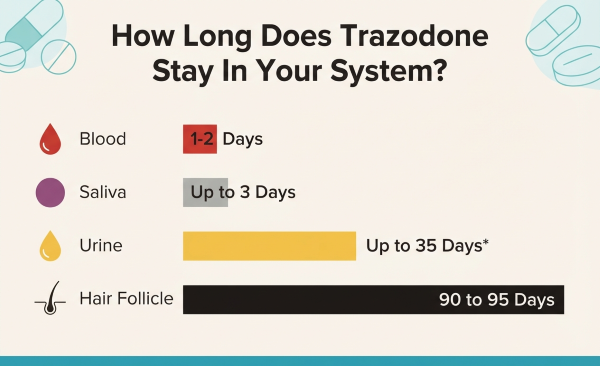
Trazodone is excreted from the body for around 1-3 days following a single dose. However, the elimination time may change. In the body for several hours, and a range of factors, including dosage, repeated usage, health status, individual metabolism and age, may shorten or extend the duration of time it remains in the body.
Generally, a person’s “how long does trazodone stay in your system for” period would be just a day or three days of taking one dose. Trazodone is an antidepressant and has also been widely used off-label for sleep-related issues. The ‘breakdown’ process is individual to each person and there is no ‘standard time’ for the process.
Key Takeaways
- Trazodone is normally largely excreted within a few days, which corresponds to 1-3 days after one dose.
- There has been some variation found in studies, and a half-life of approximately 5-13 hours has been reported.
- A longer time is required to be expectorated after repeated doses than from one dose only.
- Age, liver or kidney function, age or sex metabolism, dose, and/or other drug(s) may affect elimination.
- Keep in mind the druggiest or sleepiest feeling does not necessarily mean the max drug level.
- Only use Trazodone as directed and never adjust the dosage or discontinue use without advice from a healthcare provider.
How Long Does Trazodone Stay in Your System?
Trazodone leaves the body of most healthy people in about 1 to 3 days after they take one dose. The half-life is said to be between 5 and 13 hours, and the three-quarters deposit rate is 5.5 half-lives for the drug to be eliminated, according to Drugs.com.
In other words, slowly over time the amount of trazodone in the blood diminishes. For instance, only half of the amount of medication will be eliminated in the half-life if its half-life is a few hours; then ½ of that half will be eliminated in the next half-life, etc.
The amount of time a person spends metabolizing trazodone in the body will therefore vary somewhat, depending upon their metabolic rate and the speed of the process.
Based on the clinical pharmacokinetic study, different estimates of half-life are possible because it was determined that the initial half-life of trazodone was approximately 3 to 6 hours and the terminal half-life was approximately 5 to 9 hours.
How Does Trazodone Work?
Trazodone belongs to a class of drugs known as serotonin modulators and is most commonly used to treat depression. But it can also be prescribed by a healthcare professional for other diseases like insomnia, anxiety or for some other diseases.
The other is that trazodone can make you drowsy, hence the use at bedtime. Trazodone should not, however, be thought of as merely a time-tested sleep medicine. It’s an antidepressant that can be used at lower dosages for sleep.
The effect you experience may also be felt for a duration other than that of the medicine in your body. That is, the time it takes for trazodone to leave your body and the duration that you will feel sleepy are two different questions related to each other.
What Factors Affect How Long Trazodone Stays in Your Body?
There are a number of factors that may affect the rate of trazodone elimination.
Dosage
The bigger the dose, the more medicine that your body must deal with. But the precise elimination time is not dependent on the dosage.
Frequency of Use
If it is used regularly, repeated exposure to the drug can occur with trazodone. This can alter the timing of a single dose of the medication.
Age
Older people may metabolise medications in a different way than younger people. They can alter the removal of drugs because of changes in how the body uses them and/or how the organs function.
They are important for the function of the liver and kidneys.
The body breaks down trazodone over time, and health problems that affect how things are metabolized in the body may cause the time passed and level of trazodone in the body to differ.
Other Medications
Some medicines can interfere with the way trazodone works, or trazodone can interfere with the way the medicines work. Always inform your health care provider about any medical, prescription or over-the-counter drugs, supplements, or other substances you are using.
Alcohol and Other Drugs
Alcohol may intensify the somnolent and other effects of trazodone. MedlinePlus in particular advises consulting a healthcare specialist about alcohol utilize throughout trazodone therapy.
How Long Does Trazodone Take to Wear Off?
For some, trazodone will have a sedating effect the next morning. Even when the medicine is completely out of the system, you might not feel well, sleepy or alert.
Side effects to look out for when taking Benadryl include sleepiness, dizziness, and tiredness, per the NHS, which urges the person not to drive or operate machinery while feeling these effects.
That is why it is significant not to consider just how awake you feel as the only indication if you are wondering if trazodone is eliminated from your system or not.
Does Trazodone Show Up on a Drug Test?
Usually, drug testing would not come out positive for trazodone. Sometimes, though, these drugs (or metabolites derived from them) can be specifically ordered during laboratory tests and detected.
Other testing procedures may also interfere with drug use. If you are using trazodone when a drug test is scheduled, report the prescription to the medical professional or drug test provider.
Although you could make an educated guess at your clearance time, a professional’s advice on substance use, drug misuse, or safe trazodone use is more helpful, especially when it comes to matters of the heart.
Is Trazodone Addictive?
Trazodone is not typically an addictive drug like drugs that tend to cause a strong physical or psychological dependency. But that doesn’t imply that it can be taken in a different way than prescribed.
Discontinuation of trazodone may result in withdrawal reactions, such as dizziness, nausea, headache, confusion, anxiety, agitation, sleep disturbances, and peculiar tiredness or fatigue. However, MedlinePlus advises that people check with their healthcare providers before discontinuing treatment.
If you are using more trazodone than prescribed, mixing it with other substances or using it primarily to alter how you feel, feel free to speak to a qualified professional.
When Should You Seek Help?
An overdose of trazodone can be harmful. An overdose can manifest with such symptoms as serious drowsiness, dizziness, breathing difficulty, irregular heartbeat, low blood pressure, convulsions, unconsciousness, and others.
Call your healthcare provider if you think you or someone in your family may have overdosed on trazodone.
In addition, it is essential to discuss your trazodone use with a healthcare provider if you are unable to control your intake, are combining it with alcohol or other medications, or have unwanted changes in mood or behavior.
Get Professional Support When Medication Use Becomes Difficult
But if you are worried about trazodone use in relation to substance abuse, medication misuse, sleep disturbances, or anxiety, depression or another mental health issue you don’t have to go through it alone. Solutions Healthcare can support you in your search to find suitable treatment and support to enable you to enjoy a life of liberty from your addiction.
Call Solutions Healthcare today to learn about behavioral health and recovery services and to discuss your concerns. Taking steps early can make the next step successful.
How Long Does Trazodone Stay in Your System Compared With Its Effects?
There are three concepts to consider when talking about Trazodone: onset of action, duration of effect, and presence of traces in the body.
These are not the same schedules.
Small amounts of the drug are still excreted, so a person may, out of the blue, wake up feeling less “amped up.” At the other extreme, others may feel tired the day after the dosage, not long after the dose was given, when the drug level is actually quite low.
This is because it isn’t possible to come up with any type of ranking system to quickly gauge how long trazodone would last given how often you feel sleepy.
It’s all about your dose, health, metabolism, other medicines, and usage.
Final Thoughts
Now, what is the half-life of Trazodone? After a single dose, trazodone quickly passes from the body, typically in less than 3 days, but this may vary depending on the person. Even though its half-life is in hours, multiple half-lives will be required for most of the drug to be excreted from the body.
More important than that, however, is that it is not always the correct question whether the drug is disappearing quickly or not. Discuss side effects, drug interactions, sleep, addiction, and any other concerns you may have regarding taking trazodone with a health care provider. Solutions Healthcare may be able to offer help to you if you have concerns about mental health as well as substance use and abuse, and may be able to help you sort out a suitable course of action.
Frequently Asked Questions
How long does trazodone take to wear off?
Trazodone’s noticeable sedating effects may wear off within several hours, but some people experience next-day sleepiness or dizziness. The exact duration varies with dose, individual metabolism, other medications, and personal sensitivity to the drug.
What is the biggest side effect of trazodone?
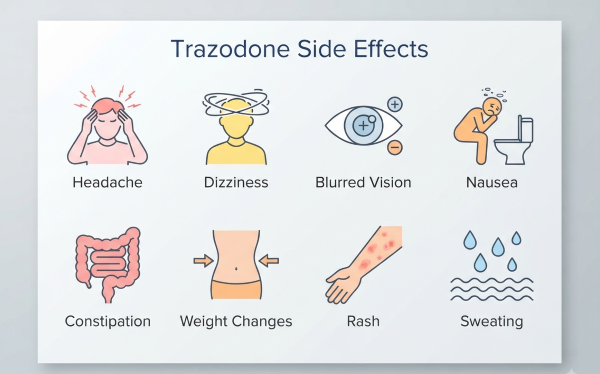
Sleepiness, dizziness, and tiredness are among trazodone’s common side effects. Some people may also experience nausea, headache, constipation, or dry mouth. Serious reactions are uncommon but require prompt medical attention when they occur.
How many hours is trazodone effective for?
There is no single number of effective hours that applies to everyone. Trazodone’s effects depend on the dose, formulation, individual response, and reason for treatment. Sedation may continue into the next morning for some people.
How long will I sleep with 50 mg of trazodone?
There is no guaranteed number of hours of sleep from a 50 mg dose. Trazodone affects people differently, and sleep duration depends on individual factors. Only take the amount prescribed by your healthcare professional.
Is trazodone 50 mg a strong sleeping pill?
Trazodone 50 mg is not considered a conventional sleeping pill. It is an antidepressant that is sometimes prescribed at lower doses to help with insomnia. Whether it feels strong depends on the person’s sensitivity and other factors.
Is 100mg of trazodone a lot for sleep?
A 100 mg dose may be prescribed for some people, but whether it is appropriate depends on the individual’s treatment plan. Do not increase trazodone for sleep without speaking with the prescribing healthcare professional first.
Can trazodone make you feel tired the next day?
Yes. Trazodone can cause sleepiness or tiredness, and some people may feel these effects the following morning. Avoid driving or operating machinery if you remain sleepy, dizzy, or less alert after taking it.
Can you stop trazodone suddenly?
You should not stop trazodone suddenly without medical advice, particularly if you have been taking it regularly. Stopping abruptly may cause symptoms such as dizziness, nausea, anxiety, agitation, headache, or sleep problems.
Disclaimer
This article is intended for general educational purposes and does not replace medical advice, diagnosis, or treatment from a qualified healthcare professional. Individual medication effects and elimination times vary. Do not change your trazodone dose, stop treatment, or combine it with alcohol or other substances without discussing it with your healthcare provider. If you suspect an overdose or experience severe symptoms, seek emergency medical care immediately.