
Perhaps you’re seeking to learn more about a parent, a partner, or your own behavior and find yourself returning to the same question: What is the root cause of narcissistic personality disorder? It’s a legitimate question and the truth is far more complex than some people realize.
Narcissistic personality disorder is a combination of genes, brain chemicals, and childhood experiences, such as emotional neglect, too much praise or criticism, or inconsistent parenting. There is no one cause to it. The difference in diagnosis rate between men and women may be due to different presentations of symptoms and not necessarily to differences between the two in prevalence.
While the knowledge of the roots does not excuse the behavior, understanding that root can help families to not blame themselves for something that is far more complicated than one bad parenting decision or one difficult year.
So, let’s examine the causes of NPD, the differences in NPD in men and women, and what a realistic perspective truly means.
What is Narcissistic Personality Disorder
Narcissistic personality disorder has no single cause; instead, researchers point to a mix of genetic vulnerability, temperament, brain chemistry, and early environment working together. Twin studies suggest narcissistic traits are meaningfully heritable, though estimates vary widely across research.
The Mayo Clinic notes that the exact cause of narcissistic personality disorder isn’t known, though genetics, environment, and neurobiology, the connection between the brain and behavior and thinking, may all play a contributing role.
Fact: Twin studies estimate narcissistic traits are anywhere from 25% to nearly 80% heritable.
The Root Cause of Narcissism: Nature and Nurture Combined
There isn’t one single root cause of narcissism, but early parenting patterns, particularly extremes of either overindulgence or neglect, appear consistently across research. Both excessive praise without accountability and cold, dismissive parenting have been linked to its development.
Contributing factors researchers commonly cite include:
- A family history of narcissistic personality disorder or other personality disorders
- Childhood emotional abuse, neglect, or unpredictable caregiving
- Overindulgent parenting that inflates a child’s sense of specialness without boundaries
- Early attachment disruptions that interfere with developing a stable sense of self
- Cultural or social environments that heavily reward status, appearance, or achievement
Researchers studying narcissism note that it isn’t the result of a single gene or too much time online. Instead, the roots lie in a genuine mix of biology, brain chemistry, and lived experience.
100% Confidential Support is Available 24/7
No matter what you’re going through, you’re not alone. Our dedicated team is here to provide a safe, judgment-free space where you can talk openly and honestly. Whether you need emotional support, resources, or just someone to listen.
We’re here for you—completely confidential and always respectful of your privacy. Call us today!
Causes of Narcissistic Personality Disorder in Men
In men, narcissistic personality disorder is diagnosed more often and tends to align more closely with grandiose traits, including dominance, aggression, and an inflated sense of achievement. Large studies consistently show men scoring higher on standard narcissism measures across age groups and decades.
Researchers link this pattern partly to social conditioning. Traits like assertiveness, ambition, and confidence are often rewarded more openly in men, which can reinforce grandiose narcissistic patterns that already have some biological footing.
A large analysis compiling three decades of narcissism research found that men consistently scored higher than women across multiple generations, regardless of age, a pattern that has remained stable over time.
If you’re trying to understand a loved one’s narcissistic traits, Solutions Healthcare can help
Contact Solutions Healthcare
Battling with Drug and Alcohol Addition? Remember, you are not alone and we are here to help you!
Causes of Narcissistic Personality Disorder in Women
In women, narcissistic personality disorder often presents as vulnerable narcissism, a quieter pattern involving insecurity, a deep need for approval, and sensitivity to criticism hidden behind an image of confidence. This form is frequently underdiagnosed or mistaken for other conditions entirely.
Presentation | More Common In | Key Features |
Grandiose narcissism | Men | Dominance, aggression, visible confidence |
Vulnerable narcissism | Women | Hidden insecurity, need for approval, sensitivity to criticism |
Researchers studying female narcissism note that the same underlying traits exist in men and women, but women tend to express narcissism in a more subtle and hidden way, which contributes to underdiagnosis.
Because current diagnostic criteria were built around grandiose traits, women with vulnerable narcissism are sometimes misdiagnosed with borderline personality disorder instead, delaying appropriate care.
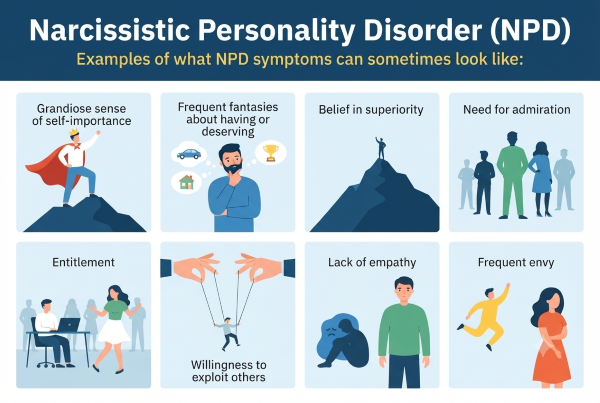
The 5 Main Habits of a Narcissist
While there’s no official clinical list, five habits show up consistently enough in research and clinical practice to serve as a useful shorthand for recognizing the pattern. These habits tend to appear together rather than in isolation.
- A constant need for admiration, attention, or validation from others
- A genuine lack of empathy for other people’s feelings or experiences
- A pattern of exploiting relationships to serve personal goals
- An inflated sense of self-importance paired with fragile self-esteem underneath
- Difficulty accepting criticism, often responding with anger, denial, or blame
Expert Advice: Avoid trying to point out these patterns directly during conflict; it rarely lands well.
How to Handle a Narcissistic Person
Handling a narcissistic person effectively usually means setting calm, consistent boundaries and limiting how much emotional reaction you offer, rather than trying to argue them into seeing your perspective. Direct confrontation tends to escalate things rather than resolve them.
- State boundaries clearly and calmly, without over-explaining your reasoning
- Keep emotionally charged conversations brief and factual
- Build a support system outside the relationship for perspective and grounding
- Recognize that change requires their genuine willingness, not just your patience
If narcissistic behavior in your family is affecting your wellbeing, Solutions Healthcare can help you navigate it
100% Confidential Support is Available 24/7
No matter what you’re going through, you’re not alone. Our dedicated team is here to provide a safe, judgment-free space where you can talk openly and honestly. Whether you need emotional support, resources, or just someone to listen.
We’re here for you—completely confidential and always respectful of your privacy. Call us today!
Can You Live a Normal Life With Narcissistic Personality Disorder
Yes, many people with narcissistic personality disorder can build a stable, functional life, especially with sustained therapy and genuine motivation to change. The outlook depends heavily on symptom severity, willingness to engage in treatment, and whether other conditions are also present.
Clinical researchers studying the course of NPD note that people who experience real achievements or maintain long-term, committed relationships often show less need for grandiosity, exploitation, or entitlement over time, particularly when a relationship offers genuine support.
Outcomes tend to be more difficult when NPD occurs alongside conditions like substance use disorder, depression, or antisocial personality traits, which is why an accurate, whole-picture evaluation matters so much before treatment begins.
When Professional Treatment Makes the Difference
Professional treatment makes the most difference when it addresses the full picture, not just narcissistic traits in isolation, especially when substance use or another mental health condition is also present. NPD itself has no FDA-approved medication, so therapy carries the primary treatment burden.
Approaches with growing evidence behind them include:
- Cognitive Behavioral Therapy to address distorted thinking patterns
- Schema therapy and psychodynamic approaches to work through early relational wounds
- Group therapy to build genuine empathy and interpersonal skill in a structured setting
- Family therapy to repair relationships strained by years of difficult dynamics
- Dual diagnosis treatment when substance use or another condition is also present

100% Confidential Support is Available 24/7
No matter what you’re going through, you’re not alone. Our dedicated team is here to provide a safe, judgment-free space where you can talk openly and honestly. Whether you need emotional support, resources, or just someone to listen.
We’re here for you—completely confidential and always respectful of your privacy. Call us today!
Narcissistic Personality Disorder Support at Solutions Healthcare
If narcissistic traits, whether your own or a loved one’s, have become tangled up with substance use or another mental health struggle, Solutions Healthcare offers evidence-based, dual-diagnosis care across Central Florida. We understand these patterns are rarely simple, and they’re rarely one person’s fault alone.
Our continuum of care includes Dual Diagnosis Treatment for co-occurring mental health and substance use concerns, flexible intensive outpatient and Outpatient Treatment options, and residential treatment for those who need more structured, immersive support. Our family therapy program helps loved ones rebuild communication and set healthier boundaries together.
Across our four Central Florida treatment centers, our clinical team is accredited by The Joint Commission and licensed through the state of Florida, with every treatment plan built around a genuine, individualized assessment.
Reach out through our contact page or call us directly at (386) 866-3600 to talk with someone who understands what your family is navigating.
FAQs
What causes narcissistic personality disorder?
Narcissistic personality disorder develops through a combination of genetic influences, brain development, and early life experiences. Factors such as inconsistent parenting, excessive praise, emotional neglect, or chronic criticism may increase risk, but no single cause has been proven responsible for the condition.
What causes narcissistic personality disorder in men?
Research suggests the same biological and developmental factors contribute to NPD in men as in women. Social expectations emphasizing dominance, achievement, and emotional suppression may reinforce grandiose narcissistic traits, though genetics and childhood experiences remain important underlying influences.
What causes narcissistic personality disorder in women?
Women with narcissistic personality disorder share many of the same underlying risk factors as men, including genetics and early experiences. Some may display more vulnerable narcissistic traits, characterized by insecurity and sensitivity to criticism, which can contribute to underrecognition or delayed diagnosis.
What is the root cause of narcissism?
There is no single root cause of narcissism. Research consistently points to a combination of inherited traits, neurobiological factors, and childhood environments involving either excessive admiration, emotional neglect, inconsistent parenting, or harsh criticism that together influence personality development over time.
What are the five main habits of a narcissist?
Common narcissistic behaviors include seeking constant admiration, showing limited empathy, exploiting relationships for personal benefit, maintaining an inflated yet fragile self-image, and reacting defensively to criticism. These patterns tend to persist across different situations and significantly affect interpersonal relationships.
How do I handle a narcissistic person?
Focus on maintaining calm, consistent boundaries rather than trying to change the person’s behavior. Keep communication respectful but firm, avoid emotional arguments, and prioritize your own wellbeing. Support from trusted friends or a mental health professional can also strengthen healthy coping strategies.
Can you live a normal life with narcissistic personality disorder?
Yes. Many people with narcissistic personality disorder develop healthier relationships and maintain stable, productive lives through long-term psychotherapy and genuine commitment to change. Outcomes vary depending on symptom severity, treatment participation, and the presence of co-occurring mental health conditions.
Is narcissistic personality disorder more common in men or women?
Narcissistic personality disorder is diagnosed more frequently in men than women. However, researchers believe differences in symptom presentation and diagnostic patterns may contribute to this gap, meaning the true prevalence across genders may be closer than previously thought.
Can narcissistic personality disorder be cured?
There is no cure for narcissistic personality disorder, but consistent psychotherapy can significantly reduce symptoms and improve emotional awareness, relationships, and daily functioning. Progress typically occurs gradually and depends largely on the individual’s willingness to actively participate in long-term treatment.
Does narcissistic personality disorder often occur with other conditions?
Yes. Narcissistic personality disorder commonly occurs alongside depression, anxiety, substance use disorders, and other personality disorders. Treating co-occurring conditions together often leads to better outcomes by addressing the full range of emotional, behavioral, and psychological challenges affecting the individual.
Is narcissism the same as narcissistic personality disorder?
No. Narcissism refers to personality traits that exist on a spectrum, including healthy confidence and occasional self-focus. Narcissistic personality disorder is a diagnosable mental health condition involving persistent patterns that significantly impair relationships, work, and everyday functioning over time.
Does insurance cover treatment for narcissistic personality disorder?
Many major insurance plans provide coverage for mental health treatment, including therapy for personality disorders. Coverage varies by provider and policy, so verifying your benefits beforehand can clarify available services, expected costs, and the treatment options covered under your specific plan.
References
- Mayo Clinic – Narcissistic Personality Disorder: Symptoms and Causes
- Cleveland Clinic – Narcissistic Personality Disorder: Symptoms & Treatment
- NIH/PMC – Female Narcissism: Assessment, Aetiology, and Behavioural Manifestations
- NIH/PMC – Clinician Perception of Pathological Narcissism in Females
- ScienceDaily – Men Tend to Be More Narcissistic Than Women, Study Finds
- Harvard Health – Narcissistic Personality Disorder: Symptoms, Diagnosis, and Treatments
- Mission Connection Healthcare – Causes of Narcissistic Personality Disorder: Risk Factors