
If you’ve been told to complete a drug and alcohol evaluation, the phrase itself probably sounds more intimidating than the appointment actually is. Here’s what it really involves: a 60- to 90-minute confidential conversation with a licensed behavioral health professional, plus a few standardized questionnaires. The evaluator’s job is to figure out whether your substance use is a problem, how serious it is if so, and what level of care fits, which sometimes means no further services at all.
Evaluations happen for lots of reasons. Courts order them after DUI or drug charges. Employers require them after failed screenings or workplace incidents. Doctors refer patients when substance use seems to be affecting their health. And plenty of people schedule one on their own because they’ve started to wonder about their drinking or drug use and want a professional answer instead of a 2 a.m. internet search.
Whatever brought you here, this guide walks through how evaluations work, what questions to expect, and what happens afterward.
Key Takeaways
- A drug and alcohol evaluation determines whether substance use is affecting your health, relationships, work, or legal standing and what level of care is appropriate.
- Licensed professionals combine a clinical interview with validated screening tools like the AUDIT and DAST.
- Evaluations can be court-ordered, employer-required, medically referred, or completely voluntary.
- Honest answers produce accurate recommendations. Minimizing your use usually leads to recommendations that don’t fit.
- “No treatment needed” is a possible outcome. So is catching a problem early, when it’s easiest to address.
What is a Substance Use Evaluation?
A substance use evaluation is a clinical assessment that determines whether someone meets the DSM-5 criteria for a substance use disorder and, if so, how severe it is. It looks at more than just how much you drink or use. Mental health, medical history, family history, work and housing situation, and legal circumstances all factor in because they all affect what kind of support would actually work.
Most evaluators pair the interview with one or more validated screening instruments: the AUDIT (Alcohol Use Disorders Identification Test), a 10-question screen developed by the World Health Organization; the DAST-10 (Drug Abuse Screening Test), 10 yes/no questions about drug use in the past year; CAGE, four quick questions about cutting down, criticism, guilt, and morning drinking; and ASSIST, a WHO tool that screens across multiple substance types at once.
These tools exist so the recommendation rests on scored, validated measures rather than one clinician’s gut feeling. The National Institute on Drug Abuse notes that thorough assessment improves treatment planning, largely because substance use disorders so often travel with anxiety, depression, or trauma, and a plan that misses the co-occurring condition tends to fail.
Common Reasons for Drug and Alcohol Evaluations
Court requirements
DUI charges, drug possession cases, and probation violations frequently come with a mandatory evaluation. In Florida, completing a substance abuse course and evaluation is typically part of the DUI process before license reinstatement. The court uses the evaluator’s findings to decide whether education or treatment should be part of the case resolution.
Workplace policies
Employers may require an evaluation after a failed drug screen, a workplace accident, or documented impairment concerns, usually as a condition of returning to work. Safety-sensitive industries regulated by the Department of Transportation have their own formal version of this process.
Medical referrals
Primary care doctors, psychiatrists, and ER physicians refer patients when lab results, injuries, or symptoms point toward substance use as a contributing factor.
Family concerns
Sometimes the evaluation happens because a spouse or parent finally said the quiet part out loud. An assessment turns a household argument into an objective answer.
Personal decision
No requirement, no referral. Just a growing suspicion that the drinking or the pills have crossed a line, and a preference for finding out now rather than later. People in this group tend to have the best outcomes, simply because they’re starting earliest.
Types of Drug and Alcohol Evaluations
The format shifts depending on who requested it and what they need from the results.
Evaluation Type | Purpose | Best For |
Court-ordered evaluation | Satisfies legal requirements; recommends education or treatment | DUI, probation, and drug-related cases |
Clinical evaluation | Diagnoses substance use disorders and treatment needs | People seeking answers voluntarily |
Employer evaluation | Assesses safety and return-to-work readiness | Employees after workplace incidents |
School evaluation | Determines educational interventions | College and university students |
Pre-treatment assessment | Builds the treatment plan before care begins | People entering rehab or counseling |
Different paperwork, same underlying goal: an accurate picture of your situation and the least restrictive level of care that will actually work.
Benefits of Getting Evaluated
Even when the result is “no disorder,” an evaluation buys you something: a documented professional finding, which matters for courts and employers, and a baseline for your own reference.
When there is a problem, the evaluation catches it at its current size instead of its future size. It identifies co-occurring mental health conditions so that both can be treated together rather than in sequence. And it replaces guesswork with a specific recommendation: counseling, IOP, and residential care are very different commitments, and matching the level to the need is what makes treatment stick.
Ready to Schedule?
Call Solutions Healthcare at (386) 866-3600 to set up a confidential drug and alcohol evaluation. Most appointments can be scheduled within a few days.
What to Expect from a Drug and Alcohol Evaluation
Plan on 60 to 90 minutes with a licensed counselor or behavioral health professional in a private setting. It’s a structured conversation, not an interrogation. The evaluator asks questions, listens, and scores the screening tools; you talk.
What information is collected?
Expect questions about current and past alcohol or drug use (what, how much, how often, for how long), medical history and current medications; mental health symptoms like anxiety, depression, or trauma history, family history of addiction or mental illness, work, school, and housing situation, legal history including any DUI or pending court matters, previous treatment and what happened, and your own goals and support system.
Honesty is the whole game here.
Evaluators hear minimized numbers all day and the screening tools are built to catch inconsistencies, but more to the point, understated answers produce recommendations for a smaller problem than the one you have. The National Institute on Alcohol Abuse and Alcoholism has found that screening and early intervention measurably reduce risky drinking, and that only works when the screen reflects reality.
Will drug testing be required?
Sometimes. Court-ordered and employer-required evaluations often include a urine drug screen or breath alcohol test. Voluntary clinical evaluations usually rely on the interview and questionnaires alone. Either way, the evaluator explains what’s happening before any testing, so nothing gets sprung on you.
Is the evaluation confidential?
Substance use assessment and treatment records get stronger privacy protection than ordinary medical records under federal law (42 CFR Part 2). One honest caveat: if a court, employer, or probation officer ordered your evaluation, you’ll typically sign a release so the evaluator can send results to that specific party. The release names exactly who receives what. Your information doesn’t go anywhere else.
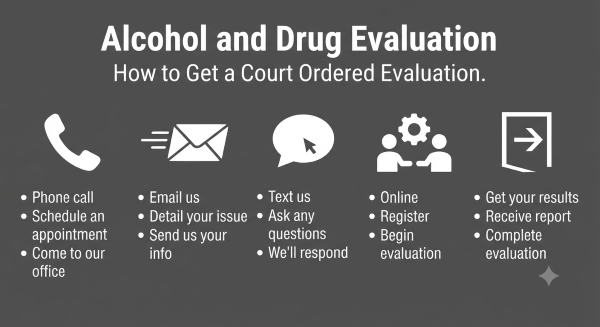
How do I get a Drug and Alcohol Evaluation?
Step 1: Contact a licensed provider.
Look for a licensed behavioral health clinic or addiction treatment center that performs full assessments. If your evaluation is for a court or employer, confirm before booking that the provider’s reports are accepted for that purpose. It’s one question and it saves you from paying for an evaluation twice.
Step 2: Schedule the appointment.
Most providers can see you within a few days. You’ll complete intake paperwork covering medical history, insurance, and the reason for the assessment.
Step 3: Bring your documents.
Court paperwork if applicable, photo ID, insurance card, a list of current medications, and any previous treatment records. The more the clinician can see, the less time gets spent reconstructing your history from memory.
Step 4: Do the interview.
Answer completely, even the uncomfortable questions. The evaluator has heard worse, and their job is to match you to care, not judging your record.
Step 5: Get your results.
At the end of the session or shortly after, you’ll receive a written recommendation. Evaluators generally use the ASAM Criteria, the standard framework for matching people to levels of addiction care, which is why recommendations come in recognizable tiers:
Evaluation Finding | Typical Recommendation | What It Means |
No substance use disorder | Education or no further services | Documentation for court or work; no treatment |
Mild substance use disorder | Weekly sessions; early intervention | |
Moderate substance use disorder | Several sessions per week while living at home | |
Severe substance use disorder | PHP or residential treatment, plus recovery planning | Structured daily care; detox first if needed |
Need a Confidential Assessment?
Whether it’s for court, work, school, or your own peace of mind, Solutions Healthcare provides drug and alcohol evaluations conducted by licensed behavioral health professionals. Call (386) 866-3600 and we’ll walk you through scheduling and what to bring.

What do I do after a Drug and Alcohol Evaluation?
That depends entirely on the results.
If no disorder was identified, you’re done, aside from delivering documentation to whoever required the evaluation. Some people in this group still choose a few counseling sessions to address the stress or habits that triggered the concern. Reasonable move.
If treatment is recommended, start soon. Not because of a deadline (though courts do set them), but because the gap between “evaluation” and “first appointment” is where momentum dies. The recommendation might include individual or family therapy, outpatient treatment, IOP, PHP, residential care, medication-assisted treatment, or peer support groups, whichever combination matches your assessment.
And keep people around you in the loop. Recovery holds up better with a spouse, friend, counselor, or group who knows what you’re working on. That’s true even for people whose only recommendation was an education class.
Conclusion
A drug and alcohol evaluation is 90 minutes that replaces months of wondering. A licensed professional reviews your substance use, health, and circumstances and hands you a specific answer: here’s where things stand, and here’s what would help. For court and employment cases, it satisfies the requirement; for everyone, it turns an ambiguous worry into a plan.
If you’ve been putting yours off, the appointment is easier than the anticipation. Call Solutions Healthcare at (386) 866-3600 to schedule a confidential drug and alcohol evaluation.
Frequently Asked Questions
What questions do they ask during a drug and alcohol evaluation?
During a drug and alcohol evaluation, the counselor asks about your current and past alcohol or drug use, medical history, mental health, family history, legal concerns, employment, relationships, and previous treatment. They may also discuss your recovery goals and daily responsibilities. These questions help determine whether substance use is affecting your life and what level of care, if any, is appropriate.
How long is a drug and alcohol evaluation?
Most drug and alcohol evaluation appointments take 60 to 90 minutes, although the exact length depends on the complexity of your history and the reason for the assessment. Court-ordered or employer-required evaluations may include additional documentation or drug testing, which can extend the appointment.
What not to say in an alcohol evaluation?
The most important advice is not to provide false or misleading information. Avoid minimizing your substance use, exaggerating your symptoms, or giving inconsistent answers. Licensed clinicians are trained to conduct objective assessments, and honest responses help ensure you receive accurate recommendations that support your health and well-being.
How do I prepare for a drug and alcohol evaluation?
To prepare for a drug and alcohol evaluation, bring a valid photo ID, insurance information (if applicable), court or employer paperwork, a list of current medications, and any previous treatment records. Before the appointment, think about your substance use history, mental health concerns, and recovery goals so you can answer questions openly and accurately.
What happens during a drug and alcohol evaluation?
A drug and alcohol evaluation typically includes a confidential interview, standardized screening questionnaires, and a review of your medical, psychological, social, and substance use history. Depending on the purpose of the assessment, the evaluator may also request a drug or alcohol screening. At the end of the evaluation, you’ll receive recommendations based on your individual needs.
What not to say during a psych evaluation?
Just like a substance use assessment, honesty is essential during a psychological evaluation. Avoid guessing, exaggerating symptoms, withholding important information, or answering based on what you think the evaluator wants to hear. Clear and truthful responses help clinicians provide the most accurate diagnosis and treatment recommendations.
Medical Disclaimer
Medical Disclaimer: This blog is intended for educational and informational purposes only and should not be considered medical, psychological, or legal advice. Reading this content does not establish a provider-patient relationship with Solutions Healthcare. Every individual has unique healthcare needs, and recommendations may vary based on personal circumstances. If you are concerned about substance use, mental health, or addiction, consult a licensed healthcare professional or contact Solutions Healthcare for a confidential assessment.
References
- AddictionHelp.com. Drug and Alcohol Evaluations. (Primary content reference provided.)
https://www.addictionhelp.com/drugs/evaluation/ - National Institute on Drug Abuse (NIDA). Principles of Drug Addiction Treatment: A Research-Based Guide.https://nida.nih.gov
- National Institute on Alcohol Abuse and Alcoholism (NIAAA). Alcohol Screening and Brief Intervention for Youth and Adults.
https://www.niaaa.nih.gov