
Key Takeaways
- Grey Area Drinking sits between casual drinking and alcohol dependence
- You don’t need to hit “rock bottom” to question your relationship with alcohol
- Emotional reliance on alcohol matters more than how much you drink
- Pandemic-era habits increased risky drinking patterns
- Support and treatment options exist long before addiction becomes severe
“Grey Area Drinking: Are You an Alcoholic?” is a question that is picking up more and more inquiries when people quietly start making a change in their drinking habits which are more of a social problem rather than a worrying one. Grey Area Drinking does not necessarily appear like addiction. You can continue at work, have the relationships and the duties yet you drink more frequently than you want. This manual separates or divides it into a simple and truthful format without labels or critique to form your own opinion on what is really going on.
Grey Area Drinking has been residing somewhere in the discomfort zone: neither at the bottom, nor completely okay. It is so slight that it can hardly be felt until the repercussions start to accumulate.
Grey Area Drinking
Grey Area Drinking (often misspelled as grey area drinking) is a trend according to which the alcohol is beginning to cause issues, mental, emotional, or physical, but it does not fit the classical definition of alcoholism.
People in this space often:
- Consume alcohol to get rid of stress or emotional problems.
- Have established regulations regarding alcohol intake but are unable to stick to them.
- Are not comfortable with their drinking consumption rate yet can over-consume alcohol without the notice of others.
The condition of Grey Area Drinking is prevalent amongst the high-functioning adults, professional and parents. The lack of dramatic impacts does not imply that alcohol is not slowly gaining power.
Symptoms of Grey Area Drinking
Grey Area Drinking symptoms are usually insidious. You may notice:
- Reminisces about alcohol consumption in the morning.
- When they cannot consume alcohol, they become restless or irritable.
- Rewarding with alcohol or alcohol as the main means of relieving stress.
- Post-drinking guilt, shame or anxiety.
Such symptoms do not require daily consumption and binge drinking. It is the aspect of the mind that alcohol takes up that is the most important and its capacity to dominate your decision-making.
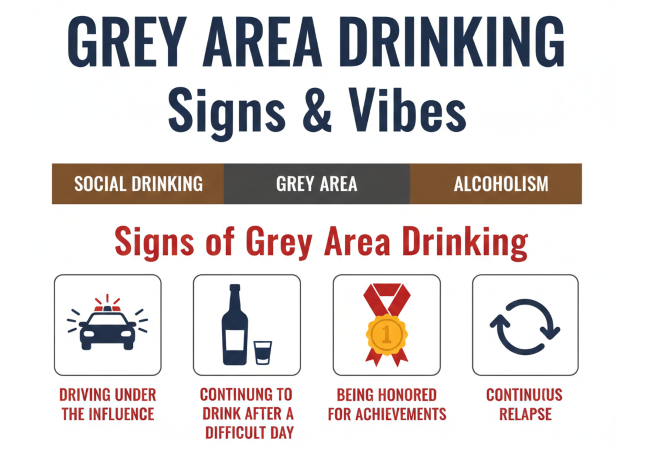
Signs of Grey Area Drinking
Although the symptoms tend to be internal, the hint of Grey Area Drinking can be noticed in everyday life:
- Consuming alcohol more than intended even sometimes.
- Enhancing reasons to drink (stress, celebrations, bad days)
- The requirement of alcohol in order to calm down or fall asleep.
- Defended or embarrassed by the challenge of drinking habits.
The confusion is the ability of the Grey Area Drinking to see that life might not have changed in a way that prompts one to view it as a success. Yet, when the internal discomfort takes place, it is a clear indication that there is something to be taken care of.
Pandemic and Grey Area Drinking Lead to Alcoholism
The pandemic altered the reasons and methods of consumption of lots of people. Social drinking and the need to cope with the situation were crossed due to isolation and uncertainty and worsened by protracted stress.
To others, Grey Area Drinking in the time of the pandemic became normal:
- The habit of drinking became acceptable.
- Time and quantitative boundaries disappeared.
- Alcohol was a regular mood stabilizer.
Unmitigated, the level of Grey Area Drinking may gradually gather to become alcohol dependence, particularly in the presence of persistent stressors and an absence of healthy coping mechanisms.
Alcohol and COVID
During COVID, alcohol consumption rose dramatically, especially among adults who had to cope with work-at-home and family pressures coupled with emotional burnout. Though alcohol might have been a temporary relief, it usually led to restlessness, insomnia and mood swings.
Frequent consumption of alcohol under stress conditions also trains the brain to respond to stress by using alcohol rather than adapting to cope with stress. This tendency over time solidifies the fact of the existence of the phenomenon of Grey Area Drinking and complicates the process of quitting it.
Drinking Alcohol Before COVID Vaccine
Medical experts recommended alcohol abstinence prior to vaccination, as alcohol has the effect of undermining immune response and accelerating dehydration. In the case of people in the Grey Area Drinking patterns, this advice pointed at the difficulty in stopping drinking, even temporarily, when people feel the need to drink.
A painful warning indication is often a struggle to quit drinking due to health considerations.
Can You Drink After the COVID Vaccine?
Alcohol consumption after vaccination is often regarded to be harmless to the majority of individuals; however, using alcohol to cope with the side effects of vaccines or to help deal with some anxiety may contribute to bad habits.
To those who are doubtful about the issue of Grey Area Drinking, such instances usually provide the picture. When alcohol becomes a necessity, but not an option, it might be necessary to dig deeper.
Effects of Grey Drinking
The consequences of the so-called Grey Area Drinking usually build up without commotion:
- Equivalent nervous tension and bad mood.
- Poor sleep quality
- Loss of interest and concentration.
- Strained relationships
- There are insidious health developments over time.
These effects hardly ever manifest themselves at once, and that is why it is easy to reject them. Combined with one another, they are indicators that there might be more to pay than to get on alcohol.
How to Know if You Have a Drinking Problem
The definition of “drinking problem” is not merely found in the quantity of consumption. Ask yourself:
- Is it to get away or get through with drinking?
- Have I attempted to curtail it and made it hard?
- Does alcohol have any impact on my mood or confidence or self-esteem?
- Am I happy that alcohol is available?
In case the alcohol has got a part to play in emotional regulation, decision-making, or identity, it is worth considering it, no matter how functional life can be.
Alcohol Addiction Treatment
It is not just the severe cases that can be treated as addicts. Timely intervention on the issue of Grey Area Drinking can make your drinking situations less addictive and redefine a healthier relationship with alcohol.
Treatment possibilities within Solutions Healthcare could be:
- Individual counseling
- Evidence-based behavioral therapy.
- Strategic and ambulatory programs.
- Anxiety or depression Support.
To ask for help is never a weak act, and it is a major strength to take initiative and be empowered.
100% Confidential Support is Available 24/7
No matter what you’re going through, you’re not alone. Our dedicated team is here to provide a safe, judgment-free space where you can talk openly and honestly. Whether you need emotional support, resources, or just someone to listen.
We’re here for you—completely confidential and always respectful of your privacy. Call us today!

Take the Next Step
If you recognize yourself in this discussion, believe that the knowledge is the start of transformation. You just do not have to wait for things to deteriorate to find help.
Bring up the issue today and confidentially discuss the possibilities of treatment with a caring professional, and that is how Call Solutions Healthcare will find ways to meet you at your level. The sooner the better and then before it is too late to reverse the progress of the Grey Area Drinking.
Disclaimer
This content is for informational and educational purposes only and is not intended to replace professional medical, psychological, or therapeutic advice. If you are concerned about your alcohol use or mental health, please consult a qualified healthcare professional.
Frequently Asked Questions
What is a grey area drinker?
A grey area drinker is someone whose alcohol use causes concern or discomfort but doesn’t meet the criteria for alcohol addiction. They may function well day-to-day yet feel mentally or emotionally reliant on alcohol.
Is grey drinking a form of alcohol abuse?
Grey drinking may not meet clinical definitions of alcohol abuse, but it can still be harmful. The risk lies in emotional dependence, habit formation, and the gradual escalation that often follows without intervention.
What qualifies someone as an alcoholic?
Alcoholism is diagnosed based on patterns such as loss of control, cravings, continued use despite harm, and withdrawal symptoms. It’s about behavior and impact—not just how often or how much someone drinks.
What are the 10 signs of being an alcoholic?
Common signs include cravings, tolerance, withdrawal symptoms, drinking more than intended, failed attempts to quit, neglecting responsibilities, secrecy, mood changes, prioritizing alcohol, and continuing despite negative consequences.
What are 5 signs that indicate a person has an addiction?
Five common signs include loss of control, emotional reliance, continued use despite harm, withdrawal symptoms, and prioritizing substance use over relationships or responsibilities.
What are the 4 types of alcohol drinkers?
Alcohol drinkers are often categorized as social drinkers, binge drinkers, heavy drinkers, and dependent drinkers. Grey Area Drinking often falls between social and dependent drinking patterns.