
In This Blog
- Knowledge about the Variables of the Length of Program
- Short-term Windows of Stabilization and Detoxification
- Standard thirty-day residential support programmes
- Long-term Sixty and Ninety-Day Extended Care
- Factors that influence the time of professional help
- Transitioning to Outpatient and Aftercare Services
The length of time taken to obtain professional assistance in alcohol use is one of the main factors that should be decided upon by those who are willing to embark on the wellness path.
Neither a standardized measure nor a fixed time span, length of a program is a dynamic measure, based on the needs, history and objectives of the person.
Such commitment to a time may be regarded as an investment in future well-being and social stability of an individual.
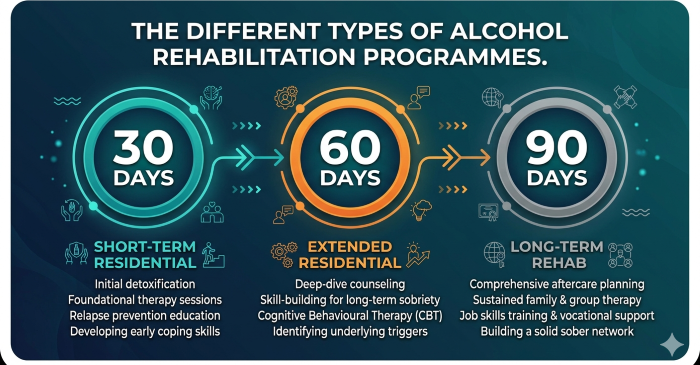
Durations can be either thirty, sixty or ninety days, but more specialized programs can take a lot longer, based on the severity of the case.
Lastly, the goal of any program time frame is to offer enough time for the brain and body to stabilize, and help people to develop the required coping skills.
The research has shown that the more the assistance services are engaged, the better the outcome in the long-term.
Expert Advice: Professional assessments determine the ideal program length based on an individual’s unique needs.
How Long Is the Detox Phase in Alcohol Rehab?
The stabilization period that focuses on the abstinence of substances in the body safely is the first step in any alcohol related program.
This stage has an average time span of three to seven days depending on the severity of use and physical fitness of the individual. This is a very important initial process which renders if the person is stable enough to participate in a behavioral aspect of recovery.
- Medical Monitoring: Interprofessional teams will provide medical monitoring 24 hours in order to safely manage the withdrawal symptoms.
- Nutritional Support: This is the time to deal with deficiencies arising as a result of alcohol consumption.
- Preparation: This is done as the foregoing of more stringent therapeutic interventions.
What Happens in a 30-Day Alcohol Rehab Program?
Those who desire to have an arranged residential help start with the thirty-day program. It gives the body sufficient time to stabilize and the individual to start the main task of behavioral therapy.
This time frame is usually perfect to those who have a fairly recent history of use or those who have major personal or professional obligations to resume.
During the four weeks, the participants would be practicing their trigger recognition and learning initial relapse prevention skills.
The organized setting allows creating a new routine without substance influence. It is a complete guide to tools to have a healthier lifestyle.
FACT: Most standard professional recovery programs last between thirty and ninety days.
What Does a 60-Day Alcohol Rehab Program Look Like?
Sixty-day programs will give a more intermediate solution to individuals who require more than a month to stabilize.
This time will enable greater discovery of the root causes of substance use and practicing more with new coping skills.
It offers a means of putting these new skills into test within a semi-professional setting, prior to a full-scale reentry into normal life.
- Enhanced Therapy: More time is dedicated to individual and group sessions to process past experiences.
- Family Involvement: Sixty-day windows often allow for more comprehensive family education and healing.
- Skill Mastery: Participants have more time to internalize and habituate healthy behavioral responses.
Why Do Some People Need a 90-Day Alcohol Rehab Program?
Those who have consistently had problems with use or have mental conditions are often suggested for the ninety-day program. Studies have continuously shown that at least ninety days of participation contribute greatly to the chances of long-term well-being. This time enables the rewarding mechanism of the brain to have a longer period to repair and adjust to the non-alcoholic life.
That is the time to learn how to live a sober life. The participants go through the levels of care and grow to be more autonomous but never lose professional help. It has been said to be the silver standard towards the creation of a solid foundation towards sustainable recovery.
What Decides How Long Your Alcohol Rehab Should Be?
There are a number of variables as to why one might spend thirty days, and the other one has to spend ninety. Professional teams take into account the whole person to make evidence-based recommendations for the duration of the stay.
- Severity of Use: The more severe or extended use may require more time of professional supervision.
- Physical Health: Comorbid physical health issues can increase the stabilization and follow-up time.
- Support System: Patients lacking adequate support at home might be longer beneficiaries of a residential setting.
- History of Relapse: The individuals who have experienced problems in holding on to their roles in the past are also likely to require more intensive, long term help.
Not sure how long alcohol rehab should be for you? Call Solutions Healthcare and we’ll help you figure it out.
What Therapies are Used During Alcohol Rehab?
The essence of the program is behavioral therapy, no matter how long the stay is. These events will be geared towards making people understand the psychological reasons for them consuming alcohol. Common interventions include Cognitive Behavioral Therapy (CBT) that focuses on a change in use-related thoughts.
These treatments require time during which the person must have the practice to quit. The longer the stay, the more the sessions and more comprehensive use of these tools in different simulated and real-world situations. This mastery is the one that leads to advancement of the sense of self-efficacy and autonomy.
What Happens After You Finish Alcohol Rehab?
When a residential program is over, the recovery process continues. Continuity care is the transfer of a high level of intensity to a low level of the same, e.g., residential to an intensive outpatient program. This will be a step-down plan which will leave the person to be assisted and reintegrated back into the community.
- Outpatient Transition: The momentum gained during a residential stay is continued through weekly therapy.
- Peer Support: Continuous group work provides support with respect to accountability and experience.
- Long-Term Monitoring: Check-ins with professionals regularly help to detect and deal with initial signs of struggle.
How Do Work and Family Affect Your Alcohol Rehab Timeline?
There are also practical considerations such as work, school and family that contribute to the duration that an individual may devote to a residential program.
Due to these roles, professional services connect with people in order to create a balance that is effective but at the same time is capable of supporting them.
The rest may choose to have a less residential stay, after which they will have a more intensive outpatient plan so that they can accommodate their day-to-day lives.
The navigation through these logistics involves planning with a professional team. The reason is to come up with a strategy so that the individual would be in a position to stick with it.
The program must be followed up to the last as per the recommended target because the outcomes will not be achieved otherwise.
How Do Mental Health Issues Affect the Length of Alcohol Rehab?
Constant struggling with the mental health issue (anxiety or depression) can also make the recovery period of individuals prolonged. This is because the two conditions are to be solved simultaneously so as to have a stable outcome. In situations where a single condition is solved, the risks of the other condition arising increase.
Developed professional programs with dual diagnoses provide specialized care where both the behavioral health and substance use services are integrated.
Compared to the use of either of these two conditions, this combined approach is time-consuming in considering the complexities of the interaction between the two conditions.
Ready to find the right alcohol rehab timeline for your needs? Call Solutions Healthcare and let’s talk through your options.

Why is Aftercare Important After Alcohol Rehab?
Possibly the most important aspect of sustaining the gains achieved during a formal program is aftercare. It involves a long-term commitment, being open to a support system, and continuing to use the skills that were developed in the course of therapy. This can include alumni clubs, one-on-one counseling and frequently attending peer support meetings.
Studies have indicated that those who do not lose the involvement in aftercare for at least one year have very high probabilities of enduring wellbeing. It provides a safety net for the inevitability of the circumstances in our normal lives and reminds us of our long-term goals. Aftercare is transforming what has been learned in a program into a lifestyle.
How Do You Decide How Long to Stay in Alcohol Rehab?
The time to allocate on a program is a decision which should be reached after consulting a team of professional people. They provide objective consideration to enable them to decide on the duration of time that has the best opportunity to lead to a successful outcome. The benefits of having an excellent foundation are immeasurable yet it can feel daunting to invest time.
Each day in a supportive, organized setting is one step to recovery of life and health. By concentrating on establishing wellness, but not a quick fix, individuals are putting themselves in a position to lead a free and stable life in the future. Professional support services will be offered to enable people to navigate through the process of this journey at any duration.
Solutions Healthcare provides evidence based interventions and expert advice to individuals who are in recovery plans. We are a group of passionate people who want to provide the means and systematic conditions to make people attain the stability and lay the groundwork for long-term wellness through the routes of individual care.
Medical Disclaimer: This article is for informational purposes only and is not a substitute for professional medical advice.
Key Takeaways
- The program length is personalised and lasts between thirty and ninety days
- The initial stage is stabilization, which takes three to seven days.
- The more extended ones (ninety days) are likely to be associated with the more long-term results.
- The recommended period is influenced by aspects such as the severity of use, the state of health as well.
- Continuity of care and aftercare is critical in continuing progress following a program.
FAQs
How long does alcohol stabilization typically last?
The stabilization phase, often referred to as detoxification, generally lasts between three and seven days. This timeframe allows for the safe management of withdrawal symptoms under professional oversight, ensuring the individual is ready for the therapeutic work that follows in a residential or outpatient program.
Why is a ninety-day program often recommended?
A ninety-day program is recommended because it allows more time for the brain to heal and for the individual to master new behavioral skills. Research shows that ninety days of engagement is a critical threshold for improving long-term success rates and building a sustainable foundation.
Can I attend a shorter program?
Yes, thirty-day programs are common and effective for many individuals, especially those with mild symptoms or strong home support. However, the duration should be based on a professional assessment to ensure that a shorter stay provides enough time for stabilization and early therapy.
Does insurance cover long-term recovery programs?
Many insurance plans provide coverage for various durations of professional support, including thirty, sixty, and ninety-day programs. It is important to verify your specific benefits with your provider or the recovery center to understand what portions of the stay are covered under your plan.
What happens after the program ends?
After a residential program ends, individuals typically transition to a “step-down” service like an intensive outpatient program or individual counseling. This aftercare phase is crucial for maintaining accountability and continuing to apply recovery tools while navigating the responsibilities and triggers of daily life.
References
- https://americanaddictioncenters.org/alcohol/rehab-treatment/how-long
- https://nida.nih.gov/publications/principles-drug-addiction-treatment-research-based-guide-third-edition/principles-effective-treatment
- https://www.cdc.gov/alcohol/fact-sheets/alcohol-use-disorder.html
- https://www.niaaa.nih.gov/publications/brochures-and-fact-sheets/treatment-alcohol-problems-finding-and-getting-help
- https://www.ncbi.nlm.nih.gov/books/NBK64815/
- https://www.psychiatry.org/patients-families/addiction-substance-use-disorders/what-is-substance-use-disorder