
There’s a special form of loneliness when one longs for companionship but is confident, on a fundamental level, that it will never be accepted. It is a quality that influences all the relationships, all jobs, all the social interactions and all opportunities which are possible to be known by others.
If this sounds familiar or if you know someone close to you in your life who seems to be like this, you may be dealing with a person with avoidant personality disorder.
This guide explores what avoidant personality disorder is, how it’s tested and diagnosed, what DSM-5-TR says, how it’s different from similar conditions, how it relates to substance use and abuse, and what treatment can look like when tackled with the proper integrated care.
What is Avoidant Personality Disorder?
Avoidant personality disorder is a personality disorder under the Cluster C category, and it is characterized by a pervasive pattern of social inhibition, feelings of inadequacy and hypersensitivity to negative evaluation, which must have begun by early adulthood and must be present in a broad range of situations.
Personality disorders are distinguished from other mental health conditions in that they involve enduring, pervasive patterns of inner experience and behavior that deviate significantly from cultural expectations, are inflexible across a broad range of situations, have an onset traceable to at least adolescence or early adulthood, are stable over time, and lead to distress or functional impairment.
Experts Advice: Distinguish AVPD from social anxiety carefully, since treatment approaches differ meaningfully between them.
What is an Avoidant Personality Disorder Test?
The Avoidant Personality Disorder Test is a structured clinical process, combining validated screening tools, a comprehensive clinical interview, a review of longitudinal history, and careful application of DSM-5-TR diagnostic criteria.
Understanding what this process actually involves helps demystify the diagnosis and reduces the anxiety that often prevents people with AVPD from seeking evaluation in the first place.
Self-Report Screening Tools
Validated self-report instruments can help identify probable AVPD before or during the formal clinical assessment process. These tools are not diagnostic on their own, but they provide structured, clinically useful information.
SCID-5-SPQ (Structured Clinical Interview for DSM-5 Screening Personality Questionnaire): The SCID-5-SPQ includes a seven-item AVPD module directly mapping to the seven DSM-5 diagnostic criteria. Items are answered yes or no and reflect past and present patterns across multiple life contexts.
SAPAS (Standardized Assessment of Personality Abbreviated Scale): An eight-item self-report tool that screens for the presence of any personality disorder and can flag likely AVPD presentations for further assessment.
Millon Clinical Multiaxial Inventory (MCMI-IV): A comprehensive self-report personality assessment used in clinical settings that generates profiles across multiple personality disorder dimensions, including AVPD.
PID-5 (Personality Inventory for DSM-5): The American Psychiatric Association’s dimensional personality assessment tool measures personality traits across the Alternative Model for Personality Disorders, offering a complementary picture of AVPD-relevant traits including negative affectivity, detachment, and inhibition.
100% Confidential Support is Available 24/7
No matter what you’re going through, you’re not alone. Our dedicated team is here to provide a safe, judgment-free space where you can talk openly and honestly. Whether you need emotional support, resources, or just someone to listen.
We’re here for you—completely confidential and always respectful of your privacy. Call us today!
The Seven DSM-5-TR Criteria for Avoidant Personality Disorder
Diagnosis of AVPD requires meeting at least four of the following seven criteria, with the pattern pervasive, stable, and causing significant distress or functional impairment.
- Criterion 1: Avoids occupational activities that involve significant interpersonal contact, because of fears of criticism, disapproval, or rejection.
- Criterion 2: Is unwilling to get involved with people unless certain of being liked.
- Criterion 3: Shows restraint within intimate relationships because of fear of being shamed or ridiculed.
- Criterion 4: Is preoccupied with being criticized or rejected in social situations.
- Criterion 5: Is inhibited in new interpersonal situations because of feelings of inadequacy.
- Criterion 6: Views self as socially inept, personally unappealing, or inferior to others.
- Criterion 7: Is unusually reluctant to take personal risks or engage in any new activities because they may prove embarrassing.
To qualify for a diagnosis, these criteria must reflect an enduring pattern present from at least early adulthood, visible across multiple life contexts, and not better explained by another mental health condition, substance use, or a medical condition.
Recognize these patterns in yourself or someone you love? Solutions Healthcare offers comprehensive AVPD assessment and treatment.
Contact Solutions Healthcare
Battling with Drug and Alcohol Addition? Remember, you are not alone and we are here to help you!
Avoidant Personality Disorder vs. Related Conditions
One of the most clinically important aspects of AVPD assessment is distinguishing it from related but distinct conditions. The Cleveland Clinic notes that researchers once thought AVPD was simply a severe form of social anxiety disorder, but studies show roughly two-thirds of people with AVPD do not meet diagnostic criteria for social anxiety disorder.
AVPD vs. Social Anxiety Disorder (SAD)
Feature | AVPD | Social Anxiety Disorder |
Core driver | Low self-esteem and pervasive sense of inadequacy | Anxiety and fear of being judged |
Scope | All contexts: work, relationships, daily life | Specific social or performance situations |
Onset | Traceable to adolescence; stable over decades | May begin at any age |
Personality | Ingrained, rigid pattern across domains | Anxiety disorder that may be more situational |
Self-image | Fundamentally flawed and inferior | Fears negative evaluation, but core self-image may be intact |
A person can have both AVPD and SAD simultaneously, and research confirms that those with both conditions typically have more severe symptoms than those with either alone.
AVPD vs. Schizoid Personality Disorder
Schizoid personality disorder also involves social withdrawal and emotional distance, but for a fundamentally different reason: schizoid individuals typically do not want or desire connection with others and feel genuinely indifferent to approval or rejection. People with AVPD want closeness intensely but avoid it out of fear. This distinction is clinically significant and directly informs the treatment approach.
AVPD vs. Dependent Personality Disorder
Both are Cluster C disorders involving anxiety and inadequacy, but dependent personality disorder is characterized by a submissive clinging to others and an intense fear of abandonment. AVPD is characterized by avoidance of others and a fear of rejection through engagement. The interpersonal direction of the distress is opposite.
AVPD vs. Introversion
Introversion is a normal personality trait, not a disorder. Introverts may prefer smaller social groups or time alone and find large social gatherings draining, but they do not experience the pervasive sense of inadequacy, chronic fear of rejection, and functional impairment that characterize AVPD. Shyness is situational and typically eases with familiarity. AVPD is pervasive, chronic, and does not ease with familiarity in the way that shyness does.
What Causes Avoidant Personality Disorder?
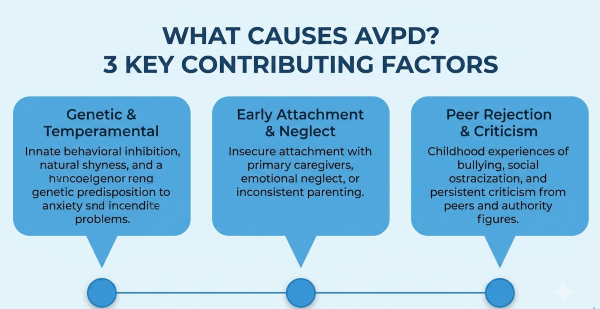
Like all personality disorders, AVPD develops through an interaction of biological, developmental, and environmental factors.
Genetic contribution: Research on AVPD cited by the Cleveland Clinic estimated that genetics account for approximately 64% of the likelihood of developing AVPD, making it one of the most heritable personality disorder presentations.
Temperament in infancy: Research has identified links between certain early temperament traits and AVPD development, including hypersensitivity, avoidance of novelty, excessive fear and distress, and rigid responses to environmental demands.
Attachment style: People with a fearful attachment style, characterized by a desire for closeness combined with distrust of others and fear of rejection, are at elevated risk for AVPD. Fearful attachment can develop when a distressed infant’s caregiver is dismissive or inconsistently available.
Early childhood environment: Experiences of criticism, rejection, humiliation, or being treated as fundamentally different or inferior during childhood are significant risk factors. These experiences can consolidate the core beliefs about the self as inadequate and inferior that are central to AVPD.
AVPD was formally included in the DSM in 1980 with the DSM-III. The disorder does not typically become diagnosable until after age 18, because personality continues to develop through adolescence, and what appears to be AVPD in a teenager may represent developmental patterns that resolve with time.
Using substances to cope with social fear takes a toll. Call Solutions Healthcare for integrated dual diagnosis care.
Who is Most Affected by Avoidant Personality Disorder?
AVPD typically begins in late adolescence or early adulthood and is not typically diagnosed before age 18. It affects men and women roughly equally, though some studies suggest slight variations in how it presents across genders.
The following conditions as more likely to co-occur with AVPD:
- Major depressive disorder
- Persistent depressive disorder (dysthymia)
- Social anxiety disorder
- Panic disorder
- Obsessive-compulsive disorder (OCD)
- Anorexia nervosa and binge eating disorder
Co-occurring personality disorders are also common, particularly Dependent Personality Disorder and other Cluster C presentations. The presence of co-occurring conditions significantly shapes the clinical picture and the most effective treatment approach.
100% Confidential Support is Available 24/7
No matter what you’re going through, you’re not alone. Our dedicated team is here to provide a safe, judgment-free space where you can talk openly and honestly. Whether you need emotional support, resources, or just someone to listen.
We’re here for you—completely confidential and always respectful of your privacy. Call us today!
Avoidant Personality Disorder Treatment
AVPD is treatable. While personality disorders are generally more treatment-resistant than Axis I conditions like depression or anxiety, evidence-based therapies produce meaningful improvements in functioning, quality of life, and symptom severity.
Cognitive Behavioral Therapy (CBT)
CBT is one of the most well-researched approaches for AVPD. It directly targets the core cognitive distortions driving avoidance: the belief that one is fundamentally inadequate, that rejection is inevitable, and that social exposure is inherently dangerous. CBT for AVPD uses gradual exposure to avoided situations, cognitive restructuring of negative self-beliefs, and behavioral experiments that challenge the accuracy of feared outcomes.
Schema-Focused Therapy
Schema therapy is particularly suited to personality disorder treatment because it works at the level of deeply held early maladaptive schemas, the core beliefs about the self and others that develop in childhood and drive the rigid patterns characteristic of personality disorders. For AVPD, the most central schemas typically involve defectiveness and shame, social isolation, and vulnerability to harm or illness. Schema therapy combines CBT techniques with experiential methods and an explicit focus on the therapeutic relationship as a vehicle for schema change.
Dialectical Behavior Therapy (DBT)
DBT builds skills in emotional regulation, distress tolerance, interpersonal effectiveness, and mindfulness. For AVPD, the emotional regulation and interpersonal effectiveness modules are particularly relevant, helping individuals develop the capacity to tolerate social discomfort, engage in relationships without fleeing when vulnerability appears, and manage the intense shame and anxiety that avoidance has historically protected them from feeling.
Acceptance and Commitment Therapy (ACT)
ACT helps individuals develop psychological flexibility, the ability to experience difficult thoughts and feelings, including the shame and anticipated rejection central to AVPD, without being controlled by them. ACT’s emphasis on living in alignment with personal values provides a motivational framework for moving toward avoided situations despite the discomfort they produce.
Psychodynamic Therapy
Longer-term psychodynamic approaches address the developmental roots of AVPD, exploring how early relational experiences created the core beliefs and defensive patterns that sustain avoidance in adulthood. Psychodynamic therapy can be particularly useful when AVPD is rooted in significant attachment disruptions or developmental trauma.
Group Therapy
Group therapy presents a particular opportunity and a particular challenge for people with AVPD. The challenge is obvious: group interaction is precisely what AVPD drives a person to avoid. The opportunity is that a well-facilitated therapeutic group provides a safe, structured context for practicing the interpersonal skills and tolerating the social vulnerability that AVPD has made impossible outside of treatment. Research supports the use of group formats in personality disorder treatment as a powerful vehicle for interpersonal learning.
Medication
There are no FDA-approved medications specifically for AVPD. However, medications targeting co-occurring anxiety and depression, including SSRIs and SNRIs, can reduce the symptom severity that makes the cognitive and behavioral work of therapy more difficult. Medication is typically used as an adjunct to therapy rather than a standalone intervention for AVPD.
FACT: Genetics account for roughly sixty-four percent of avoidant personality disorder’s likelihood.

Solutions Healthcare Can Help With AVPD
If you or someone you love is struggling with avoidant personality disorder, a co-occurring substance use disorder, or both, Solutions Healthcare in Central Florida provides comprehensive, evidence-based dual diagnosis treatment across four treatment centers including Orlando, DeLand, Palm Coast, and Melbourne.
SHC specializes in integrated treatment for individuals managing personality disorders alongside addiction, understanding that the psychological patterns driving avoidance and the patterns driving substance use are deeply intertwined and must be addressed together.
Recovery from AVPD is possible. The first step is an honest assessment of what is actually happening, and that starts with a conversation.
Call Solutions Healthcare at (386) 866-3600 or visit their contact page to speak with someone who understands.
100% Confidential Support is Available 24/7
No matter what you’re going through, you’re not alone. Our dedicated team is here to provide a safe, judgment-free space where you can talk openly and honestly. Whether you need emotional support, resources, or just someone to listen.
We’re here for you—completely confidential and always respectful of your privacy. Call us today!
FAQs
Q: What is an avoidant personality disorder test?
An avoidant personality disorder test is a professional assessment process rather than a single questionnaire. Mental health providers use screening tools, interviews, personal history, and DSM-5 criteria to determine whether someone has a persistent pattern of social avoidance, fear of rejection, and significant impairment.
Q: What are the seven DSM-5 criteria for avoidant personality disorder?
The DSM-5 criteria include avoiding activities due to criticism fears, reluctance to engage unless certain of acceptance, restraint in relationships, preoccupation with rejection, inhibition in new situations, feelings of inferiority, and reluctance to take risks because of potential embarrassment. Four criteria are required.
Q: How is avoidant personality disorder different from shyness?
Shyness is a personality trait that often improves with familiarity and usually doesn’t interfere significantly with daily functioning. Avoidant personality disorder involves chronic social withdrawal, persistent feelings of inadequacy, and an intense fear of rejection that significantly affects relationships, work, and many aspects of life.
Q: Can avoidant personality disorder be confused with social anxiety disorder?
Yes. Both conditions involve social discomfort and avoidance, but they are distinct disorders. Social anxiety focuses on fear in specific situations, while avoidant personality disorder involves a broader, deeply rooted sense of inadequacy and rejection that affects self-image and functioning across multiple areas of life.
Q: What causes avoidant personality disorder?
Avoidant personality disorder likely develops from a combination of genetic, biological, and environmental factors. Research suggests inherited vulnerability, sensitive temperament, insecure attachment patterns, and experiences of criticism, rejection, or humiliation during childhood may all contribute to the development of the disorder.
Q: Is there a connection between avoidant personality disorder and substance use?
Yes. Some individuals with avoidant personality disorder use alcohol or drugs to cope with anxiety, shame, or social discomfort. This can increase the risk of developing substance use disorders. Treating both conditions together generally produces better outcomes than addressing either condition alone.
Q: Can avoidant personality disorder be treated?
Yes. Although personality disorders often require long-term treatment, many people experience meaningful improvement through therapies such as cognitive behavioral therapy, schema therapy, dialectical behavior therapy, and group therapy. Treatment focuses on reducing avoidance, improving self-esteem, and building healthier relationships and coping skills.
Q: Who can diagnose avoidant personality disorder?
Avoidant personality disorder can be diagnosed by qualified mental health professionals, including psychiatrists, psychologists, and licensed therapists with appropriate training. Because symptoms overlap with other conditions, a thorough assessment is necessary to determine whether avoidant personality disorder or another condition better explains someone’s experiences.
Q: At what age can avoidant personality disorder be diagnosed?
Avoidant personality disorder is usually diagnosed after age eighteen because personality patterns continue developing throughout adolescence. Clinicians need evidence that symptoms are stable, long-standing, and present across different situations before making a diagnosis rather than attributing them to normal developmental challenges.
Q: How do screening tools for AVPD work?
Screening tools ask questions that correspond with the DSM-5 criteria for avoidant personality disorder. They help identify patterns suggesting that further evaluation may be beneficial. However, screening questionnaires cannot provide a diagnosis and should always be followed by a comprehensive professional assessment.
Q: What is the difference between AVPD and schizoid personality disorder?
Both conditions involve social withdrawal, but the motivations differ significantly. People with avoidant personality disorder desire relationships but avoid them because they fear rejection. People with schizoid personality disorder generally prefer limited social interaction and often have little interest in close relationships.
Q: Can someone with AVPD have successful relationships and a career?
Yes. Many people with avoidant personality disorder build fulfilling careers and meaningful relationships, especially with appropriate treatment and support. Recovery focuses on increasing flexibility, reducing fear-based avoidance, and helping individuals make choices based on personal values rather than fear of rejection.
References
- Torrico TJ, Sapra A. Avoidant Personality Disorder. StatPearls. Updated February 2024. NCBI.NLM.NIH.gov
- Cleveland Clinic. Avoidant Personality Disorder. ClevelandClinic.org
- American Psychiatric Association. DSM-5-TR Avoidant Personality Disorder Criteria, Code 301.82. Psychiatry.org
- Ioannidis CA, et al. A Network Analysis of DSM-5 Avoidant Personality Disorder Diagnostic Criteria. Personality and Individual Differences. ScienceDirect. 2021. ScienceDirect.com
- Simpson EL, et al. Effectiveness of Psychosocial Interventions for Adults With Substance Use Disorder and Co-Occurring Mental Health Disorder: An Umbrella Review. Drug and Alcohol Review. 2025. PMC.NCBI.NLM.NIH.gov
- National Alliance on Mental Illness. Personality Disorders. NAMI.org
- Lampe L, Malhi GS. Avoidant Personality Disorder: Current Insights. Psychology Research and Behavior Management. 2018. PMC.NCBI.NLM.NIH.gov
- National Institute of Mental Health. Personality Disorders. NIMH.NIH.gov
- Solutions Healthcare. Dual Diagnosis and Mental Health Treatment. SHC.health
This content is for educational purposes only and does not constitute medical advice. Only a licensed mental health professional can diagnose avoidant personality disorder. If you or someone you love is struggling, please consult a qualified healthcare provider or contact Solutions Healthcare for professional support.