
Overview: Understanding PTSD and CPTSD
The only distinction between PTSD and CPTSD is the added emotional regulation, self-image and relationship issues that are related to complex post-traumatic stress disorder (CPTSD). Both disorders can occur following a trauma, and entail flashbacks, nightmares, avoidance, and ongoing perceptions of danger.
CPTSD is usually related to extended or repeated trauma, but it can follow other varieties of traumatic experiences. This knowledge can aid individuals in identifying if they are suffering from these conditions and seek the necessary help.
Solutions Healthcare in Port St. Lucie, Florida, can assist you in considering options for mental health assistance if you are experiencing trauma in your life. To talk about services, call (386) 866-3600.
Key Takeaways
- PTSD may arise as the result of a traumatic event or from witnessing a traumatic event.
- CPTSD includes the same core symptoms of PTSD, plus more related to emotions, self, and relationships.
- Most people at risk of CPTSD have experienced repeated and/or prolonged trauma; however, a history of trauma is not sufficient in itself for diagnosis.
- CPTSD is listed as a separate diagnosis in the ICD-11 but is not included in the DSM-5-TR.
- Treatment is available for both conditions, and people can receive professional assistance to help them cope with the symptoms and enhance their lives.
100% Confidential Support is Available 24/7
No matter what you’re going through, you’re not alone. Our dedicated team is here to provide a safe, judgment-free space where you can talk openly and honestly. Whether you need emotional support, resources, or just someone to listen.
We’re here for you—completely confidential and always respectful of your privacy. Call us today!
What is PTSD?
Post-traumatic stress disorder (PTSD) is a mental health disorder that can develop following involvement in a distressing and/or frightening event. These may range from physical or sexual violence, high-risk accidents, a fight, natural disaster, or any incident that results in or poses imminent serious injury.
Patients suffering from PTSD may also have unwanted recollections, nightmarish fantasies, flashbacks, avoidance, mood changes and increased alertness. Usually symptoms last for longer than 1 month and either are distressing or interfere with functioning in a normal way. Struggling with PTSD is not weak and some treatments are effective.
Contact Solutions Healthcare
Battling with Drug and Alcohol Addition? Remember, you are not alone and we are here to help you!
What is Complex PTSD (CPTSD)?
Further understanding of the extra symptoms of complex PTSD could clarify the difference between PTSD and CPTSD. CPTSD involves experiencing the same main symptoms related to PTSD and struggling with regulation of emotion, positive self-esteem, and relationship building.
Prolonged or repeated traumatic experience is often associated with it: ongoing childhood abuse, domestic violence, captivity, or torture. But neither type nor period of trauma alone can be the diagnosis. The person’s symptoms, history, and functioning must be evaluated by a qualified mental health professional.
CPTSD as a Diagnosis
CPTSD has been officially acknowledged by the World Health Organization (WHO) as a disorder in the 11th revision of the ICD, the International Disease Classification system (ICD-11). In this system, a person has to have criteria of PTSD and also have some additional difficulties that are ongoing in the areas of emotional regulation, self-concept, and/or relationships.
On the other hand, the American Psychiatric Association’s DSM-5-TR does not consider CPTSD as a unique diagnosis. Many of the symptoms of complex trauma, however, are part of the larger set of symptoms for PTSD. This distinction is important because the diagnosis given could be based on a diagnosis system that the healthcare provider employs.
The main difference between PTSD and complex PTSD is the presence of additional difficulties in emotional regulation, self-perception, and relationships in CPTSD.
Feature | PTSD | CPTSD |
Trauma history | Can follow a single event or repeated trauma | Often associated with prolonged or repeated trauma |
Flashbacks and nightmares | May occur | May occur |
Avoidance of trauma reminders | Common | Common |
Emotional regulation | May be affected | Persistent difficulties are a core feature |
Self-image | Negative beliefs may occur | Persistent feelings of worthlessness, shame, or defeat may occur. |
Relationships | Trust and closeness may be affected | Persistent relationship difficulties are a core feature |
Diagnostic classification | Recognized in ICD-11 and DSM-5-TR | Separate diagnosis in ICD-11, not in DSM-5-TR |
These differences are general patterns, not a way to diagnose yourself. PTSD can also involve serious emotional and relationship difficulties.
CPTSD and BPD
Symptoms of emotional distress, relationship problems, impulsivity, and faulty self-perception are common with complex PTDs as well as BPD. But these are separate illnesses that are diagnosed differently.
CPTSD encompasses trauma-related symptoms and ongoing problems with self-organization. BPD involves a more pervasive instability in emotion, relationships, self-image and behaviors.
BPD can be linked to experiences of trauma or such experiences may only be part of a patient’s diagnosis. A skilled clinician will be able to evaluate coinciding symptoms and know which diagnosis and treatment will be most appropriate.
100% Confidential Support is Available 24/7
No matter what you’re going through, you’re not alone. Our dedicated team is here to provide a safe, judgment-free space where you can talk openly and honestly. Whether you need emotional support, resources, or just someone to listen.
We’re here for you—completely confidential and always respectful of your privacy. Call us today!
How Common is CPTSD?
As there are many different methods of studying CPTSD, it is unclear what the prevalence is. Clinicians at Cleveland Clinic estimate that the prevalence of CPTSD in the world is about 1% to 8%. This span should not necessarily be considered a “worldwide rate”.
CPTSD is a fairly new formal diagnosis and researchers are still looking into the prevalence of CPTSD, the causes of CPTSD, and how they are related to PTSD. While common, chronic trauma symptoms should be addressed if they impact relationships, work, activities of daily living, or sleep.
Difference Between PTSD and CPTSD Symptoms
The following is a list of some of the differences between PTSD and CPTSD symptoms.
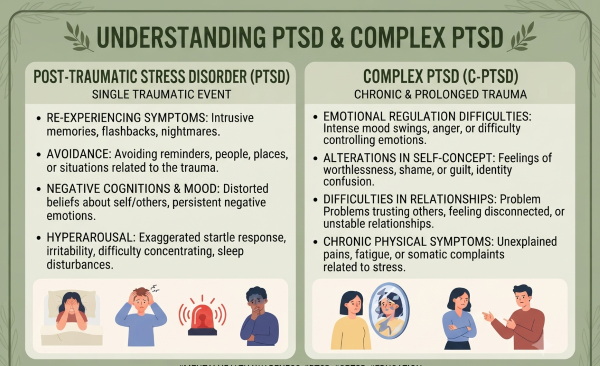
Under ICD-11, PTSD and CPTSD share three basic symptom patterns which include: Reliving traumatic experiences as if they are happening again, avoiding reminders of the trauma, and a sense of current threat becoming persistent.
CPTSD causes these symptoms, as well as other challenges with emotional control, self-esteem, and relationships. Each person experiences and has specific symptoms, which may differ.
Someone may wish to seek assessment based on this knowledge of patterns, but only a qualified professional can assess whether the diagnostic criteria are fulfilled.
100% Confidential Support is Available 24/7
No matter what you’re going through, you’re not alone. Our dedicated team is here to provide a safe, judgment-free space where you can talk openly and honestly. Whether you need emotional support, resources, or just someone to listen.
We’re here for you—completely confidential and always respectful of your privacy. Call us today!
What Are the Symptoms of CPTSD?
CPTSD symptoms can manifest in thoughts, feelings, behavior, physical health and relationships. Common symptoms include:
- Flashbacks, intrusive memories, and nightmares.
- Not going to places, people, conversations or situations that are linked with trauma.
- Being always alert, unsafe or easily startled.
- Having trouble controlling anger, sadness, fear or emotional overload.
- Ongoing shame and guilt; feeling worthless or beaten.
- Trouble seeing other people as trustworthy and afraid of close relationships.
- Loss of opportunity for connection or difficulty with emotional closeness.
The collection of 17 CPTSD symptoms is not necessarily a universal one. Multiple symptom checklists with varying numbers of symptom examples may exist but diagnosis is based on key clinical criteria and not just on the number of symptoms.
What Causes CPTSD?
CPTSD may occur when an event or circumstance is extremely threatening or distressing, especially if a trauma experience is prolonged, repeated, or elusive. Some of these are prolonged abuse in childhood, domestic violence, imprisonment, torture, and trafficking.
Someone’s sense of safety, trust, and identity and emotional regulation may be impacted by repeated interpersonal trauma. Not all those who suffer from trauma that has happened for a long time, however, go on to develop CPTSD, and a person can have CPTSD with different types of traumatic experiences.
How one experiences trauma can be influenced by personal factors, networks, and other psychosocial factors.
How is CPTSD Diagnosed?
CPTSD cannot be identified by any single blood test, brain scan or questionnaire. Mentally health professional evaluates the individual’s trauma history, symptoms, emotional experiences, relationships and extent of daily dysfunction.
Structured interviews or a validated screening instrument may be used, and other conditions, including CST, depression, anxiety disorders, and BPD, should be addressed.
This diagnostic system is important because ICD-11 and DSM-5-TR define CPTSD differently. An assessment should be respectful, take place at a pace that helps the person feel as safe as possible, and allow them to discuss difficult experiences.
How is CPTSD Treated?
The goal of CPTSD treatment is to decrease the distress caused by trauma, help regulate emotions, boost self-worth, and foster healthier relationships. Psychotherapy is a major treatment option and should be personalized based on one’s symptoms, needs, and preferences.
Trauma-focused cognitive behavioral therapy (CBT), cognitive processing therapy (CPT), and eye movement desensitization and reprocessing (EMDR) are some of the therapies that may be used. Emotional regulation skills and grounding techniques are helpful for some to learn prior to working through traumatic memories.
Treatment does not, of course, involve a person telling all about his or her trauma at once. It may take some time to make progress and professional guidance is necessary.
Medication for CPTSD
At present, no drugs are specifically licensed for the treatment of CPTSD. Medications may be used to help control other symptoms (such as depression, anxiety, and trouble sleeping), however, which will be prescribed by a healthcare provider. Antidepressants, some of which are selective serotonin reuptake inhibitors (SSRIs), may be used but only when clinically appropriate.
The choice of medication is dictated by the symptoms, past medical history, any other meds being used, and possible side effects. Medications, which may be used in conjunction with psychotherapy, should not be considered to be substitutes for adequate psychological care. Do not stop, start or change a prescribed medication without the advice of the prescribing health care professional.
What is the Prognosis (Outlook) for CPTSD?
CPTSD has a different prognosis for each individual. Some will improve significantly following treatment, but others may require more long-term care for their recurrent symptoms. Recovery can’t always be defined as memory loss or as a time when the distress is stopped.
It can mean fewer intrusive memories, better response to triggers, healthier relationships, and increased security in one’s everyday world. Supportive relationships and help with coping strategies, early assessments, and consistent care may help improve functioning. Having a diagnosis of CPTSD isn’t a death sentence or a sentence to never live a fulfilling life.
Treatment Options for PTSD and CPTSD
Treatment should be individualized based on the person’s symptoms, preferences, and circumstances. Options may include:
Trauma-focused psychotherapy: Aids the individual in releasing and processing traumatic experiences and in changing unhelpful beliefs that are connected with them.
Cognitive processing therapy (CPT): Helps anyone who is having a troubling thought or idea about what has happened.
Trauma-focused CBT: Helps people learn to respond differently to thoughts and reminders about trauma while developing coping skills.
EMDR: Works using systematic sessions with traumatic memories and bilateral stimulation to decrease distress.
Skills-based therapy: Helps to regulate emotions, get grounded, tolerate distress and enhance relationships.
May be helpful for selected symptoms, as recommended by a qualified practitioner who prescribes the medication.
Social and practical support: Getting support from trusted people, through a support group, healthy lifestyle, or a safe environment, can be combined with professional treatment.
Some treatments are not for all. A trained clinician can assist in identifying more suitable options and a combination of strategies that might be useful.

When Should I See a Healthcare Provider?
If memories of the trauma, nightmares, avoidance, anxiety, emotional overreacting, or problems with relationships continue or interfere with your life, you may want to talk with a health care provider or a mental health professional. It’s never too early to seek help, even before symptoms get really bad.
Support from a professional could be particularly helpful if you have trouble sleeping, have a poor sense of self, isolate, or need alcohol or drugs to cope. Seek immediate help using local emergency services or a crisis service if in immediate danger or thinking about hurting yourself.
Get Support for Trauma-Related Mental Health Concerns
Knowing the distinctions between PTSD and CPTSD can help secure the appropriate help and support, but one doesn’t have to deal with trauma all on their own. When emotional issues, painful memories or stress are hurting your life,
Solutions Healthcare in Port St. Lucie, Florida, can be the beginning of a conversation about mental health treatment services.
If you are interested in the services offered by the Joondalup Community Hospice and the steps to take for support, please call (386) 866-3600. Calling doesn’t imply weakness. It indicates you take care of your health.
Frequently Asked Questions
Is CPTSD More Serious Than PTSD?
Not necessarily. CPTSD includes additional difficulties with emotional regulation, self-image, and relationships, which can make daily life challenging. However, PTSD can also be severely disabling. The impact of either condition depends on symptom severity, personal circumstances, co-occurring conditions, and access to effective treatment.
How Do I Tell If I Have CPTSD or PTSD?
You cannot reliably distinguish the two conditions based on symptoms alone. Both may involve flashbacks, avoidance, nightmares, and hypervigilance. Persistent problems with self-worth, emotional regulation, and relationships may suggest CPTSD under ICD-11 criteria. A qualified mental health professional can assess your experiences and symptoms.
What Are the 17 Symptoms of Complex PTSD?
There is no official universal list of exactly 17 CPTSD symptoms. Common examples include flashbacks, nightmares, avoidance, hypervigilance, emotional overwhelm, shame, guilt, low self-worth, difficulty trusting others, and relationship problems. Diagnosis is based on recognized criteria, not on reaching a particular number of symptoms.
What Is a CPTSD Trigger Like?
A CPTSD trigger is a reminder that brings up a strong emotional or physical response associated with past trauma. It might be a particular tone of voice, an argument, a smell, or a situation that feels unsafe. Responses can include fear, shame, anger, tension, or feeling disconnected.
Is CPTSD Permanent Brain Damage?
CPTSD is not the same as permanent brain damage. Research suggests that trauma can be associated with changes in brain functioning and stress responses, but these findings do not mean that every affected person has permanent structural damage. Symptoms can improve with appropriate treatment and support.
What Is the Hardest Trauma to Heal From?
There is no single type of trauma that is hardest for everyone to recover from. Repeated abuse, childhood trauma, and prolonged situations in which escape is difficult can have lasting effects. However, recovery depends on individual experiences, support, personal circumstances, and access to appropriate treatment.
Does CPTSD Ever Fully Go Away?
Some people experience major and lasting improvements in CPTSD symptoms, while others continue to manage symptoms over time. Recovery looks different for everyone. Treatment can help people feel safer, improve relationships, manage triggers, and regain daily functioning, even when some memories remain distressing.
What Does CPTSD Get Mistaken For?
CPTSD may be confused with PTSD, borderline personality disorder, depression, anxiety disorders, or other conditions because some symptoms overlap. Difficulties with trust, emotional regulation, and self-worth can occur in several diagnoses. A comprehensive assessment helps identify the most accurate explanation for a person’s experiences.
Can People With CPTSD Ever Be Happy?
Yes. People with CPTSD can experience happiness, meaningful relationships, confidence, and a fulfilling life. Trauma-related symptoms may make these experiences harder at times, but they do not define a person’s future. With suitable treatment, support, and coping skills, many people build lives that feel safer and more satisfying.
Medical Disclaimer
This article is intended for educational and informational purposes only. It does not replace professional medical advice, diagnosis, or treatment. Symptoms of PTSD and CPTSD can overlap with those of other mental health conditions. Always consult a qualified healthcare professional for an individual assessment and treatment recommendations. If you are experiencing a mental health emergency, contact your local emergency services.
References
- Cleveland Clinic. CPTSD (Complex PTSD): What It Is, Symptoms & Treatment.
- U.S. Department of Veterans Affairs, National Center for PTSD. Complex PTSD.
- U.S. Department of Veterans Affairs, National Center for PTSD. Complex PTSD: Assessment and Treatment.
- U.S. Department of Veterans Affairs, National Center for PTSD. PTSD and DSM-5.
- World Health Organization. International Classification of Diseases, 11th Revision (ICD-11).