

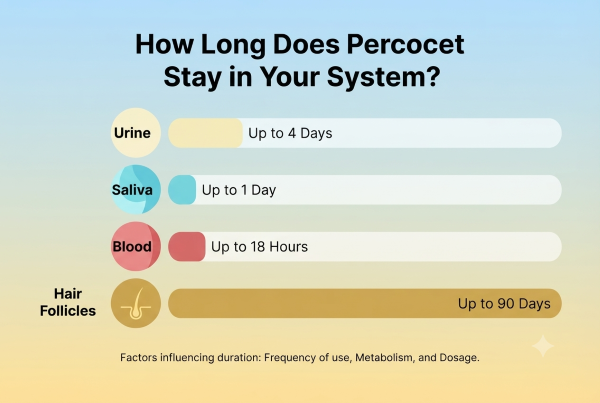
How long will Percocet be in your body? Although most people get rid of Percocet in 24 to 48 hours, it can be detectable for longer periods of time, depending on which drug test it is. The drug can be detected in urine for up to 4 days, blood for approximately 24 hours, saliva for up to 48 hours, and hair for up to 90 days. The Percocet detection window will vary based on a number of unique factors, such as the dosage, how often the drug was used, whether a certain type of Percocet was used, overall health, hydration, age, and liver function.
It doesn’t matter if you or someone in your life is taking Percocet without a physician’s note, or if you are a Percocet user and addict; you have a safer choice for healing using a professional treatment facility.
The question of how long Percocet stays in your system can be found on the internet when someone either takes the prescription or wonders about a potential addiction and pretests for a job or seminar. There is no one-size-fits-all answer, but understanding the way Percocet is metabolized in the body can help you understand your health choices.
No matter how many times you’ve used it before or after a surgery, it’s critical to know the Percocet detection window, the potential Percocet withdrawal symptoms and when Percocet detox might be necessary all in the name of staying safe.
Key Takeaways
- Percocet is a combination of acetaminophen and oxycodone.
- Most people get rid of Percocet in 24-48 hours, but can be detected much longer.
- The Perc or Perc 30 detection window will vary depending on the kind of tests performed.
- The systemic availability of the drug affects the duration of its presence in the body and depends on factors such as metabolism, age, bodyweight, liver function, dose and duration of use.
- There are no quick fixes for removing Percocet from your system.
- Percocet detox might be the best option for some people who have arrived at the point of addiction.
- Medical assistance can help lessen the discomfort that is associated with Percocet withdrawal signs and symptoms.
What Is Percocet?
Percocet is a prescription drug to relieve moderate to severe pain. Both contain two active ingredients:
Oxycodone, a powerful opioid pain reliever
A non-opioid drug, which means it doesn’t contain a pain reliever, that helps manage pain and fever.
When using Oxycodone, the brain and nervous system are made to react differently to pain. Although helpful for short-term alleviation of pain, it can also be misused, addictive and can cause dependence with extended use and/or larger doses than prescribed.
Many people ask how long oxycodone stays in your body since it’s one of the components of Percocet. For the most part, the logic used is that oxycodone is the more frequently tested drug during a drug test.
100% Confidential Support is Available 24/7
No matter what you’re going through, you’re not alone. Our dedicated team is here to provide a safe, judgment-free space where you can talk openly and honestly. Whether you need emotional support, resources, or just someone to listen.
We’re here for you—completely confidential and always respectful of your privacy. Call us today!
How Long Does Percocet Stay in Your System?
It varies depending on several factors, but most healthy adults metabolize oxycodone within approximately one day. It can be detected in a drug test even after it wears off.
Here is the typical Percocet detection window:
Drug Test | Typical Detection Time |
Urine | 2–4 days |
Blood | Up to 24 hours |
Saliva | 24–48 hours |
Hair | Up to 90 days |
These statistics are also average statistics and cannot be guaranteed. Some people break the drug down faster; some of them break it down slower.
Because everyone’s body reacts differently to drugs, to gain a clearer understanding of how long Percocet stays in your system, averages need to be taken with a grain of salt.
Contact Solutions Healthcare
Battling with Drug and Alcohol Addition? Remember, you are not alone and we are here to help you!
Why Does Percocet Stay in Some People Longer?
In the process of how medications are metabolized, no two people are the same. The rate at which Percocet is eliminated from the body can depend on several biological/behavioral factors.
Dosage
The more you take, the longer it will take your body to get rid of the med. If the person using Percocet has taken the drug several times a day, the detection period will be longer than if the person has taken a single Percocet pill.
Frequency of Use
Taking oxycodone repeatedly causes it to accumulate in the body. When it comes to detection, regular users have a longer window of detection than occasional users can have.
Age
Metabolism tends to be slower with age. Percocet may take longer to work for people.
Liver Function
The liver is an important organ involved in metabolizing oxycodone and acetaminophen. Impaired liver function or liver disease delays the clearance of drugs.
Kidney Health
The kidneys work to flush drugs and their metabolites from the body. If kidney function is decreased, the amount of detection time may be increased.
Metabolism
Those who have high body metabolism tend to metabolize drugs quicker than do people with low body metabolism.
Body Composition
Muscle mass, body fat and body weight can affect the way drugs are distributed and eliminated from your body.
How Long Does Oxycodone Stay in Your System?
Oxycodone lasts up to 4 hours in measurable quantities in the body and up to 2 hours.
With that said, given that oxycodone is the opioid part of Percocet, it’s a logical question to ask about how long does oxycodone last?
The half-life of oxycodone is about 3 to 5 hours, which means that the body removes half of the drug from the body during that time. In most cases, the time it takes for most of a drug’s effect to wear off is about 5 half-lives.
However, drug tests are designed to check for the same drug as well as other metabolites. The testing can also be positive days after the effects of the drug have worn off, since metabolites are detected as the body breaks down oxycodone.
How Long Does Percocet Stay in Urine?
The most popular method for conducting drug screening tests is to test the urine. The urine test is inexpensive, simple to perform and extremely reliable.
For most people:
- A few times: around 2 days
- Prevention: up to 4 days
Heavy or chronic use: sometimes longer (up to a year or more)
Urine tests are used to detect recent opioid use and are provided by many employers, healthcare providers, rehabilitation programs and legal systems.
100% Confidential Support is Available 24/7
No matter what you’re going through, you’re not alone. Our dedicated team is here to provide a safe, judgment-free space where you can talk openly and honestly. Whether you need emotional support, resources, or just someone to listen.
We’re here for you—completely confidential and always respectful of your privacy. Call us today!
Does Percocet Show Up on a Hair Test?
One common question that people have is, does Percocet test positive in hair?
Yes. For as long as 90 days after consumption, oxycodone can be found in a person’s hair. Growing hair traps a small amount of drug metabolites inside the fragments and this can be used to detect drug use that occurred over a predetermined period (up to several months).
Routine use of hair testing rarely takes place, and the test might be ordered for legal cases or child custody proceedings, or for specialized testing at some workplaces.
Hair testing offers the longest detection window, but can not be used to detect very recent drug use as the drug metabolites generally aren’t detected in newly growing hair for several days.
Does Hydration Change the Percocet Detection Window?
They believe that consuming excessive amounts of water can flush drugs from their system in a relatively short period of time. Sadly, this is not true.
Hydration is good for your kidney; however, it cannot do much work regarding decreasing the Percocet detection time. You are still going to need to allow your liver and kidneys to work out and naturally eliminate the medication.
Drinking anything to try to “detox” the body, drinking more water than usual, or using any product for a detox (when there is no proof that it helps), is unlikely to alter the results of a drug test and may be harmful to health.
100% Confidential Support is Available 24/7
No matter what you’re going through, you’re not alone. Our dedicated team is here to provide a safe, judgment-free space where you can talk openly and honestly. Whether you need emotional support, resources, or just someone to listen.
We’re here for you—completely confidential and always respectful of your privacy. Call us today!
Can You Speed Up How Fast Percocet Leaves Your Body?
To immediately flush Percocet out of your system, there’s no medical evidence that shows that it can be done.
Good healthy habits can help your body take care of its metabolism, such as:
- Drinking adequate water
- Eating balanced meals
- Getting enough sleep
- Staying physically active
When you follow your health care provider’s directions
None of these techniques, however, are sure to speed up drug elimination or to help beat a drug test.
For those who have become dependent on Percocets, going through professional Percocet detox is a much safer and more effective method of handling Percocet detox than trying to do it alone.
When Does Percocet Become a Problem?
A lot of individuals start using Percocet correctly. But, with time, some people find that they must take a larger dosage for the same pain relief to occur.
Some of the signs and symptoms may be:
- Risking the patient by giving more medicines than prescribed
- Running out of prescriptions early
- Craving the medication
- Getting prescriptions from more than one health care provider
- Taking Percocet to manage stress and not pain
- Getting sick between doses
- A feeling of loss of control in attempting to stop when desired
If a person is experiencing any of these symptoms, they may be signs of opioid dependence, and should be addressed by a trained healthcare provider.
Take the First Step Toward Recovery
When you have an interest in the period of time that Percocet remains in your system and you or a loved one is facing an opioid habit, you don’t have to go it alone.
For reliable expert advice on a case-by-case basis, call Solutions Healthcare today. Timely treatment will increase the chance of a successful recovery and will make it safer and more comfortable.
Symptoms of Percocet Withdrawal
Withdrawal may occur if someone abruptly discontinues taking Percocet after taking the drug regularly or for a prolonged period. Opioid withdrawal itself is generally not life-threatening; however, it’s highly uncomfortable and can lead to a potential for a relapse if someone attempts to quit on their own.
Percocet withdrawal symptoms can start as soon as the body develops a physical dependence to oxycodone. The severity is dependent upon the duration of use, dosage of a certain medication, overall health, and if other substances were used.
Some of the symptoms of Percocet withdrawal are each:
- Muscle pain and pain in the body
- Anxiety or restlessness
- Sweating
- Chills or goosebumps
- Runny nose and watery eyes
- Yawning
- Trouble sleeping
- Nausea and vomiting
- Diarrhea
- Stomach cramps
- Increased heart rate
- Dilated pupils
- Intense urges to take Percocet
These symptoms seldom pose a medical risk, but dehydration, profuse vomiting, or relapse can. Symptoms are kept under control with professional care safely and comfortably.
How Long Do Withdrawals From Percocet Last?
Withdrawal can occur in these stages:
6 – 12 hours after last dose
Early signs and symptoms can include:
- Anxiety
- Restlessness
- Sweating
- Muscle aches
- Frequent yawning
- Trouble sleeping
24–72 Hours
This is often when symptoms are most severe. People may experience:
- Nausea
- Vomiting
- Diarrhea
- Abdominal cramps
- Intense cravings
- Increased blood pressure
- Difficulty sleeping
- Chills and sweating
4–7 Days
Gradually, there’s a change in the physical symptoms. The level of energy may still be low and sleeping may still be an issue.
Several Weeks
A few people have emotional reactions that can last and include:
- Anxiety
- Mood swings
- Depression
- Fatigue
- Difficulty concentrating
Each recovery journey is unique, so the length of withdrawals from Percocet can vary from one person to the next. Under medical supervision, it can be much more comfortable and be much safer.
What is Percocet Detox?
Percocet detox refers to the process whereby the body gets rid of oxycodone while keeping the withdrawal symptoms from getting too extreme.
While detox can be an initial step in addiction treatment, it’s not the same as recovery. Detox treats physical dependence, while long-term treatment concentrates on the psychological and emotional component of addiction as well as behavior.
Percocet detox can comprise of the following, based on individual requirements:
- Medical monitoring
- Symptom management
- Medication-assisted treatment (MAT)
- Nutritional support
- Hydration
- Individual counseling
Plans to help support treatment once a student has graduated from program.
If withdrawal symptoms begin to be overwhelming, it may be more likely for someone to relapse when they try to detox on their own.
Why Professional Detox is Safer
“Cold turkey”” is a term many use to describe the process of quitting opioids. This may be the easiest way but sometimes the quickest.
Professional Percocet detox might have a range of advantages:
- 24/7 medical supervision
- Reduced withdrawal discomfort
- Monitoring for complications
- Emotional support
- Lower relapse risk
- A seamless integration into continued care.
Treatment professionals can also ascertain if medication-assisted treatment might be helpful to diminish cravings and maintain long-term recovery.
What Happens After Detox?
Recovery doesn’t finish when the detoxification process is completed.
Sustained treatment addressing the root causes of substance abuse is key to success.
Treatment options may involve:
Individual Therapy
Through one-to-one counseling, individuals can help determine triggers, become more effective in coping with these triggers, and gain confidence in their ability to recover.
Group Therapy
Group therapy offers support, experiences, and accountability with other people with addiction.
Family Therapy
The whole family is impacted by addiction. Family counseling can be a supportive method of enhancing communication, re-establishing trust and working on family support.
Medication-Assisted Treatment (MAT)
Medications that are sometimes used to help reduce craving for opioids and lessen the likelihood of returning to substance use have received FDA approval to use and depending on the person, they can be effective when coupled with counselling.
Relapse Prevention Planning
It is important to learn how to identify triggers and react to high-risk situations to maintain long-term recovery.

When Should You Seek Help?
It may be time to seek professional treatment if you:
- Feel pressured to take Percocet; know that this will lead to feeling unwell if you try stopping them
- Require increased amounts of the medication for the same effect.
- Get withdrawal symptoms as per the gap between doses
- Take Percocet after prescription has run out
- Think and/or find major time for the medicine.
- Use even when you have work/school or family issues
Early intervention can have beneficial results and decrease the likelihood of overdose or future health issues.
Compassionate Treatment at Solutions Healthcare
Often there is a search for how long Percocet stays in the human body, as it relates to dependence, but help is available.
We understand that at Solutions Healthcare, no two people will be affected by opioid addiction in the same way. From Percocet detox to outpatient services, behavioral therapy, medication-assisted treatment, and even planning for long-term recovery, our nurturing staff is here to provide care for you.
No one should have to deal with addiction by themselves. Recovery can occur with the proper support, guidance, and evidence-based treatment.
Begin Your Recovery Nowadays
Knowing how long Percocet stays in your system is only part of the equation. If you or someone you know is suffering from prescription opioid drug misuse, there is no better time to act than now.
Solutions Healthcare’s healthcare professionals expertly evaluate patients and create treatment essentials with compassion, warmth and care, and assist individuals in safely overcoming opioid dependence. Whether you need Percocet detox in a medically supervised program or therapy/session and relapse prevention, we’re here for you.
Find out the answers to your questions by speaking with a compassionate treatment professional today at Solutions Healthcare. The first step in the road to a life of recovery is a single conversation, and we’re here to help you do that.
Frequently Asked Questions
What are the 3 C’s of alcoholism?
The three C’s of alcoholism are craving, loss of control, and continued use despite harmful consequences. These characteristics help explain why alcohol use disorder is considered a chronic medical condition rather than simply a lack of willpower.
How long will you test positive for pain pills?
Most opioid pain medications remain detectable in urine for two to four days, although the exact timeframe depends on the medication, dosage, frequency of use, metabolism, and the type of drug test being used.
How long does it take for oxycodone to wear out of your system?
The pain-relieving effects of oxycodone usually wear off within 4 to 6 hours, but the medication and its metabolites can remain detectable in the body for several days depending on the testing method.
What drug stays in your system the longest?
Hair testing can detect several drugs for up to 90 days, including opioids, cocaine, amphetamines, and cannabis. Detection time varies based on the substance, frequency of use, and individual metabolism.
What does oxycodone show up as in a urine test?
Oxycodone may appear as an opioid on specialized urine drug screens. Some standard opioid panels may require additional testing specifically designed to identify oxycodone and its metabolites.
Does water flush out drugs?
No. Drinking water supports normal hydration but does not quickly eliminate drugs from the body or reliably change drug test results. The liver and kidneys still require time to metabolize and remove medications naturally.
What is the fastest way to clean out your system for a drug test?
There is no scientifically proven method to remove drugs from your body instantly. Time, normal metabolism, and overall health determine how quickly substances are naturally eliminated.
Is 5 mg of oxycodone very strong?
A 5 mg dose is generally considered a lower therapeutic dose for opioid pain management. However, even low doses can cause drowsiness, dependence, or overdose in some individuals, especially when combined with alcohol or other sedatives.
Does oxycodone get eliminated from my body by peeing?
Yes. After the liver metabolizes oxycodone, the kidneys filter its metabolites, which are then excreted through urine. This is why urine testing is commonly used to detect recent opioid use.
Do oxycodone and Percocet test the same?
Yes. Because Percocet contains oxycodone, drug tests typically detect the oxycodone component. Whether someone takes oxycodone alone or in Percocet, specialized testing generally identifies the same opioid metabolites.
Disclaimer
This article is intended for educational purposes only and should not be considered medical advice, diagnosis, or treatment. Drug detection times and withdrawal experiences vary from person to person. Always consult a qualified healthcare provider regarding medication use, substance dependence, or treatment decisions. If you believe you or someone you know is experiencing an opioid overdose, call emergency services immediately.
Author Bio
Dr. Zach Miller, Ph.D., LMHC, MCAP, CRRA, is a dedicated leader in behavioral mental health with over 15 years of experience transforming lives. As a co-founder of Solutions Healthcare, he has played a pivotal role in developing innovative therapeutic interventions for individuals struggling with mental health and substance use disorders.
References
- American Addiction Centers. How Long Does Percocet Stay in Your System? https://americanaddictioncenters.org/opioids/oxycodone/percocet/how-long-in-system
- Orlando Recovery Center. Percocet Addiction and Withdrawal. https://www.orlandorecovery.com/drug-addiction-resources/percocet/
- National Institute on Drug Abuse (NIDA) – Opioids Research
- U.S. Centers for Disease Control and Prevention (CDC) – Opioid Information
- Substance Abuse and Mental Health Services Administration (SAMHSA) – Find Treatment