In This Blog
- Debunking the Myth: Is Cannabis Really Addictive?
- Defining Cannabis Use Disorder (CUD)
- Short-Term Effects vs. Long-Term Risks
- The Impact of High-Potency THC on the Brain
- Recognizing Signs of Withdrawal
- The Importance of a Monitored Treatment Setting
- Evidence-Based Recovery Services for Cannabis
- Taking the Next Step Toward Stability
With the cultural perception and legal environment of marijuana shifting, one question still lingers: “Is cannabis addictive? Although some regard it as a non-addictive drug, clinical studies conducted by such organizations as Solutions Healthcare prove that cannabis may be addictive. About 1 out of 10 marijuana users will get addicted to its use and this figure increases to 1 out of 6 among those people who start using it in their teenage years.
This health condition is medically known as Cannabis Use Disorder (CUD) and is seen when a person is unable to quit taking the drug despite it causing health, social, or functional issues in his or her life. The reality that you cannot get addicted to weed is a false assumption that, in most cases, leads one to adopt the habit, which takes a heavy toll on their career, education, and even personal relationships.
Knowledge of cannabis being an addictive drug is not a matter of judgment but rather a matter of appreciation of the physiological alterations induced by the drug to the reward system of the brain. To the addict who finds it difficult to reduce, a professional treatment setting would provide the safety and encouragement to overcome the dependency cycle. This guide will discuss the impacts, risks, and services provided by the recovery that will assist you in the outlook.
Expert Advice: Currently, cannabis addiction is a chronic disease, the recovery process is most effective with the assistance of supervised support and behavioral therapy.
Defining Cannabis Use Disorder (CUD)
Cannabis Use Disorder is a known mental health problem that is marked by a disorderly style of consumption. It ranges between mild and severe. Once the consumption of cannabis ceases to be recreational but compulsive, it implies that the brain has gotten used to having the psychoactive substance in cannabis, which is known as THC (tetrahydrocannabinol).
Severity | Diagnostic Indicators |
Mild | Using more than intended; unsuccessful attempts to cut down. |
Moderate | Neglecting responsibilities; continued use despite social problems. |
Severe (Addiction) | High tolerance; experiencing withdrawal; giving up important activities to use. |
The importance of labeling it as a disorder is that it helps to guarantee a treatment process as clinically rigorous as any other substance use disorder and apply the use of structured care and professional supervision.
100% Confidential Support is Available 24/7
No matter what you’re going through, you’re not alone. Our dedicated team is here to provide a safe, judgment-free space where you can talk openly and honestly. Whether you need emotional support, resources, or just someone to listen.
We’re here for you—completely confidential and always respectful of your privacy. Call us today!
Short-Term Effects vs. Long-Term Risks
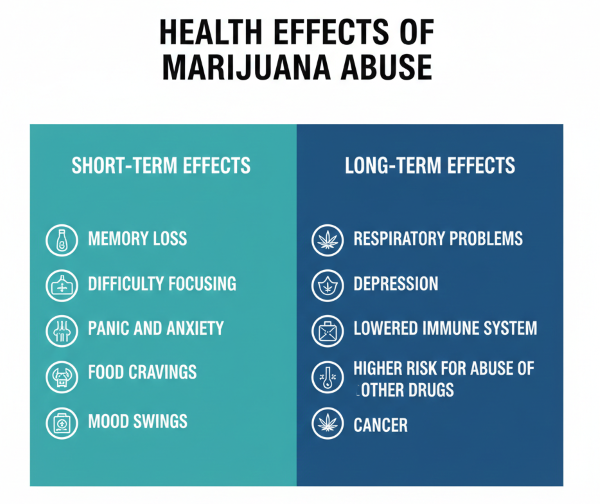
The drug cannabis has varying effects depending on the potency and the biology of the individual using the drug. Although the immediate spike in the short run is likely to be soothing, the biological dangers over the long run are massive.
Short-Term Effects
- Hypersensitivity and perversion of time was experienced.
- Slow response and loss of normal body movement.
- Fastening of heart rate and possible acute anxiety or paranoia.
Long-Term Risks
- Cognitive Decline: Permanent impact on memory, learning, and IQ, especially if used during adolescence.
- Respiratory Problems: Chronic bronchitis and lung irritation among the people who smoke or vape.
- Mental Health: At risk of psychosis, schizophrenia, depression, and anxiety.
- Cannabinoid Hyperemesis Syndrome (CHS): Repeat episodes of vomiting and abdominal pain which are acute and severe.
Since these risks are cumulative, the best prevention method is early intervention in a supervised environment which will avoid irreparable damage.
Solutions Healthcare offers special tests that reveal how cannabis will affect your health after a long time.
FACT: Cannabis Withdrawal Syndrome is a diagnosis in the DSM-5. The symptoms usually occur in the first week of the quitting process and may take up to 14 days.
Contact Solutions Healthcare
Battling with Drug and Alcohol Addition? Remember, you are not alone and we are here to help you!
The Impact of High-Potency THC on the Brain
The cannabis products nowadays are much stronger than those that were being sold many decades ago. THC of high strength (which is in concentrates, oils, and dabs) saturates the receptors of cannabinoids in the brain, causing quick tolerance. Overstimulation of these receptors causes a decrease in the amount of endocannabinoids that the brain normally produces, which makes the person physically and psychologically dependent on the drug to seem normal.
In a developed treatment setting the emphasis is on letting these receptors mend and get back to their natural resting point. This is a process that in most cases needs supervised help in order to combat the strong cravings that come with the use of high potency.
Recognizing Signs of Withdrawal
The evidence of cannabis addiction can be most realistic when one attempts to quit. The strong evidence of dependence is withdrawal symptoms. Common signs include:
- Irritability and Mood Swings: Experiencing anger or aggression.
- Sleep Disorders: Sleeplessness or disastrous dreams.
- Physical Complaints: Headaches, sweat, chills, and abdominal pain.
- Loss of Appetite: This is difficulty in eating or loss of weight.
It may be difficult to manage these symptoms without a supervised environment, which would result in a so-called relapse just to get the pain to go away.
Evidence-Based Recovery Services for Cannabis
The process of CUD recovery is very feasible with a combination of community support and behavioral therapies. The recovery services are often effective when they involve:
- Cognitive Behavioral Therapy (CBT): Determining the antecedents and cognitions which precipitate use.
- Motivational Enhancement Therapy (MET): Developing internal strength to continue a drug-free life.
- Contingency Management: The use of actual rewards because of following abstinence.
- Family Therapy: Teaching the family members on how to assist the recovery process without enabling them.
Solutions Healthcare is the provider of professional guidance to incorporate such therapies into an effective life plan.
100% Confidential Support is Available 24/7
No matter what you’re going through, you’re not alone. Our dedicated team is here to provide a safe, judgment-free space where you can talk openly and honestly. Whether you need emotional support, resources, or just someone to listen.
We’re here for you—completely confidential and always respectful of your privacy. Call us today!
The Importance of a Monitored Treatment Setting
The environment is the most difficult to overcome cannabis addiction, as is the case in many. The controlled environment takes the person out of the peer groups and geographical areas where the person was used. This medicalized care setting offers:
- Safety: Health checkup to check physical health during the detox.
- Responsibility: Frequent follow-ups that promote regularity.
- Community: Interaction with the people who are aware of the unique difficulties of CUD.
With the help of supervised support, the person would have the chance to revitalize fully with the distractions of daily life.
Is Cannabis Addictive?
The answer is a lived reality to millions of people all over the world. The first step to regaining your health and motivation is acknowledging the fact that you or the person you love has become dependent. Cannabis Use Disorder is a disease that can be treated and the request of assistance is a strength rather than a weakness.

Solutions Healthcare offers high-quality and accessible recovery services and professional care to individuals with cannabis issues. We focus on the structured treatment environment, which focuses on both physical and psychological aspects of addiction. We enable our clients to get rid of the fog of their minds by providing supervised support in a secure, regulated environment and create the future that will be characterized by clarity and stability.
Medical Disclaimer: This blog is for informational purposes only and is not a substitute for professional medical advice.
100% Confidential Support is Available 24/7
No matter what you’re going through, you’re not alone. Our dedicated team is here to provide a safe, judgment-free space where you can talk openly and honestly. Whether you need emotional support, resources, or just someone to listen.
We’re here for you—completely confidential and always respectful of your privacy. Call us today!
FAQs
Is cannabis addiction real?
Yes, cannabis addiction clinically known as Cannabis Use Disorder—is a recognized medical condition. It occurs when the brain’s reward system becomes dependent on THC. Breaking this cycle often requires professional oversight and structured care to manage withdrawal symptoms and address the underlying behavioral triggers of the addiction.
How does high-potency THC affect addiction risk?
High-potency THC products, such as concentrates and edibles, deliver massive doses of the chemical to the brain. This rapidly increases tolerance, making the brain more likely to become dependent. Seeking recovery services is especially important for those using high-potency products, as the withdrawal symptoms can be more intense.
Can adolescents recover from the brain changes caused by cannabis?
The adolescent brain is still developing, making it highly vulnerable to THC. While the brain is resilient, long-term use can cause lasting cognitive deficits. Early intervention in a monitored setting with supervised support provides the best chance for the brain to heal and for the individual to succeed.
What is the “gold standard” for cannabis treatment?
There is no single “cure,” but a combination of Cognitive Behavioral Therapy (CBT) and Motivational Enhancement Therapy (MET) is considered highly effective. These treatments help individuals develop coping skills and increase their motivation to stay sober within a structured treatment environment that prioritizes long-term behavioral stability.
How long do cannabis withdrawal symptoms last?
Most physical symptoms of cannabis withdrawal, such as irritability and sleep issues, begin within 24 hours of quitting and peak during the first week. However, psychological cravings can last longer. This is why a monitored setting and continued recovery services are vital for preventing relapse during the first month.
Reference Links
- Cleveland Clinic – Cannabis Use Disorder
- NIDA – Is Marijuana Addictive?
- CDC – Marijuana Health Effects
- SAMHSA – Treatment for Substance Use Disorders: