
Key Takeaways
- One can have Borderline Personality Disorder and Bipolar Disorder.
- It is possible as they experience similar symptoms and present varied patterns and causation.
- It is a two-fold diagnosis that health care professionals must take part in.
- This may involve treatments, drugs, and assistance.
- The earlier the treatment, the better.
Whether you have ever posed a question about having a borderline personality disorder and a bipolar disorder, the answer is yes, several people can have both disorders simultaneously. Although borderline personality disorder and bipolar disorder are distinct diagnoses, they may intersect in a manner that leads to confusion of symptoms and makes them hard to control without proper treatment. It is important to comprehend the way these conditions interact to make the correct diagnosis and good treatment.
Clinically, the two disorders can be said to have mood instability, but this is linked to the way the mood changes take place, the duration of the mood swings and the cause. This is the case most of the time as a therapist when I can find people being misdiagnosed or who took years to get a clear diagnosis. The positive side of it is that with the correct diagnosis and the correct support, it can indeed be recycled. –
Understanding Bipolar Disorder
Bipolar disorder is a mood disorder, which is distinguished by episodes of elevated (mania or hypomania) and depressed mood. Such episodes of mood may be worse than regular up and down moods and may affect one’s work, social life and general decision-making.
The most common types of bipolar disorder are bipolar I, Bipolar II, and cyclothymia. They differ in severity and duration of mood episodes. They all exhibited periods of high and low spirits.
100% Confidential Support is Available 24/7
No matter what you’re going through, you’re not alone. Our dedicated team is here to provide a safe, judgment-free space where you can talk openly and honestly. Whether you need emotional support, resources, or just someone to listen.
We’re here for you—completely confidential and always respectful of your privacy. Call us today!
Symptoms of Bipolar Disorder
Symptoms are of two kinds:
- Mania or Hypomania:
- High or angry mood.
- Heightened activity or energy.
- Reduced sleepiness.
- Risky behavior (spending, risk-taking)
- On a roll/racing/thoughts.
- In a bad mood or depressed.
- Loss of interest in activities.
- Tiredness or lack of energy.
- Difficulty concentrating
- Suicide and self-harming thoughts.
These may take days, weeks, or even longer and may or may not have an apparent cause.
Causes and Risk Factors of Bipolar Disorder
A combination of:
- Genetics: Family history is a risk factor.
- Brain chemistry: Chemical imbalances in the brain.
- Life events: Stress or trauma.
- Medications: May cause or aggravate episodes.
Bipolar is caused by many factors but awareness of risk factors can be used to treat it.
Contact Solutions Healthcare
Battling with Drug and Alcohol Addition? Remember, you are not alone and we are here to help you!
Understanding Borderline Personality Disorder
Borderline personality disorder (BPD) is a personality disorder that influences thinking, mood and relationships. It is characterized by tumultuous emotions, connections and rejection.
BPD mood disorders, in contrast to bipolar disorder, are more triggered by initiation to interpersonal events or abandonment.
Symptoms of Borderline Personality Disorder
Common symptoms include:
- Strong anxiety of desertion.
- Unstable relationships
- Abnormal mood (between hours)
- Impulsive behaviours (shopping, taking drugs)
- Seeking to be uncertain or vacuous.
- Difficulty controlling anger
- Suicidal or self-harming behavior.
These feelings are difficult to deal with but can be treated.
Causes of Borderline Personality Disorder
Borderline Personality Disorder may be brought about by the following:
- Childhood trauma or neglect.
- Attachment issues
- Genetic vulnerability
- Differences in brain structure and functioning.
The majority of people with BPD have experienced the unfortunate events of their early life (traumatic or otherwise).
The necessary advice is getting assistance at Solutions Healthcare
Between Bipolar Disorder vs. Borderline Personality Disorder
This is where it becomes tricky. The conditions of both borderline personality disorder and
bipolar disorder, regarding mood instability, impulsivity and emotionality, are similar.
However, there are differences:
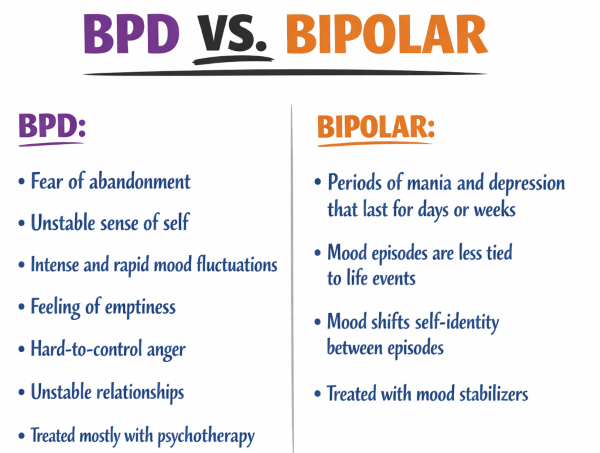
- Period: Bipolar moods are longer (days-weeks); BPD moods are shorter (hours)
- Triggers: It is not that Bipolar moods must be triggered; BPD moods are usually triggered by relationships.
- Basic mood: Bipolar moods; BPD mood sensitivity.
This leads to overlaps and even misdiagnosis, as we learned with Solutions Healthcare. Sometimes, they can be diagnosed with one of the disorders, and then the other comes out.
100% Confidential Support is Available 24/7
No matter what you’re going through, you’re not alone. Our dedicated team is here to provide a safe, judgment-free space where you can talk openly and honestly. Whether you need emotional support, resources, or just someone to listen.
We’re here for you—completely confidential and always respectful of your privacy. Call us today!
Diagnosis of Co-occurring Bipolar and Borderline Personality Disorder
Both disorders are diagnosed using a mental health assessment.
- Patterns of symptoms
- Triggered time of mood.
- Self and family history.
- Mood and behavior patterns.
No single test is available to help determine either of the conditions; it is advisable to consult a professional. All the disorders can be diagnosed only when both criteria are met.
Treatment Options for Co-occurring Disorders
In case one has these two conditions, then treatment must be personalised. There is no best treatment.
Typical treatments include the following:
- Drug: Antipsychotics, antidepressants, or mood stabilizers.
- Dialectical Behavior Therapy (DBT): effective against BPD.
- Cognitive Behavioral Therapy (CBT): Leave of absence from thoughts.
- Group support and therapy.
- Physical activity: Sleep, nutrition, and stress.
Therapy is oriented to stabilize mood and enhance self-control and interpersonal relationships.
100% Confidential Support is Available 24/7
No matter what you’re going through, you’re not alone. Our dedicated team is here to provide a safe, judgment-free space where you can talk openly and honestly. Whether you need emotional support, resources, or just someone to listen.
We’re here for you—completely confidential and always respectful of your privacy. Call us today!
Mental Health Care and Treatment At Solutions Healthcare
We know co-occurring at Solutions Healthcare. We believe in personalised care and a caring hand.
We provide:
- Full mental health assessments.
- Combination planning treatments.
- Dialectical behaviour therapy (DBT)
- Cognitive behavioral therapy (CBT).
- Sustainable recovery in long-term care.
We collaborate with our clients, make them feel listened to, cared about and cheered on the journey

Take the First Step Toward Stability and Healing
You do not need to solve it by yourself if you or a loved one be facing the problem of borderline personality disorder as well as bipolar disorder. A life-changing difference can be achieved with professional support.
Call Contact Solutions Healthcare and talk to a caring mental health practitioner today and seek custom treatment. This is where you begin to see clearly and be balanced.
Disclaimer
This content is for informational purposes only and should not replace professional medical advice, diagnosis, or treatment. Always consult a qualified mental health provider for personalized guidance.
Frequently Asked Questions
What do BPD and bipolar disorder together look like?
When both conditions occur, individuals may experience long-term mood episodes from bipolar disorder, along with rapid emotional shifts triggered by relationships, characteristic of BPD. This combination can intensify emotional instability and complicate diagnosis.
Do you have BPD for life?
BPD is not necessarily lifelong. With consistent therapy, especially DBT, many people see significant improvement in symptoms over time and develop healthier coping mechanisms and relationships.
Can people with BPD have a happy life?
Yes, absolutely. With proper treatment and support, individuals with BPD can build fulfilling relationships, maintain stability, and lead meaningful, happy lives.
Do BPD patients have manic episodes?
No, true manic episodes are specific to bipolar disorder. People with BPD may experience intense mood swings, but these are typically shorter and triggered by external factors.
Which is more serious, bipolar or BPD?
Both conditions are serious and can significantly impact life. The level of severity depends on the individual, symptom intensity, and access to treatment rather than the diagnosis itself.