If you’re reading this, you or someone you know is probably having a difficult time. Then one of the questions that inevitably arises, sometimes frustrated, sometimes bewildered, sometimes painful, is this: is addiction a disease, or is it something that is simply a continuous decision being made?
The answer matters. Academically and also in the real world. Your perception of addiction determines your actions toward the addiction, the way you speak about it, whether you seek treatment or wait for willpower to correct what willpower can’t.
It addresses what the science reveals, what the top medical organizations have determined, where the debate continues to exist, why stigma continues to prevent millions of people from getting the care they need, and what modern addiction treatment looks like when it is done right.
Is Addiction a Disease? What the Science Says
Yes. Addiction is classified as a disease by the most authoritative medical bodies in the United States and worldwide.
The American Society of Addiction Medicine (ASAM) updated its definition in 2025 to describe addiction as a chronic brain disease influenced by both genetic vulnerability and repeated substance exposure. The American Medical Association (AMA), the National Institute on Drug Abuse (NIDA), and the American Psychiatric Association (APA) all classify addiction as a medical condition requiring treatment, not a moral failing requiring punishment.
The brain disease model of addiction is strongly supported by scientific evidence. Their analysis found that chronic substance exposure disrupts critical brain structures and behaviors, including those governing loss of control, compulsive drug taking, inflexible behavior, and negative emotional states.
What Happens in the Brain During Addiction
Understanding addiction as a disease requires understanding what substances actually do to the brain. This is where science becomes both compelling and clarifying.
The brain has a reward system built on dopamine, a neurotransmitter that creates feelings of pleasure and motivates behavior. When a person eats, connects with others, or achieves something meaningful, dopamine is released. It reinforces that behavior and tells the brain: do this again.”
Addictive substances hijack this system. Alcohol, opioids, stimulants, cannabis, and other substances trigger dopamine surges that are far more intense than anything natural rewards produce. Over time, the brain adapts in two important ways:
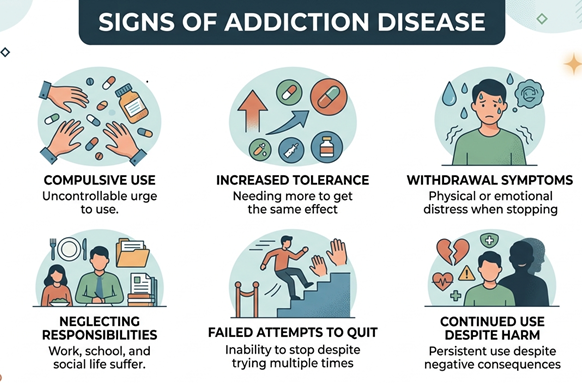
Tolerance: The reward circuitry recalibrates. The same amount of the substance produces less dopamine response, so more is needed to feel the same effect.
Withdrawal: When the substance is absent, the brain’s chemistry becomes dysregulated. Withdrawal symptoms are the nervous system’s protest against the absence of something it has restructured itself around.
These changes do not happen in the realm of willpower or decision-making. They happen in the prefrontal cortex, which governs impulse control and judgment, and in the limbic system, which governs emotion and reward. Both are altered by chronic substance exposure in ways that measurably reduce a person’s capacity to choose differently, even when they desperately want to.
100% Confidential Support is Available 24/7
No matter what you’re going through, you’re not alone. Our dedicated team is here to provide a safe, judgment-free space where you can talk openly and honestly. Whether you need emotional support, resources, or just someone to listen.
We’re here for you—completely confidential and always respectful of your privacy. Call us today!
The Brain Disease Model: Mainstream Medicine’s Position
The brain disease model of addiction (BDMA) has been the dominant framework in addiction medicine since 1997, when NIDA Director Alan Leshner published a foundational article in Science arguing that addiction is best understood as a chronic, relapsing brain disease caused by structural and functional brain changes.
The model has been central to a major public health goal: shifting how society understands addiction away from moral failure and toward medical reality. That shift matters because stigma kills. It keeps people from asking for help, delays treatment, and drives political decisions that restrict access to care.
The ASAM’s most current definition describes addiction as a primary, chronic disease of brain reward, motivation, memory, and related circuitry. It shares core features with other chronic diseases:
- It has a biological basis: Identifiable changes in brain structure and function
- It has genetic components: 40% to 60% of risk is heritable
- It is influenced by environment: Trauma, stress, social context, and early exposure all modify risk
- It can be treated: With evidence-based approaches, sustained recovery is achievable for most people
- It can relapse: Like diabetes or hypertension, relapse is part of the disease course, not a sign that treatment failed
Contact Solutions Healthcare
Battling with Drug and Alcohol Addition? Remember, you are not alone and we are here to help you!
Addiction Is Not a Choice, But Recovery Requires Action
This is one of the most important and most misunderstood distinctions in addiction medicine.
Saying addiction is a disease does not mean the person with addiction bears no responsibility in their recovery. What it means is that the disease has altered the neurological systems that govern choice, impulse control, and decision-making. The person is not choosing to fail. They are operating in a brain that has been structurally reorganized around the substance.
Recovery requires action. It requires honesty, engagement, effort, and willingness to do hard things. Those are real and necessary. But they are much more available to a person who receives the right clinical support, medical treatment, and therapeutic environment than to someone trying to white-knuckle their way through a disease that has changed the organ doing the choosing.
The distinction matters for families too. A loved one who keeps relapsing is not failing because they do not love you enough or do not want to get better. They are struggling with a disease that has a very real neurological grip. Treatment does not remove that struggle. It provides the tools to work through it.
Addiction by the Numbers: The Scale of the Crisis
Understanding that addiction is a disease becomes urgent when you look at how many people it affects.
According to SAMHSA’s 2024 National Survey on Drug Use and Health:
- 48.4 million Americans aged 12 or older met criteria for a substance use disorder in 2024
- 27.9 million had an alcohol use disorder
- 28.2 million had a drug use disorder
- 21.2 million adults had both a substance use disorder and a co-occurring mental health condition
- Of the 52.6 million people who needed substance use treatment in 2024, only 3.5% received it
That treatment gap is not primarily caused by people choosing not to get help. It is caused by stigma, cost barriers, limited availability of quality care, and a widespread misconception that addiction is a personal failing that should be handled privately rather than a medical condition deserving medical care.
What Drives Addiction: Risk Factors That Matter
Because addiction is a disease shaped by multiple factors, understanding those factors helps explain why some people develop it and others do not, even when exposed to the same substances.
Biological Risk Factors
- Genetics: Between 40% and 60% of addiction vulnerability is inherited. Specific gene variants, including ADH1B and ALDH2 variants relevant to alcohol metabolism, have been identified through genomic research.
- Brain development: The prefrontal cortex, which governs impulse control, is not fully developed until the mid-20s. Early substance use during adolescence, when the brain is still forming, dramatically increases lifetime addiction risk.
- Co-occurring mental health conditions: Anxiety, depression, PTSD, bipolar disorder, and ADHD all increase vulnerability. Many people with addiction are managing an underlying condition they were never properly treated for.
Psychological Risk Factors
- History of trauma or adverse childhood experiences (ACEs)
- Chronic stress and limited coping skills
- Mental health conditions that go untreated
- Low self-esteem or impulsivity
Environmental Risk Factors
- Early exposure to substance use in the home
- Peer influence and community norms around substance use
- Socioeconomic stressors including poverty, unemployment, and housing instability
- Limited access to healthcare and mental health services
- Social isolation and lack of meaningful connection
No single factor determines who develops addiction. The interaction between these dimensions, biological, psychological, and social, shapes each person’s individual risk. This is why effective treatment must address all three, not just the substance use.
100% Confidential Support is Available 24/7
No matter what you’re going through, you’re not alone. Our dedicated team is here to provide a safe, judgment-free space where you can talk openly and honestly. Whether you need emotional support, resources, or just someone to listen.
We’re here for you—completely confidential and always respectful of your privacy. Call us today!
The Disease of Addiction and Co-Occurring Disorders
One of the most important clinical realities in addiction treatment is that addiction rarely travels alone.
According to SAMHSA’s 2024 data, 21.2 million adults in the United States live with both a substance use disorder and a co-occurring mental health condition simultaneously. Anxiety and depression are the most common, but PTSD, bipolar disorder, personality disorders, and ADHD are also frequently seen.
The relationship runs in both directions. Mental health conditions increase the risk of substance use, because people often use substances to manage symptoms they have not received proper treatment for. At the same time, chronic substance use alters brain chemistry in ways that worsen anxiety, depression, and mood instability over time.
This is sometimes called a dual diagnosis or co-occurring disorder. Treating the substance use without treating the mental health condition, or vice versa, consistently produces worse outcomes than integrated treatment that addresses both simultaneously.
What Does Addiction Treatment Actually Look Like?
If addiction is a disease, then treatment should look like what we do for other chronic diseases: assess accurately, treat with evidence-based methods, manage through periods of difficulty, and support long-term recovery rather than expecting a one-time cure.
Effective addiction treatment includes multiple components, individualized to each person’s specific conditions, history, and circumstances.
Medical Detox
For substances that cause physical dependence, including alcohol, opioids, and benzodiazepines, the first step is medically supervised detoxification. Withdrawal from some substances can be life-threatening, making medical supervision essential for safety and comfort. Detox is not a treatment on its own. It is the preparation for treatment.
Medication-Assisted Treatment (MAT)
Several FDA-approved medications significantly improve outcomes for addiction:
- Buprenorphine and methadone for opioid use disorder: Reduce cravings and withdrawal, allow people to stabilize and engage in treatment
- Naltrexone for both opioid and alcohol use disorder: Blocks the rewarding effects of opioids and reduces alcohol cravings
- Naloxone: Reverses opioid overdose and is a critical harm-reduction tool
- Acamprosate and disulfiram for alcohol use disorder
MAT is evidence-based, effective, and life-saving. The outdated view that MAT is simply substituting one addiction for another is not supported by science and has no place in quality addiction care.
Evidence-Based Behavioral Therapies
Medication addresses the biological dimensions of addiction. Therapy addresses the psychological and behavioral ones. Effective therapeutic approaches include:
Cognitive Behavioral Therapy (CBT): Identifies and changes the thought patterns and behaviors that drive substance use. Builds relapse prevention skills and addresses underlying mental health symptoms.
Dialectical Behavior Therapy (DBT): Develops emotional regulation, distress tolerance, and interpersonal effectiveness. Particularly effective when intense emotions or self-destructive patterns are present.
Acceptance and Commitment Therapy (ACT): Builds psychological flexibility and the ability to engage with difficult emotions without being controlled by them.
Motivational Interviewing (MI): Resolves ambivalence about change and strengthens internal motivation for recovery.
Family Therapy: Involves loved ones in the recovery process, addresses family dynamics that may reinforce use, and builds a stronger support environment at home.
Group Therapy: Provides peer support, reduces isolation, and creates accountability in a therapeutic context.
Levels of Care
Treatment intensity should match the severity of the condition. The continuum includes:
- Residential/Inpatient Treatment: 24-hour structured care for severe presentations or when a safe home environment is not available
- Partial Hospitalization Program (PHP): 20+ hours of structured programming per week with the ability to return home each evening
- Intensive Outpatient Program (IOP): 9 to 19 hours per week, structured for people who can maintain some daily responsibilities
- Outpatient Treatment: Ongoing therapy and support for stable individuals maintaining their recovery
- Aftercare: Alumni programs, support groups, and continued clinical engagement to sustain long-term recovery
Treating Co-Occurring Disorders
For the millions of people with both a substance use disorder and a co-occurring mental health condition, integrated dual diagnosis treatment is not optional. It is the standard of care. Both conditions must be treated together, by a team that understands the interaction between them.

100% Confidential Support is Available 24/7
No matter what you’re going through, you’re not alone. Our dedicated team is here to provide a safe, judgment-free space where you can talk openly and honestly. Whether you need emotional support, resources, or just someone to listen.
We’re here for you—completely confidential and always respectful of your privacy. Call us today!
Stigma: The Disease That Delays Treatment
Stigma is one of the most dangerous forces in addiction medicine. It operates as a barrier between people who are suffering and the care that could help them.
Stigma looks like: dismissing addiction as weakness, blaming the person rather than treating the disease, refusing to discuss it openly in families, healthcare providers who treat people with addiction with less compassion than they would treat patients with diabetes or cancer, and policies that criminalize illness rather than treating it.
When addiction is understood as a choice rather than a disease, stigma feels justified. When it is understood as a disease, the appropriate response becomes clear: compassion, treatment, and support.
If you are a family member watching someone struggle, the research is consistent: judgment and ultimatums are far less effective than informed, compassionate engagement paired with encouragement to seek professional help. Family members who understand addiction as a disease are better equipped to support recovery without enabling it.
Solutions Healthcare: Treating the Disease of Addiction
At Solutions Healthcare, serving Central Florida across four treatment centers including Orlando, DeLand, Palm Coast, and Melbourne, addiction is treated exactly as what it is: a complex, treatable disease that deserves real clinical care.
SHC provides a full continuum of evidence-based addiction treatment including Residential Treatment, Intensive Outpatient Programs (IOP), Outpatient Treatment, Dual Diagnosis Programs, and Aftercare Services. Their clinical teams treat every substance use disorder, including alcohol, opioids, fentanyl, cocaine, methamphetamine, benzodiazepines, heroin, marijuana, and prescription drug addiction, with personalized plans that address the biological, psychological, and social dimensions of each person’s condition.
Recovery from addiction is real. Millions of people have done it. The first step is understanding that you are not dealing with a weakness. You are dealing with a disease. And disease responds to treatment.
Call Solutions Healthcare today or visit the contact page to speak with someone who can help.
FAQs
Is addiction a disease or a choice?
Addiction is classified as a disease by the American Society of Addiction Medicine, the American Medical Association, the American Psychiatric Association, NIDA, and NIAAA. The ASAM’s 2025 definition describes it as a chronic brain disease influenced by genetic vulnerability and repeated substance exposure. While early substance use may involve choices, the disease alters the brain systems governing impulse control and decision-making, making continued use far less a matter of choice than it appears from the outside.
What is the brain disease model of addiction?
The brain disease model of addiction (BDMA) holds that chronic substance exposure produces structural and functional changes in the brain, particularly in the prefrontal cortex and limbic system, that disrupt reward processing, impulse control, and emotional regulation. These changes are measurable through neuroimaging and explain the compulsive, difficult-to-stop nature of addiction. NIDA, NIAAA, and most major medical bodies endorse this model as the most scientifically grounded framework for understanding addiction.
How much of an addiction is genetic?
Research from both NIH and NIDA estimates that genetics account for between 40% and 60% of a person’s addiction vulnerability. Children with a parent who has addiction are up to four times more likely to develop a substance use disorder themselves. Specific gene variants affecting how the body metabolizes substances have been identified through genomic research. Genetic risk does not determine destiny, but it is a significant biological factor in the disease.
What is the difference between dependence and addiction?
Dependence refers to the physical adaptation of the body to a substance, producing tolerance and withdrawal symptoms when use is reduced. Addiction involves compulsive seeking and use of a substance despite serious negative consequences, and is defined by loss of control over use. A person can be physically dependent on a substance without being addicted, as can happen with some pain medications. Addiction typically includes dependence but also involves behavioral, psychological, and social disruption.
Can people recover from addiction?
Yes. Recovery from addiction is real, common, and achievable with the right support. A 2024 report from the Recovery Research Institute estimated that 29.3 million U.S. adults have resolved a significant substance use problem. Of the 48.7 million people with a past-year substance use disorder surveyed in the 2023 NSDUH, nearly half considered themselves to be in recovery or having recovered. Long-term recovery is significantly more likely with professional treatment than without it.
Why do people with addiction relapse?
Relapse is a feature of chronic disease, not a sign that treatment failed or that the person does not want to get better. Just as people with diabetes may have their blood sugar spike despite treatment, people with addiction may relapse during the recovery process. Research indicates that 40% to 60% of people treated for substance use disorders relapse at least once. Relapse is a signal that treatment or support needs to be adjusted, not that recovery is impossible.
What is a dual diagnosis?
Dual diagnosis, also called co-occurring disorders, refers to the simultaneous presence of a substance use disorder and a mental health condition. SAMHSA’s 2024 data shows 21.2 million U.S. adults have both. The two conditions amplify each other: untreated mental health conditions increase substance use risk, while substance use worsens mental health symptoms. Effective treatment must address both conditions together in an integrated program.
What treatments are available for addiction?
Evidence-based addiction treatment includes medically supervised detox, Medication-Assisted Treatment (MAT) using FDA-approved medications like buprenorphine or naltrexone, behavioral therapies including CBT, DBT, and ACT, individual and group therapy, family therapy, and ongoing aftercare support. Treatment intensity ranges from residential care to outpatient programs depending on the individual’s clinical needs. Dual diagnosis programs are available for people with co-occurring mental health conditions.
Why do so few people with addiction receive treatment?
SAMHSA’s 2024 data found that of the 52.6 million people who needed substance use treatment in 2024, only 3.5% received it. Barriers include stigma, cost, limited availability of quality care, lack of awareness of treatment options, and the belief, often reinforced by family and culture, that addiction is a personal failing that should be handled privately. Understanding addiction as a treatable disease is the foundation for removing these barriers.
Does addiction affect mental health?
Yes, significantly. Chronic substance use alters brain chemistry in ways that worsen anxiety, depression, mood instability, and cognitive function. Many people with addiction are also managing an underlying mental health condition, often one they were never properly diagnosed or treated for. The relationship is bidirectional: mental health conditions increase addiction risk, and addiction worsens mental health. Both must be addressed for recovery to be lasting.
Is addiction the same as substance abuse?
The terms are sometimes used interchangeably but have distinct clinical meanings. Substance abuse or misuse refers to harmful or hazardous use of a substance. Addiction, clinically referred to as a substance use disorder (SUD) in the DSM-5-TR, involves compulsive use, loss of control, and continued use despite significant negative consequences. Not everyone who misuses substances develops a substance use disorder, but misuse is a risk factor for doing so.
How does trauma relate to addiction?
Trauma is one of the strongest predictors of addiction. Adverse childhood experiences (ACEs) including abuse, neglect, and household instability increase substance use risk significantly. Many people with addiction use substances to manage the emotional pain of unprocessed trauma. This is sometimes called self-medication. Trauma-informed treatment that addresses the root of that pain, rather than only the substance use, is essential for lasting recovery.
References
- American Society of Addiction Medicine. Definition of Addiction 2025. ASAM.org
- National Institute on Drug Abuse. Drugs, Brains, and Behavior: The Science of Addiction. NIDA.NIH.gov
- Volkow N, Koob G. Brain Disease Model of Addiction. The Lancet Psychiatry. NIAAA.NIH.gov
- Blithikioti C, et al. Reevaluating the Brain Disease Model of Addiction. The Lancet Psychiatry. 2025.
- Recovery Research Institute. Recovery Definition and Prevalence. RecoveryAnswers.org
- National Institute on Drug Abuse. Genetics and Epigenetics of Addiction. NIDA.NIH.gov
- Centers for Disease Control and Prevention. About Mental Health and Substance Use. CDC.gov
- MedlinePlus. Substance Use Disorders. MedlinePlus.gov
This content is for educational purposes only and does not constitute medical advice. If you or someone you love is struggling with addiction, please consult a qualified healthcare provider or contact Solutions Healthcare for professional support.